
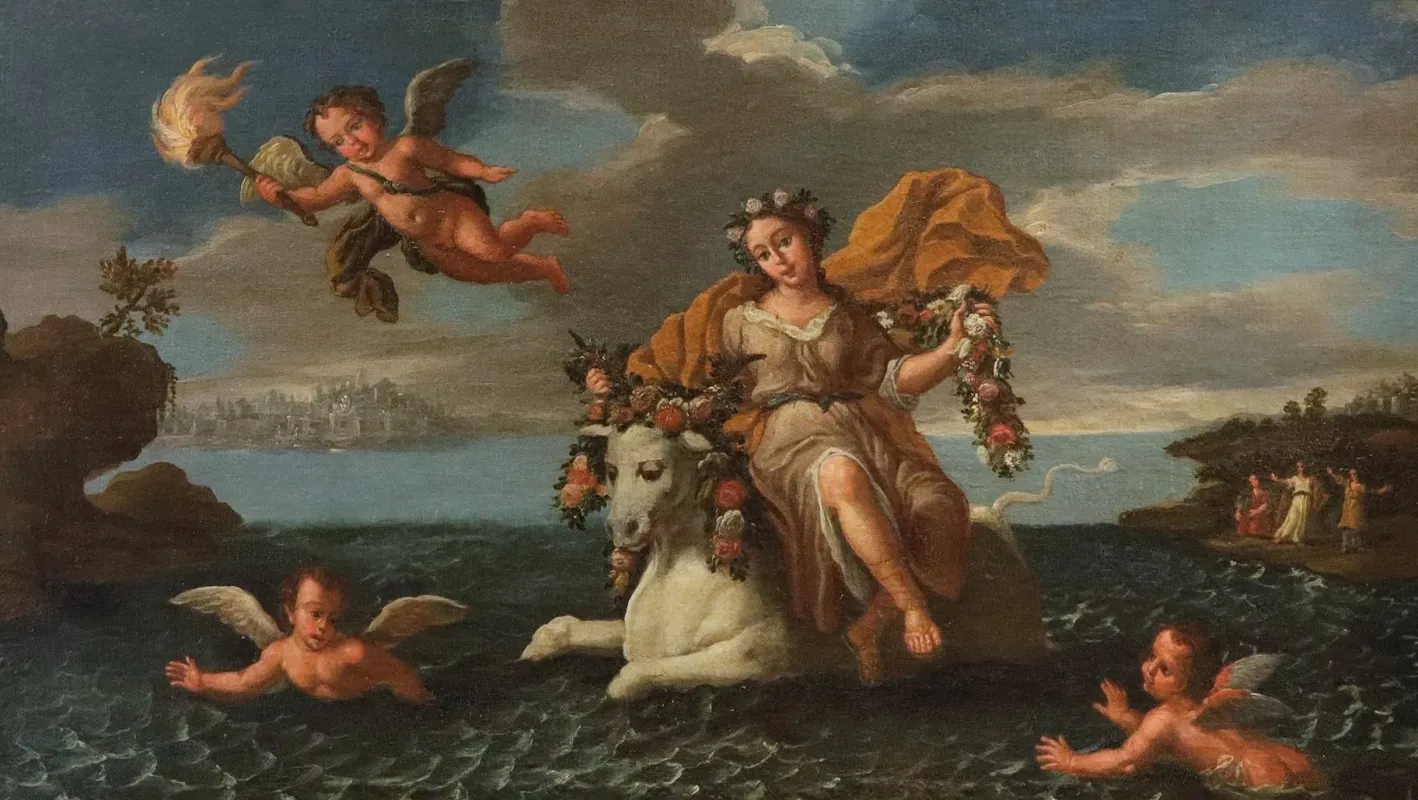
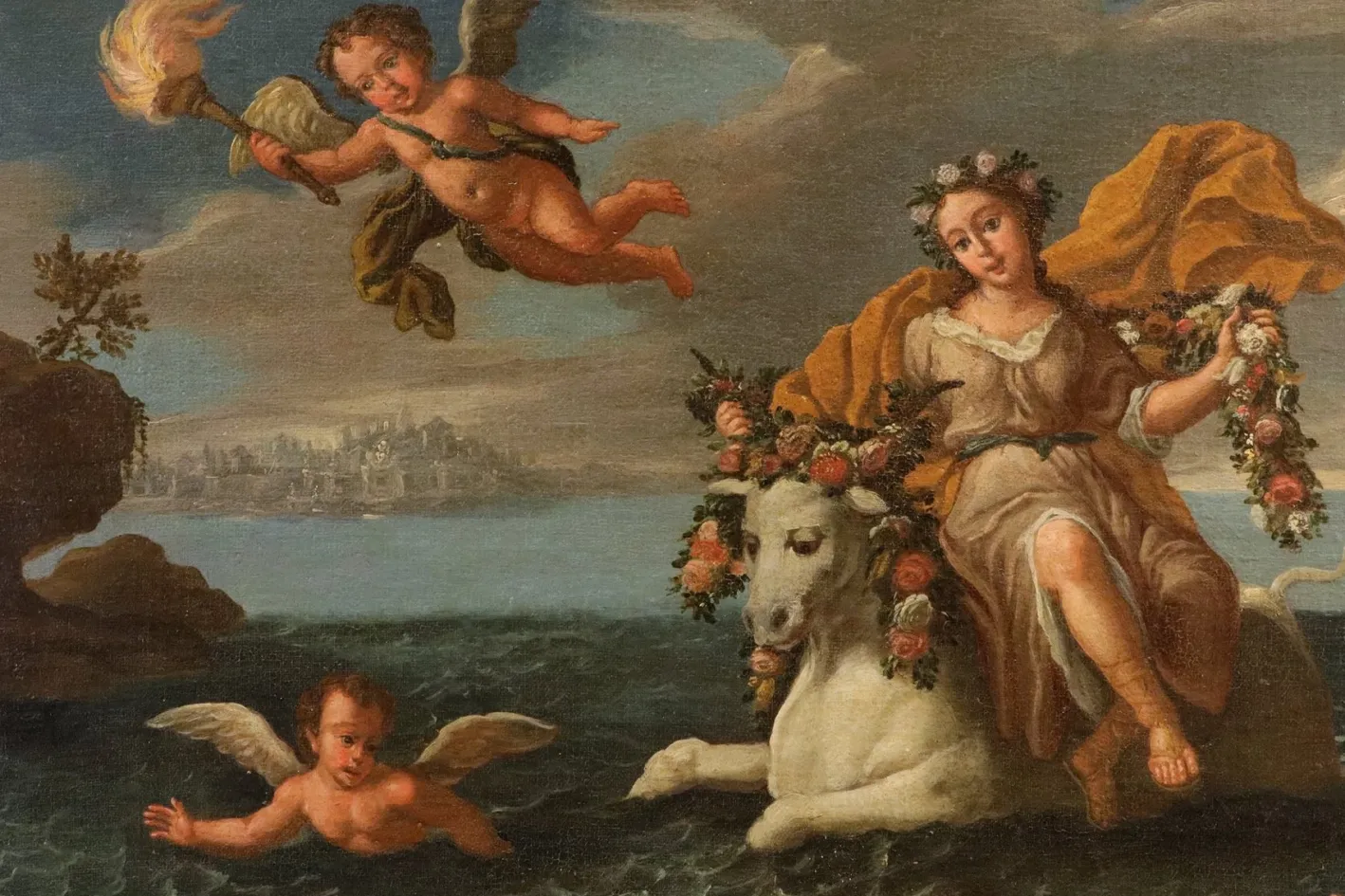
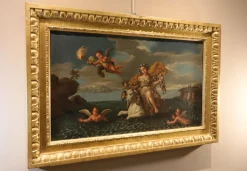
Kreis von Paolo de Matteis, Abduction of Europa, 1730, Öl auf Leinwand
Original price was: €7,714.20.€114.37Current price is: €114.37.
The Abduction of Europa – Circle of Paolo De Matteis (Piano Vetrale, 1662 – Naples, 1728)
Oil on canvas
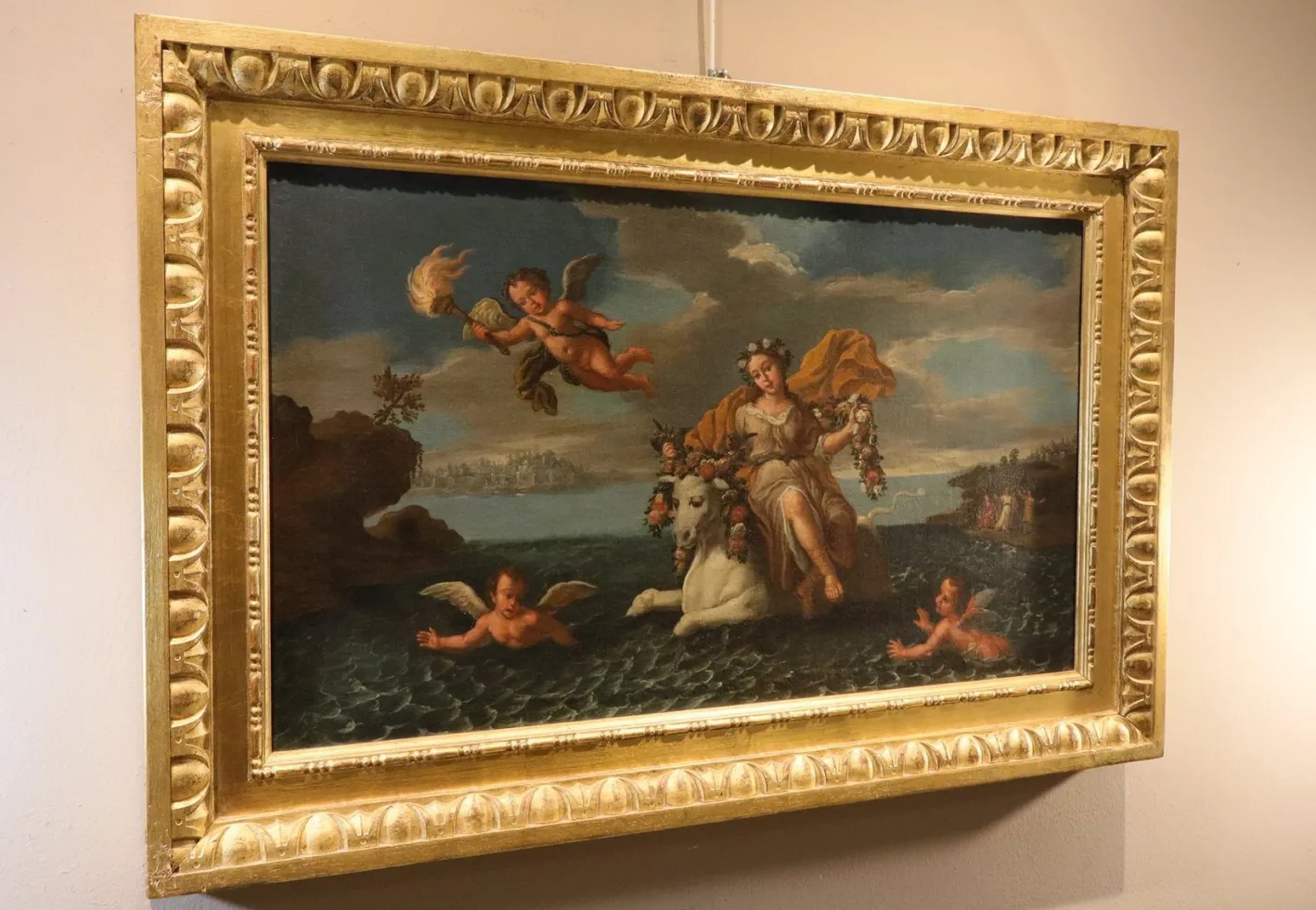
(cm.) 57 x 98 – with gilded wooden frame 77 x 118 cm.
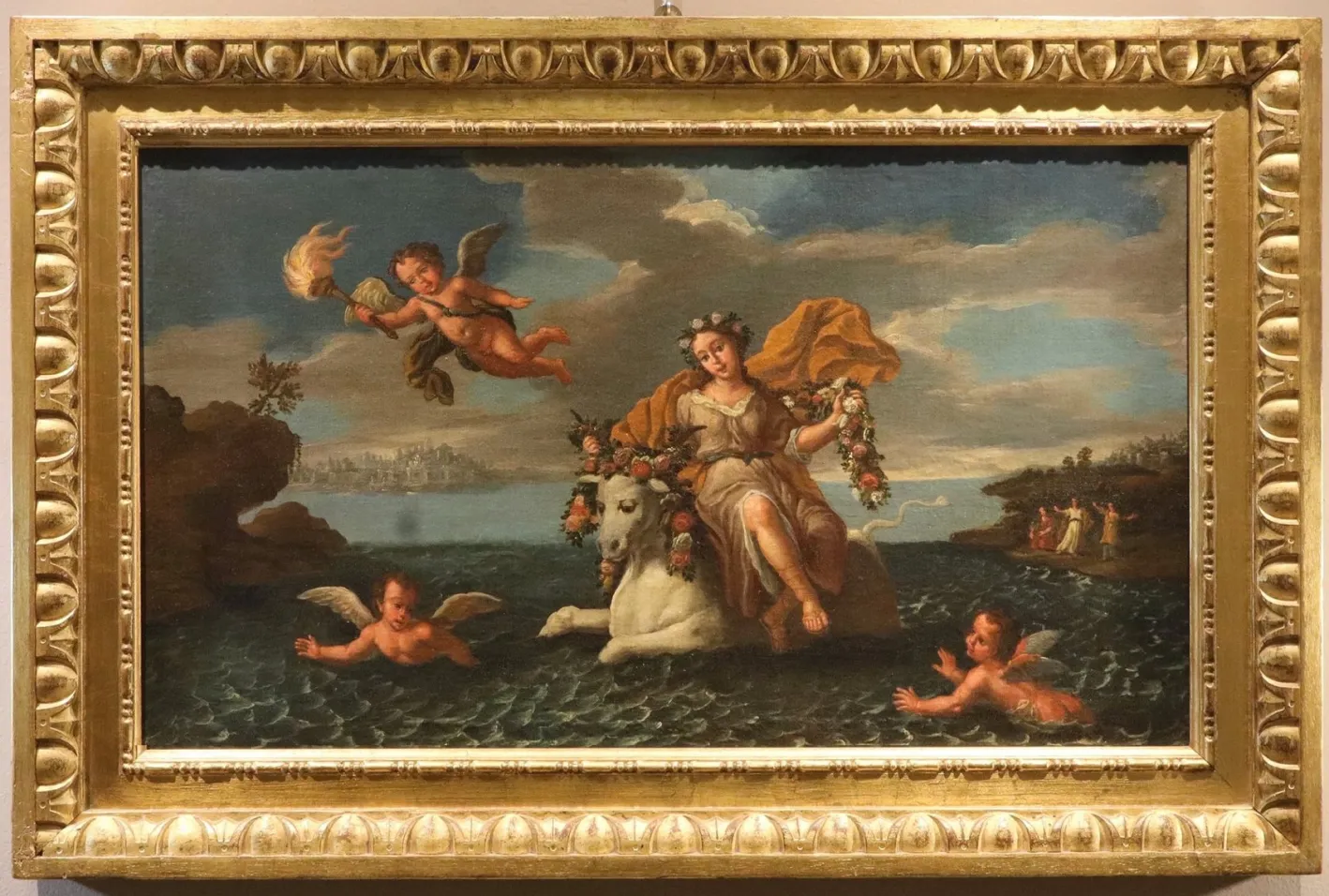
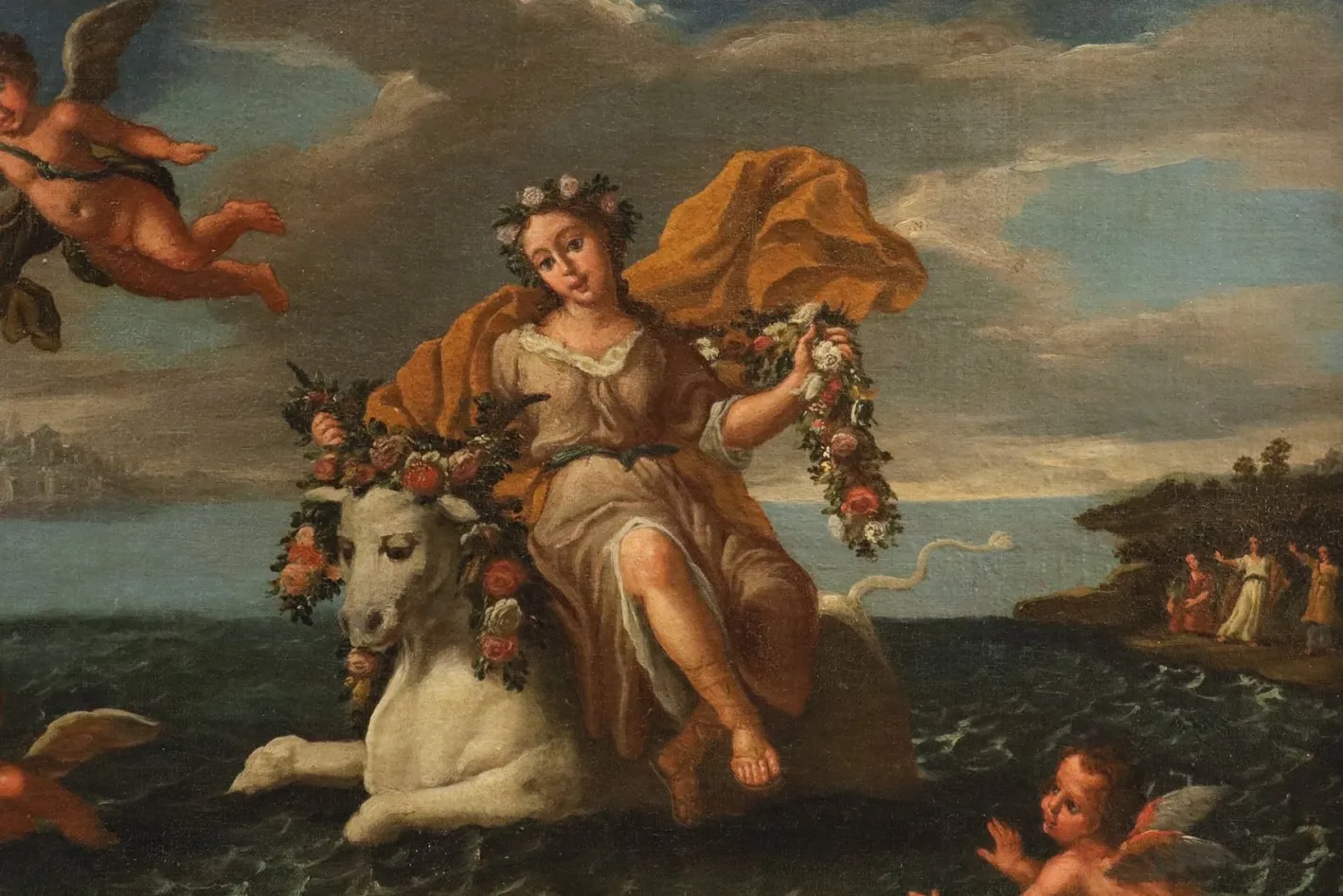
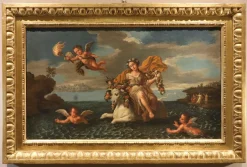
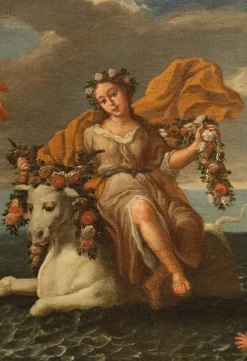
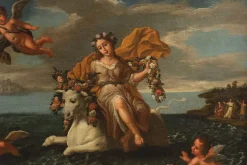
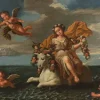
This beautiful painting, which can be attributed to the circle of Paolo De Matteis (Piano Vetrale, 1662 – Naples, 1728), depicts, through a highly elegant composition, an episode from Greek mythology: the abduction of the Phoenician princess Europa by Jupiter, as described by the Latin poet Ovid in his Metamorphoses.
This myth enjoyed great popularity in Roman Baroque painting of the late 16th and early 17th centuries, often commissioned as a subject to decorate the sumptuous private rooms of the city’s aristocratic palaces.
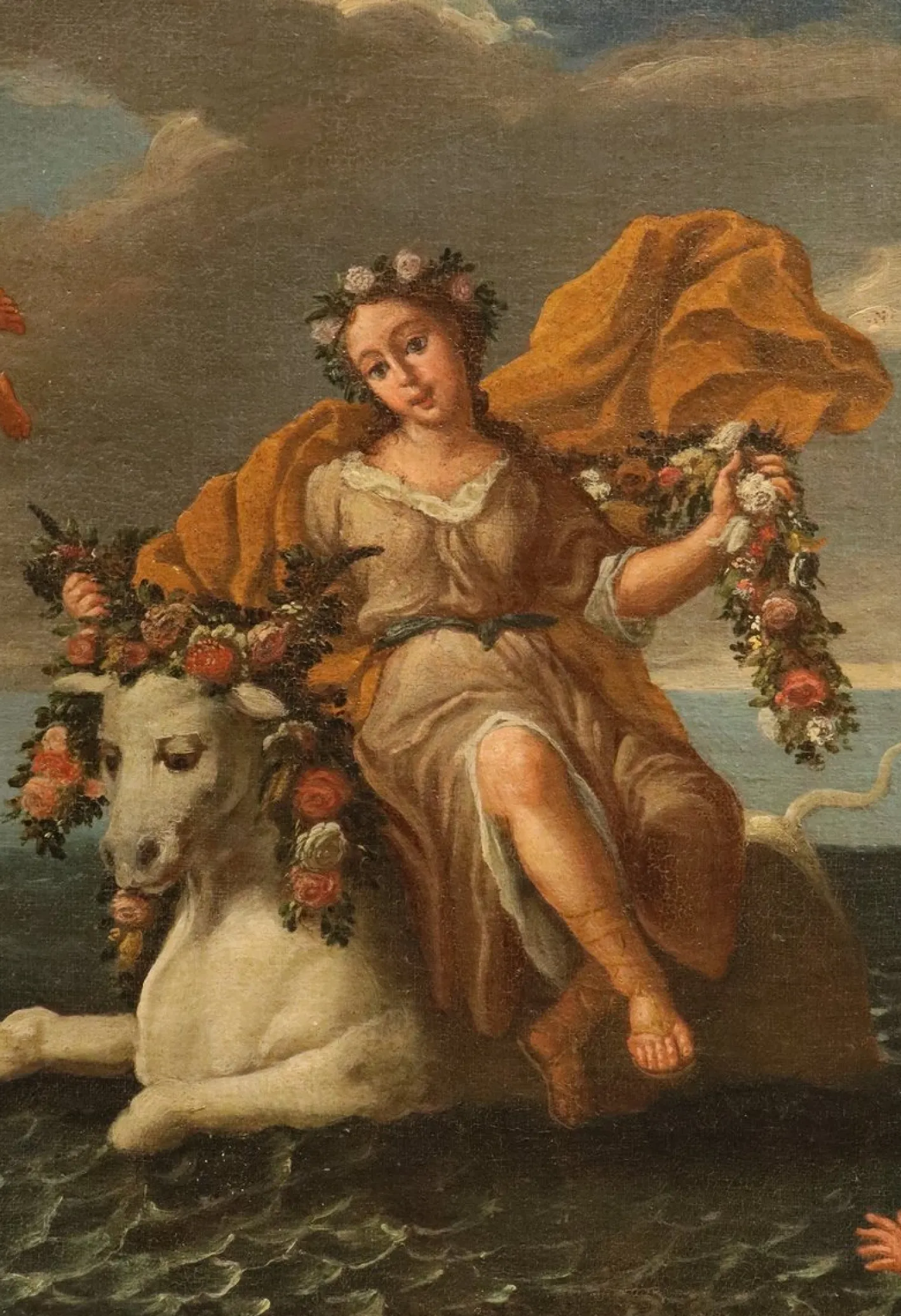
The work illustrates, in particular, the climax of the tale in which the King of the Gods, having transformed himself into a bull to deceive her, takes Europa by force, fleeing to the island of Crete, and swims away proudly, cutting through the rough sea.
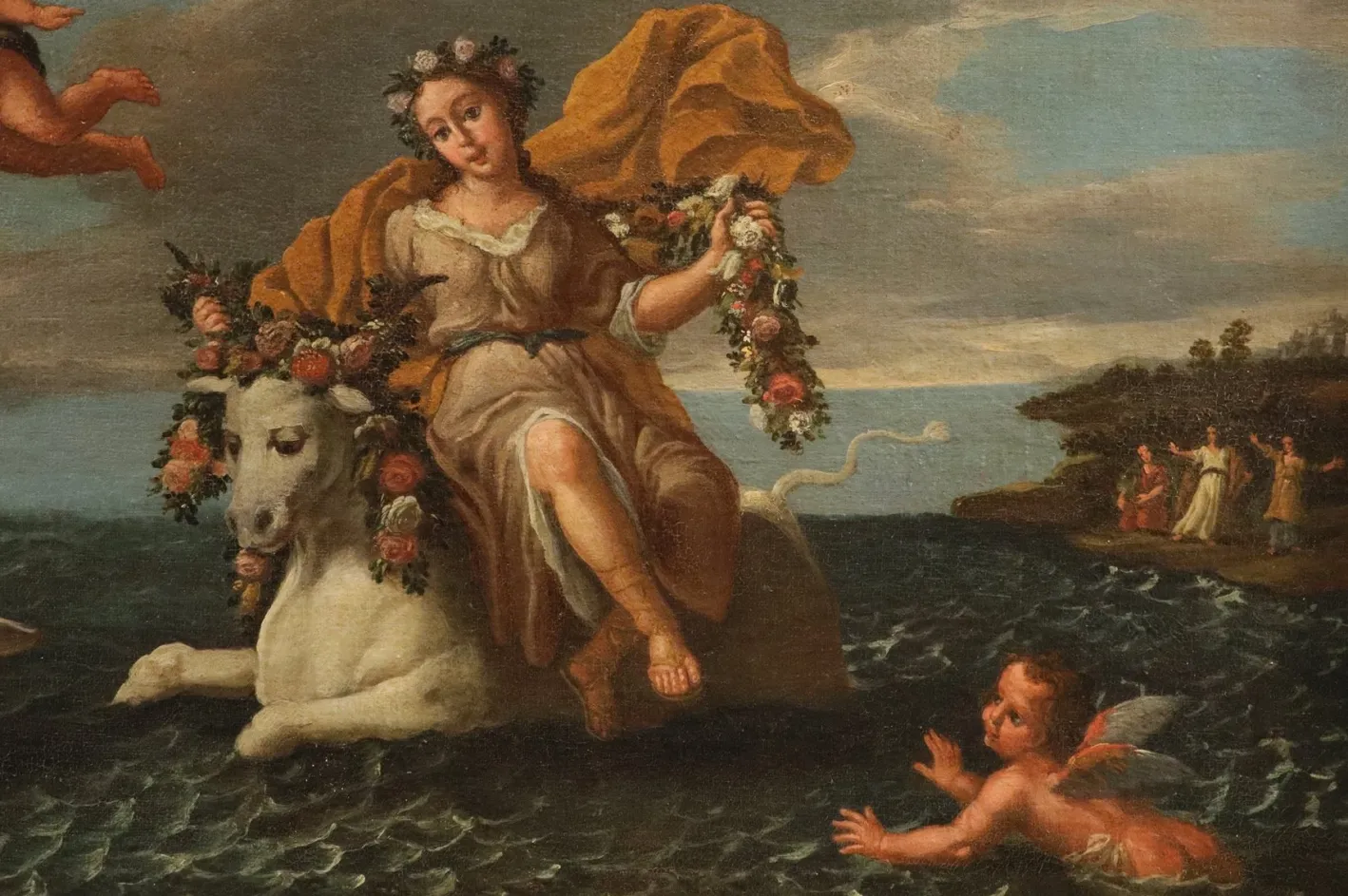
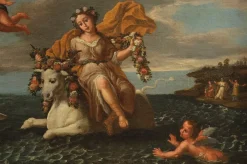
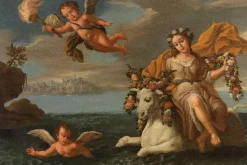
The princess does not appear terrified, but assumes a regal and languid pose, sitting on the animal’s back while holding onto its horns, crowned with flowers and wrapped in a classical robe. In her left hand, she holds a floral garland, while behind her, a large golden cloth billows, catching the wind.
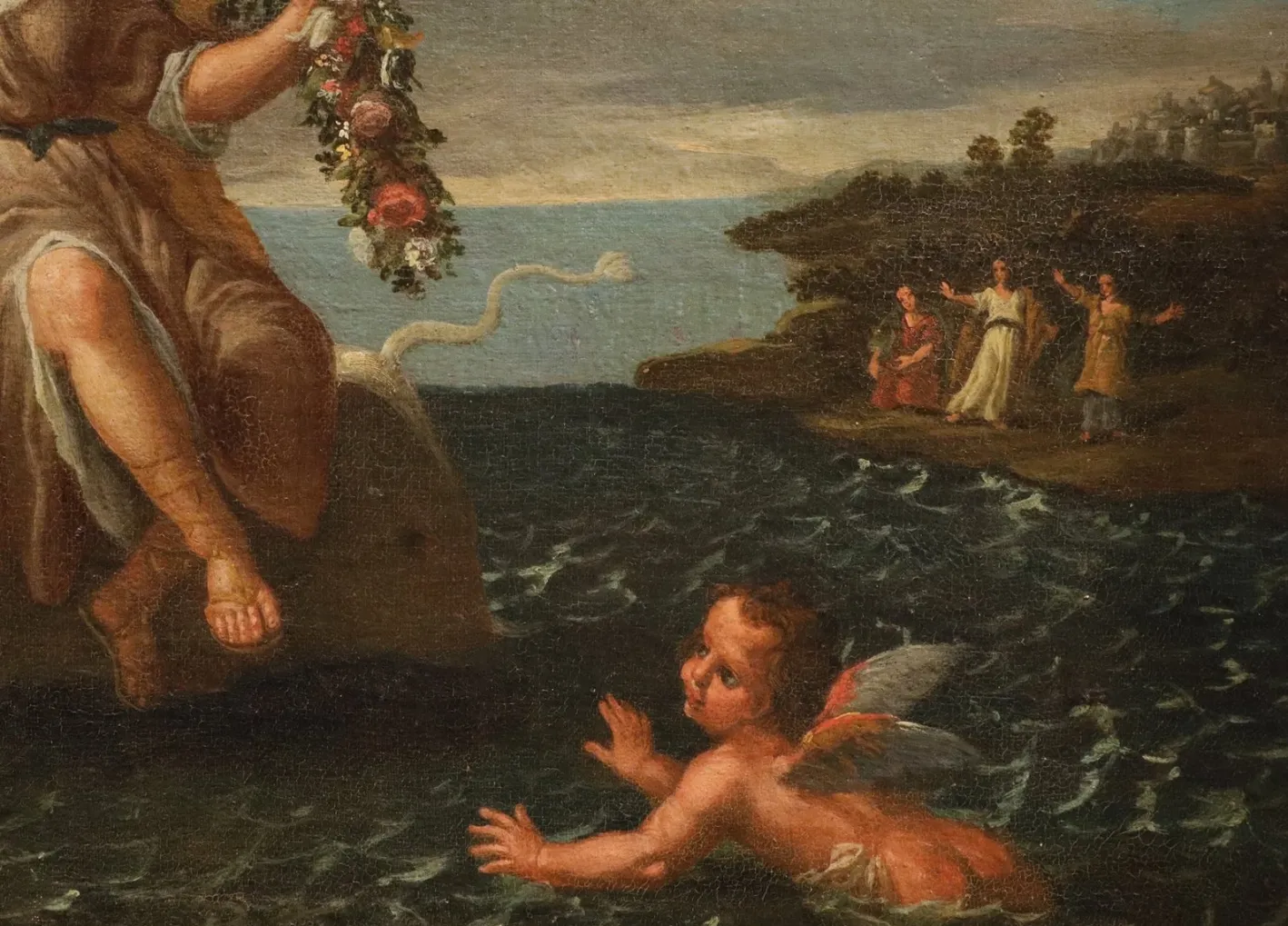
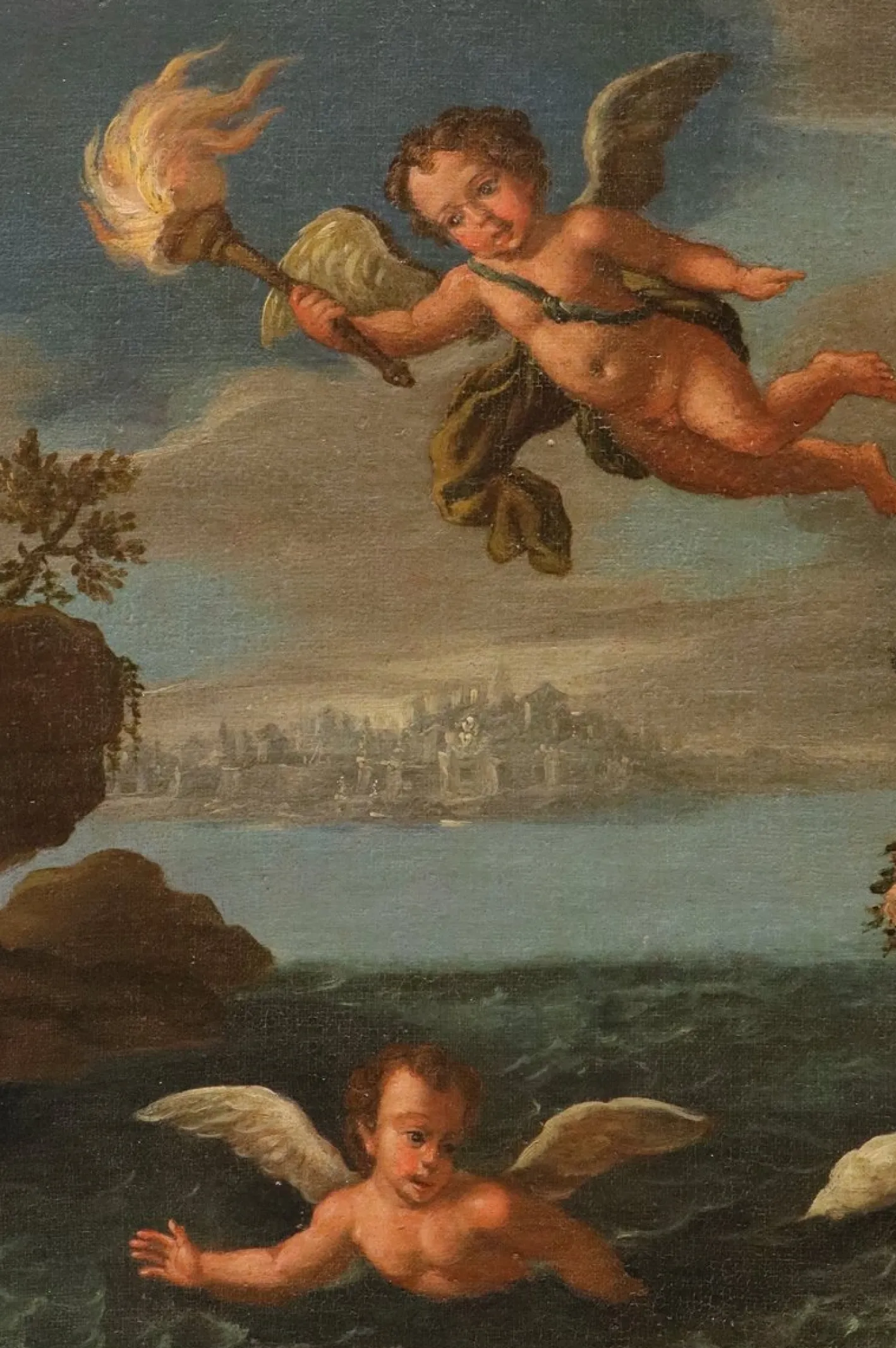
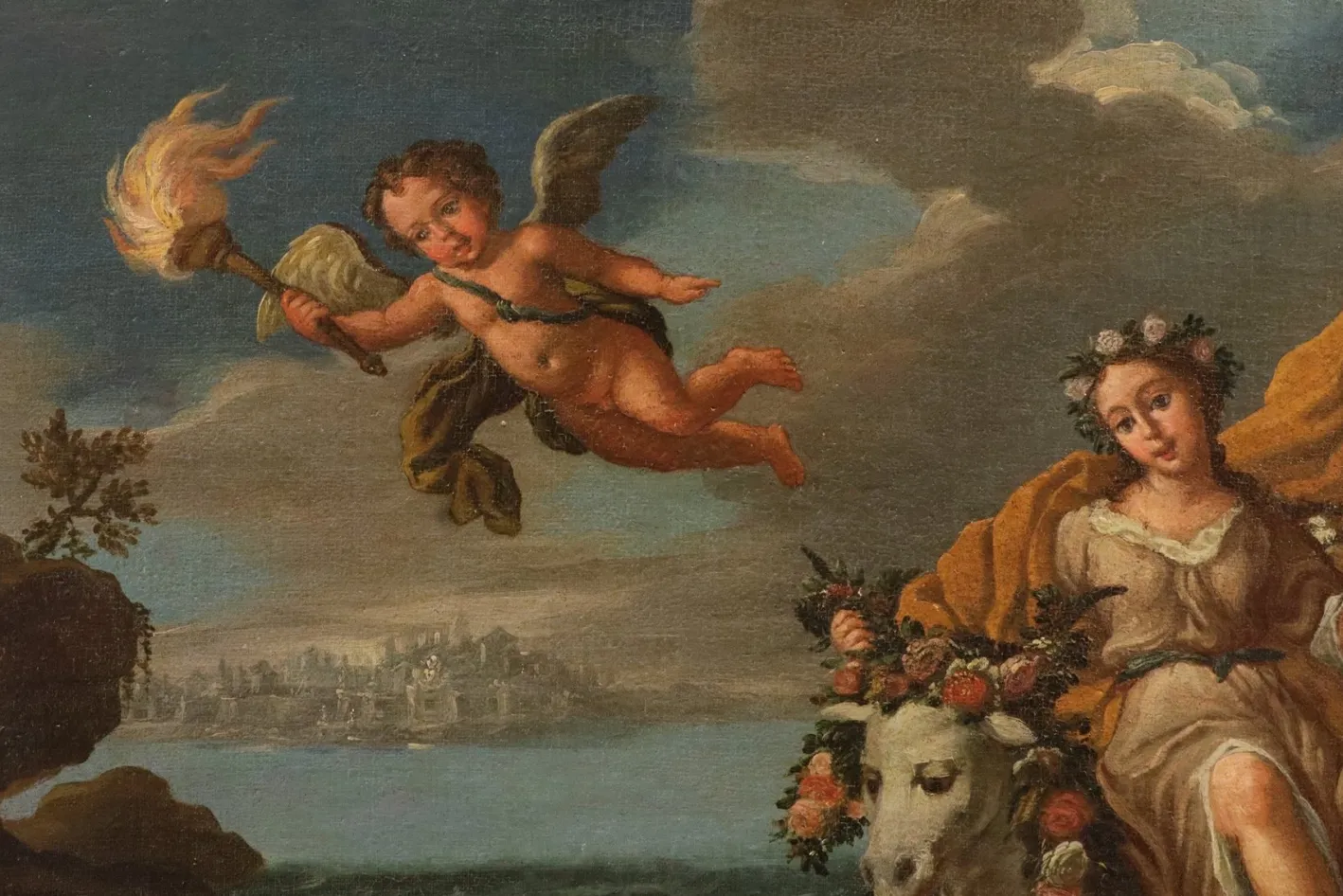
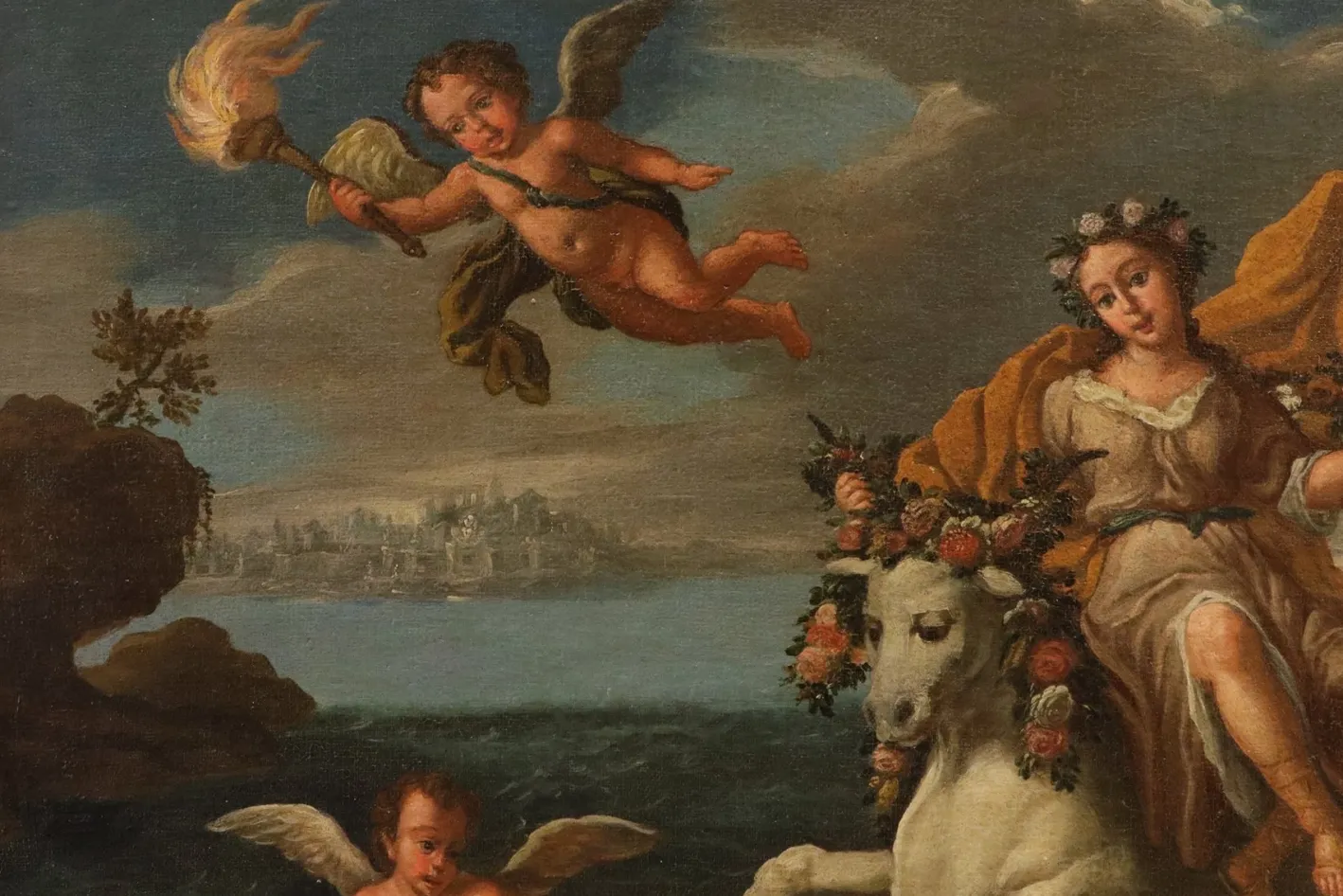
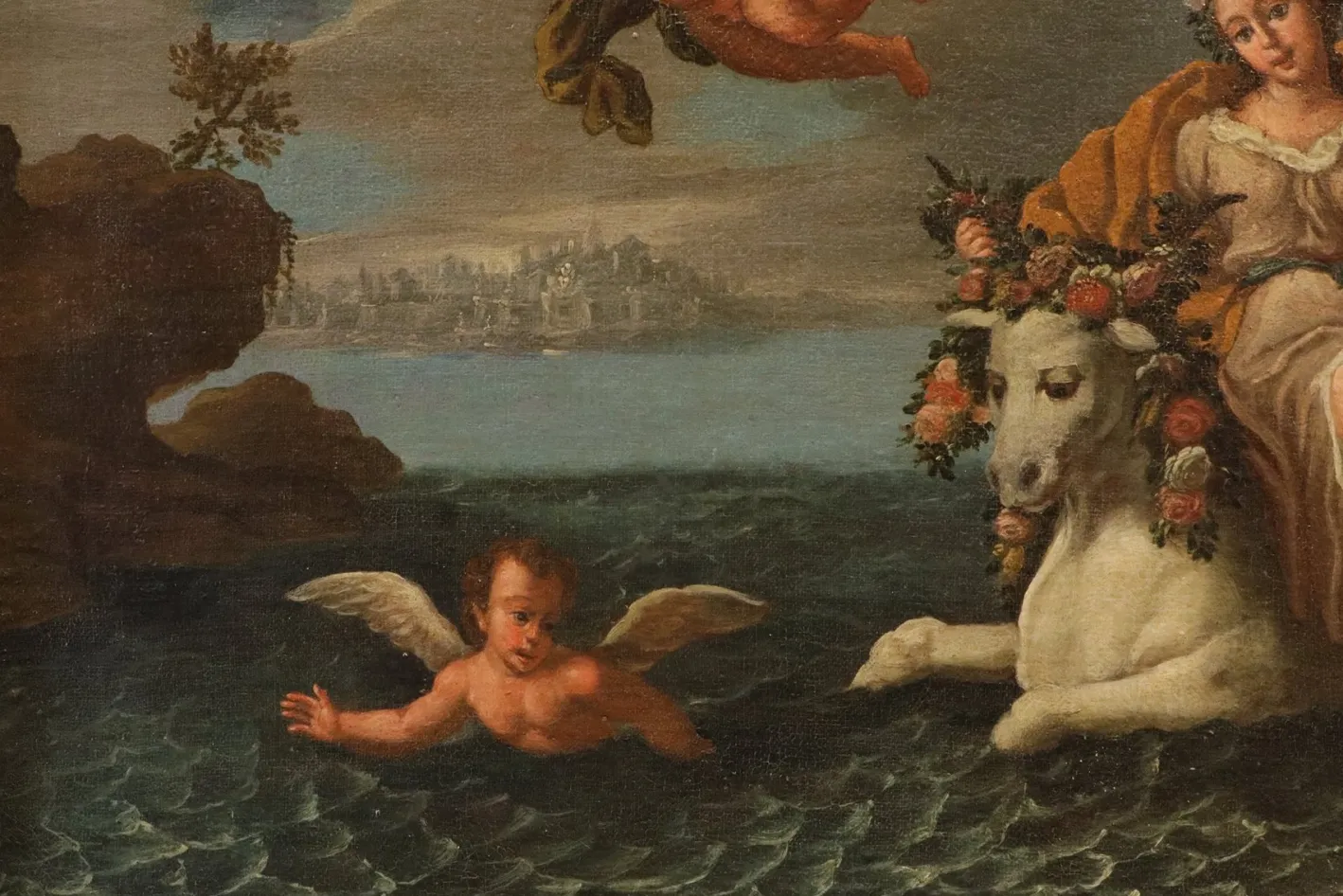
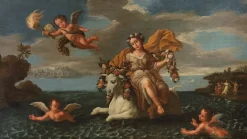
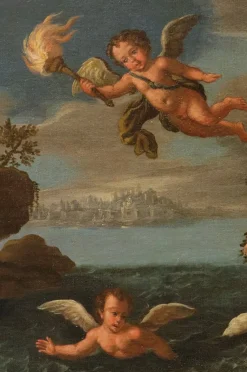
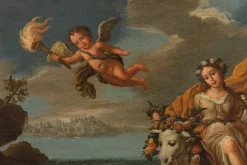
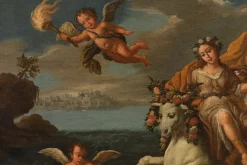
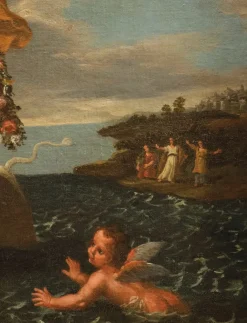
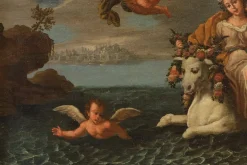
A flying putto precedes the couple on the left, tearing through the clouds and holding a burning torch, a symbol of the passionate love that drove Zeus to this gesture. Two other putti move in the rippling waters: one on the left swims, looking upward, while the one on the right flanks the bull’s tail, as if escorting and protecting the divine crossing to Crete.
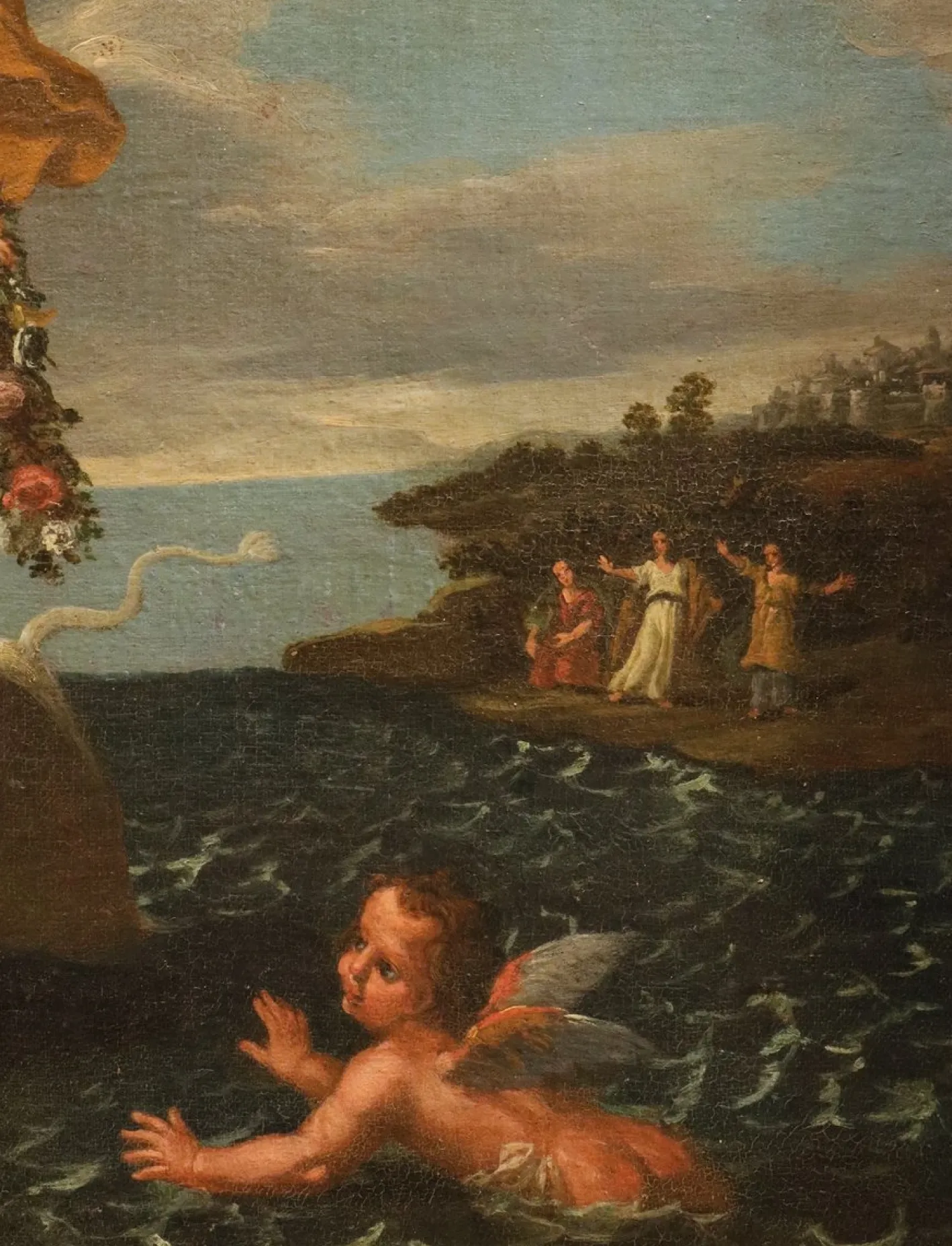
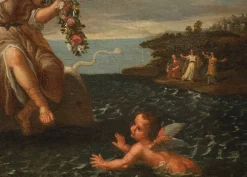
On the rocky outcrop to the right, Europa’s three maids helplessly watch the scene, waving their arms and reaching out to their princess, expressing grief and dismay at her sudden disappearance.
On the left, beyond the flying putto, the coast ends with a dark rocky promontory. In the distance, along the sea horizon, the faint outline of a fortified city can be seen, a symbol of her native Phoenicia, which Europa is leaving behind forever.
The composition and classicism of the style, highlighted by the brilliant color palette, and the painterly quality evident in the painting support its attribution to Paolo de Matteis, one of the most important painters of the Southern Italian Baroque.
A prominent pupil of Luca Giordano, he successfully combined the master’s vigorous Baroque influence with a more graceful classicism, thanks to his predilection for mythological subjects.
His stay in Rome (between 1682 and 1683) was crucial to his development, where he deeply absorbed the classicist teachings of Carlo Maratta, an advocate of an ideal classicism influenced by Raphael and Annibale Carracci. Maratta modified the compositional grace and chromatic luminosity with his orderly and rigorous design, anticipating the softness and elegance typical of eighteenth-century Rococo.
Regarding the canvas in question, elements such as the idealized figure of Europa, the theatrical rendering of the waves, and the presence of three small fluttering angels are characteristic expressions of his reinterpretations of the myths of Ovid’s Metamorphoses: in our specific case, the composition is indebted to the design of the same subject conceived by Maratta.
ADDITIONAL INFORMATION:
The work being sold is complete with a beautiful gold frame and comes with a certificate of authenticity and guarantee.
Die Entführung der Europa – Umkreis von Paolo De Matteis (Piano Vetrale, 1662 – Neapel, 1728)
Öl auf Leinwand
(cm) 57 x 98 – mit vergoldetem Holzrahmen 77 x 118 cm.
Dieses wunderschöne Gemälde, das dem Kreis um Paolo De Matteis (Piano Vetrale, 1662 – Neapel, 1728) zugeschrieben werden kann, zeigt in einer äußerst eleganten Komposition eine Episode aus der griechischen Mythologie: die Entführung der phönizischen Prinzessin Europa durch Jupiter, wie sie der lateinische Dichter Ovid in seinen Metamorphosen beschreibt.
Dieser Mythos erfreute sich in der römischen Barockmalerei des späten 16. und frühen 17. Jahrhunderts großer Beliebtheit und wurde oft als Motiv in Auftrag gegeben, um die prächtigen Privaträume der aristokratischen Paläste der Stadt zu schmücken.
Das Werk illustriert insbesondere den Höhepunkt der Erzählung, in dem der König der Götter, der sich in einen Stier verwandelt hat, um sie zu täuschen, Europa gewaltsam an sich nimmt, auf die Insel Kreta flieht und stolz davonschwimmt, während er die raue See durchpflügt.
Die Prinzessin wirkt nicht verängstigt, sondern nimmt eine königliche und träge Haltung ein: Sie sitzt auf dem Rücken des Tieres, hält sich an dessen Hörnern fest, ist mit Blumen gekrönt und in ein klassisches Gewand gehüllt. In ihrer linken Hand hält sie einen Blumengirlande, während hinter ihr ein großes goldenes Tuch im Wind weht.
Ein fliegender Putto eilt dem Paar auf der linken Seite voraus, durchbricht die Wolken und hält eine brennende Fackel in der Hand, ein Symbol für die leidenschaftliche Liebe, die Zeus zu dieser Tat trieb. Zwei weitere Putten bewegen sich im plätschernden Wasser: Der linke schwimmt und blickt nach oben, während der rechte den Schwanz des Stiers flankiert, als würde er die göttliche Überfahrt nach Kreta begleiten und beschützen.
Auf dem Felsvorsprung rechts beobachten Europas drei Zofen hilflos die Szene, winken mit den Armen und strecken die Hände nach ihrer Prinzessin aus, um ihre Trauer und Bestürzung über ihr plötzliches Verschwinden auszudrücken.
Links, hinter dem fliegenden Putto, endet die Küste mit einem dunklen Felsvorsprung. In der Ferne, am Meereshorizont, ist der schwache Umriss einer befestigten Stadt zu erkennen, ein Symbol für ihre Heimat Phönizien, die Europa für immer hinter sich lässt.
Die Komposition und der Klassizismus des Stils, unterstrichen durch die leuchtende Farbpalette, sowie die malerische Qualität des Bildes stützen die Zuschreibung an Paolo de Matteis, einen der bedeutendsten Maler des süditalienischen Barocks.
Als herausragender Schüler von Luca Giordano verband er dank seiner Vorliebe für mythologische Sujets erfolgreich den kraftvollen barocken Einfluss seines Meisters mit einem anmutigeren Klassizismus.
Entscheidend für seine Entwicklung war sein Aufenthalt in Rom (zwischen 1682 und 1683), wo er die klassizistischen Lehren von Carlo Maratta, einem Verfechter eines von Raffael und Annibale Carracci beeinflussten idealen Klassizismus, tief in sich aufnahm. Maratta modifizierte die kompositorische Anmut und die chromatische Leuchtkraft durch seine geordnete und strenge Gestaltung und nahm damit die für das Rokoko des 18. Jahrhunderts typische Weichheit und Eleganz vorweg.
Was das vorliegende Gemälde betrifft, so sind Elemente wie die idealisierte Figur der Europa, die theatralische Darstellung der Wellen und die Anwesenheit von drei kleinen flatternden Engeln charakteristische Ausdrucksformen seiner Neuinterpretationen der Mythen aus Ovids Metamorphosen: in unserem konkreten Fall ist die Komposition dem Entwurf desselben Sujets verpflichtet, den Maratta konzipiert hat.
ZUSÄTZLICHE INFORMATIONEN:
Das zum Verkauf stehende Werk ist mit einem wunderschönen Goldrahmen versehen und wird mit einem Echtheits- und Garantiezertifikat geliefert.
Klicken Sie hier für die vollständige BeschreibungSchließen
| Epoche | Vor 1890 |
|---|---|
| Jahr | 1730 |
| Produktionszeitraum | Vor 1890 |
| Hergestellt in | Italien |
| Kennzeichnung vorhanden | Dieses Objekt wird dem oben genannten Designer/Hersteller zugeschrieben. Es hat keine Kennzeichnung |
| Stil | Klassisch, Figurative, Grand Tour, Italian, Louis XIV, Mediterranean, Alte Meister, Portraiture, Religious, Barock, Rococo |
| Zustand | Gut — Dieser Vintage/antike Artikel kann einige Gebrauchsspuren wie Kratzer und andere Zeichen der Zeit aufweisen. |
| Details über Schäden und Restaurierungen |
Leichte altersbedingte Gebrauchsspuren, Altersbedingte Patina, Neu bezogen, Zum Teil restauriert
|
| Artikelnummer | CYT-2560477 |
| Material | Öl auf Leinwand |
| Farbe | Mehrfarbig |
| Breite | 118 cm 118 cm |
| Tiefe | 12 cm 12 cm |
| Höhe | 77 cm 77 cm |
Be the first to review “Kreis von Paolo de Matteis, Abduction of Europa, 1730, Öl auf Leinwand”
Related products
Abstraction


Kollektionen
Artur Debat, Surreal Minimal Architecture mit Geometric Volumes und Psychedelic Colors, Fotografie
Druckgraphiken Und Multiples
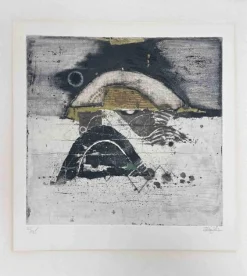
Johnny Friedlaender, Edition von 135 ohne Titel, 1970er, Radierung





Arbeiten Auf Papier
Jugendstil
Reviews
There are no reviews yet.