
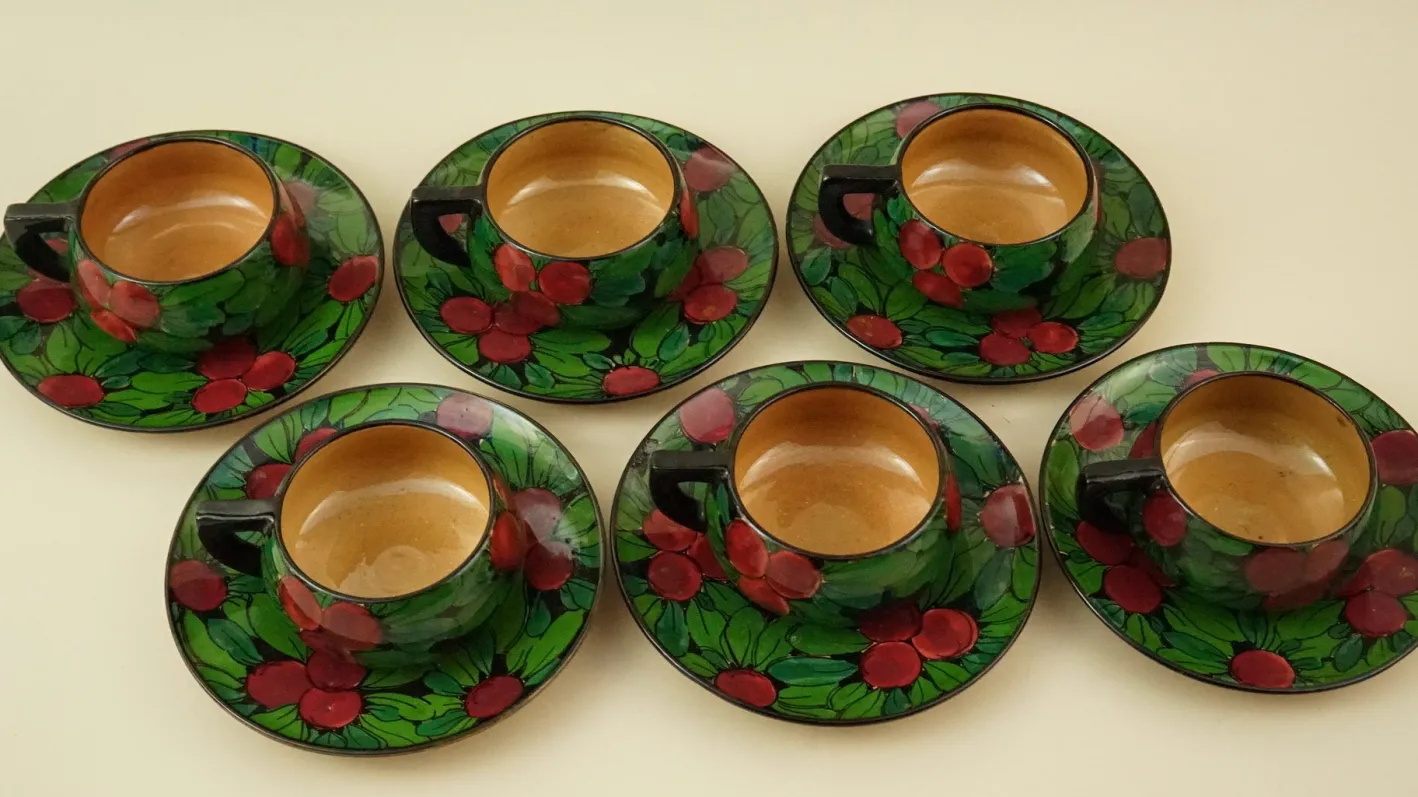
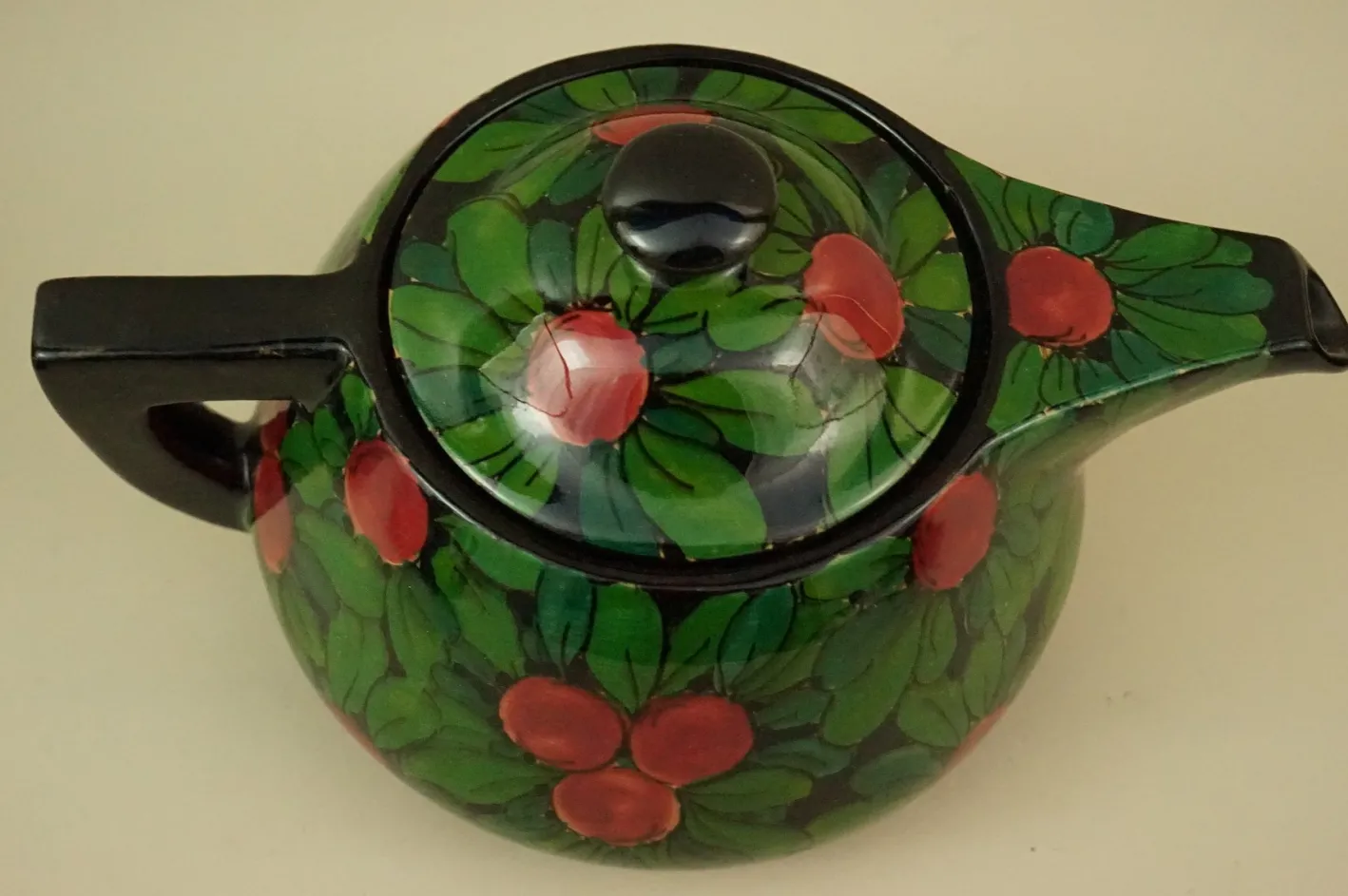
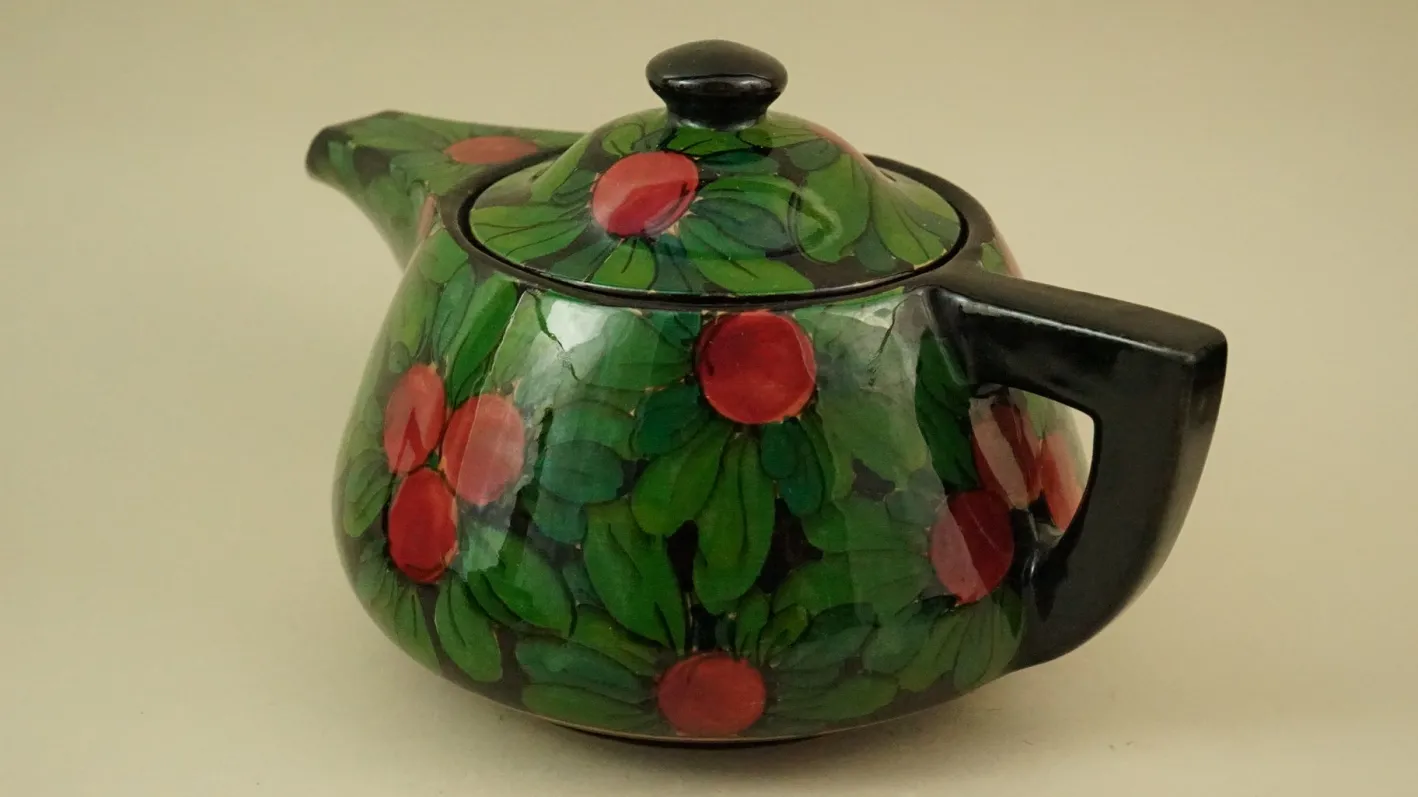
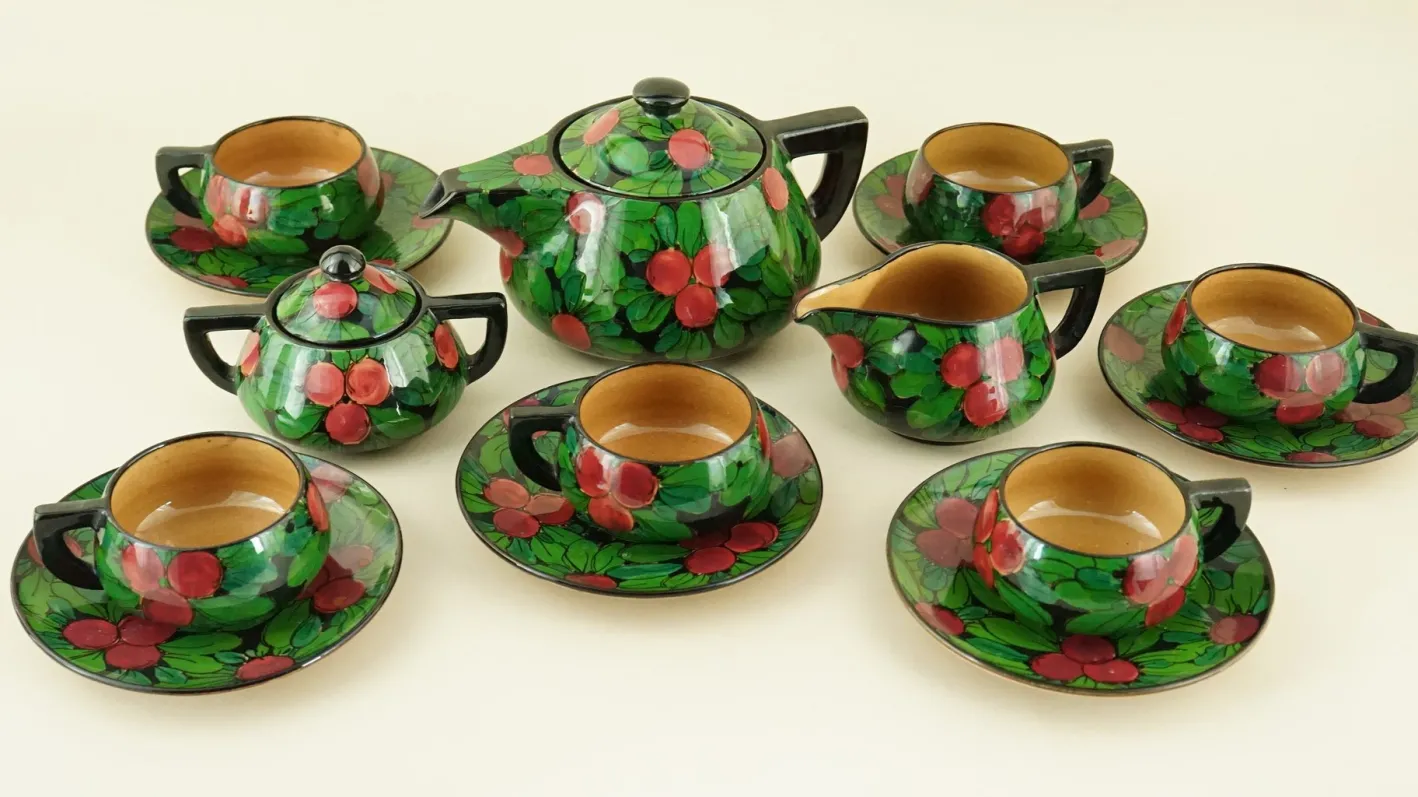
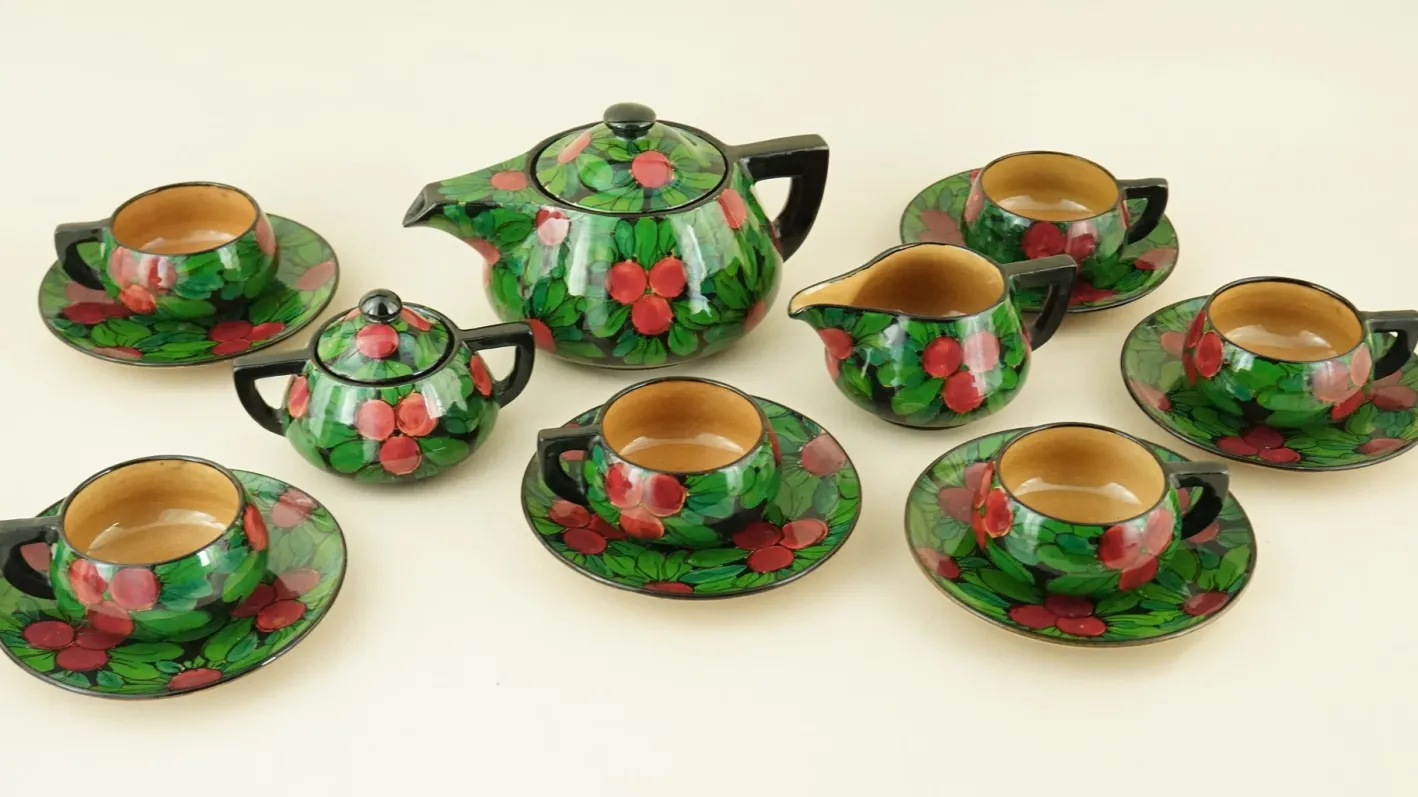
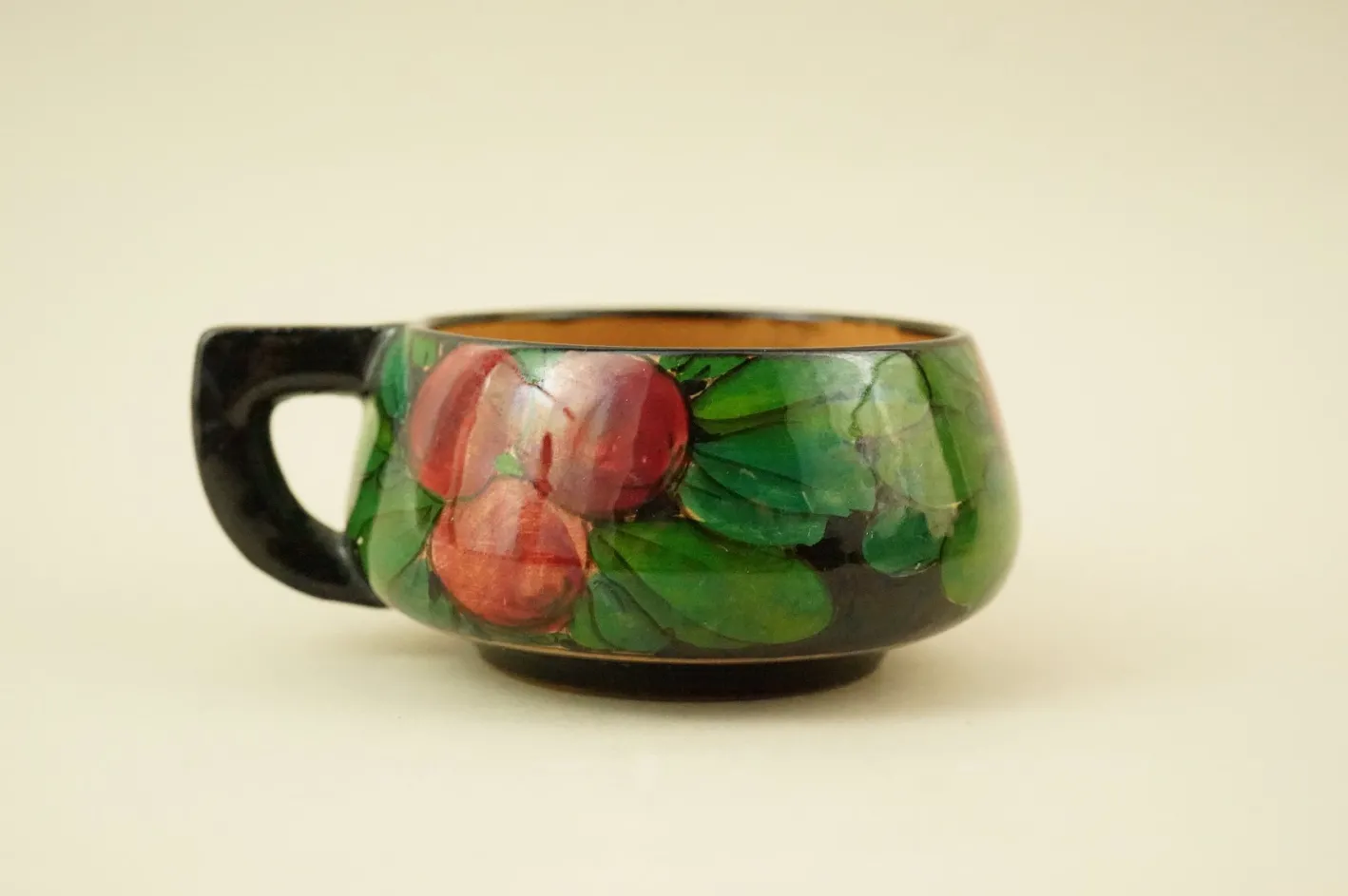
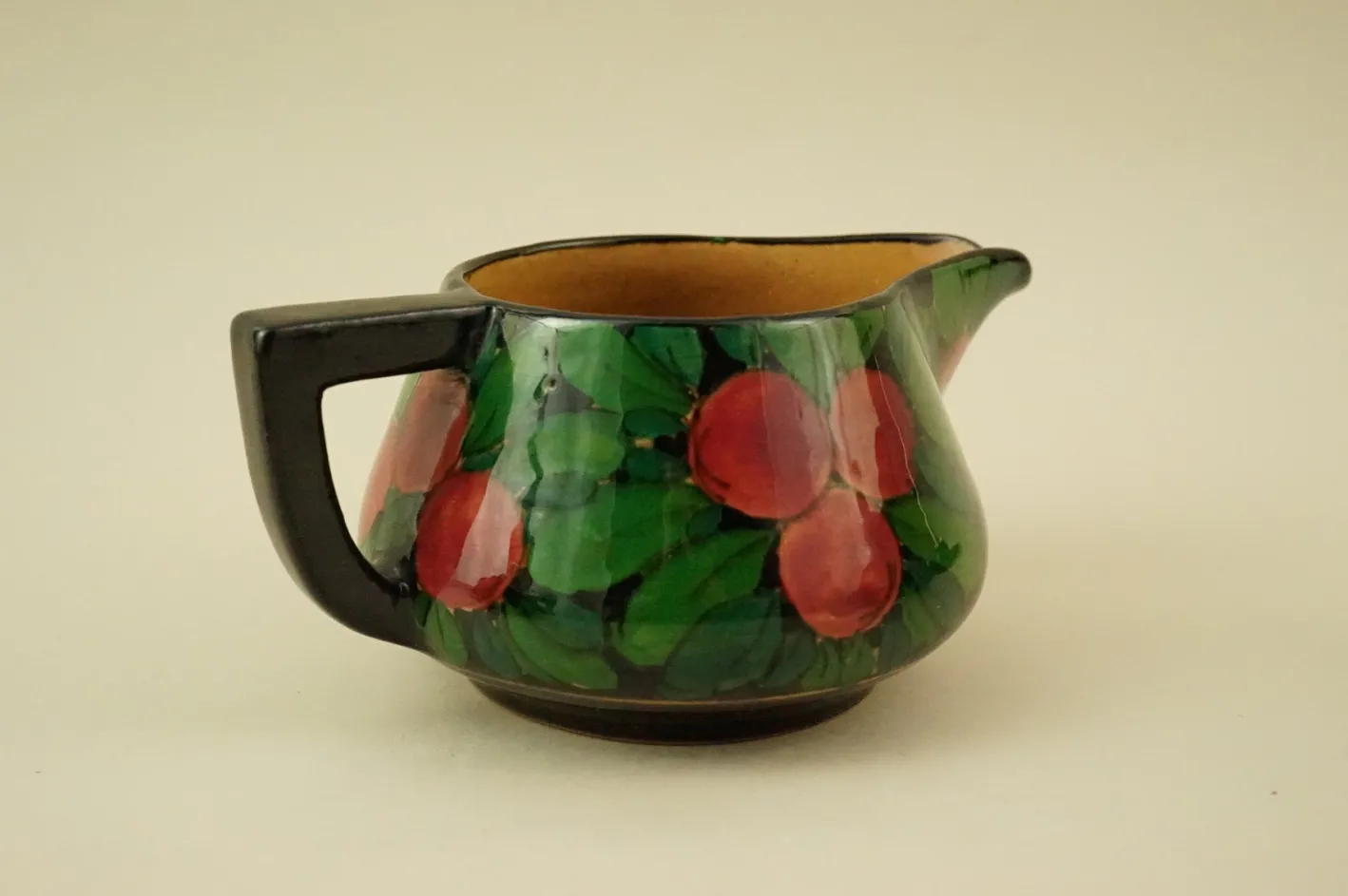
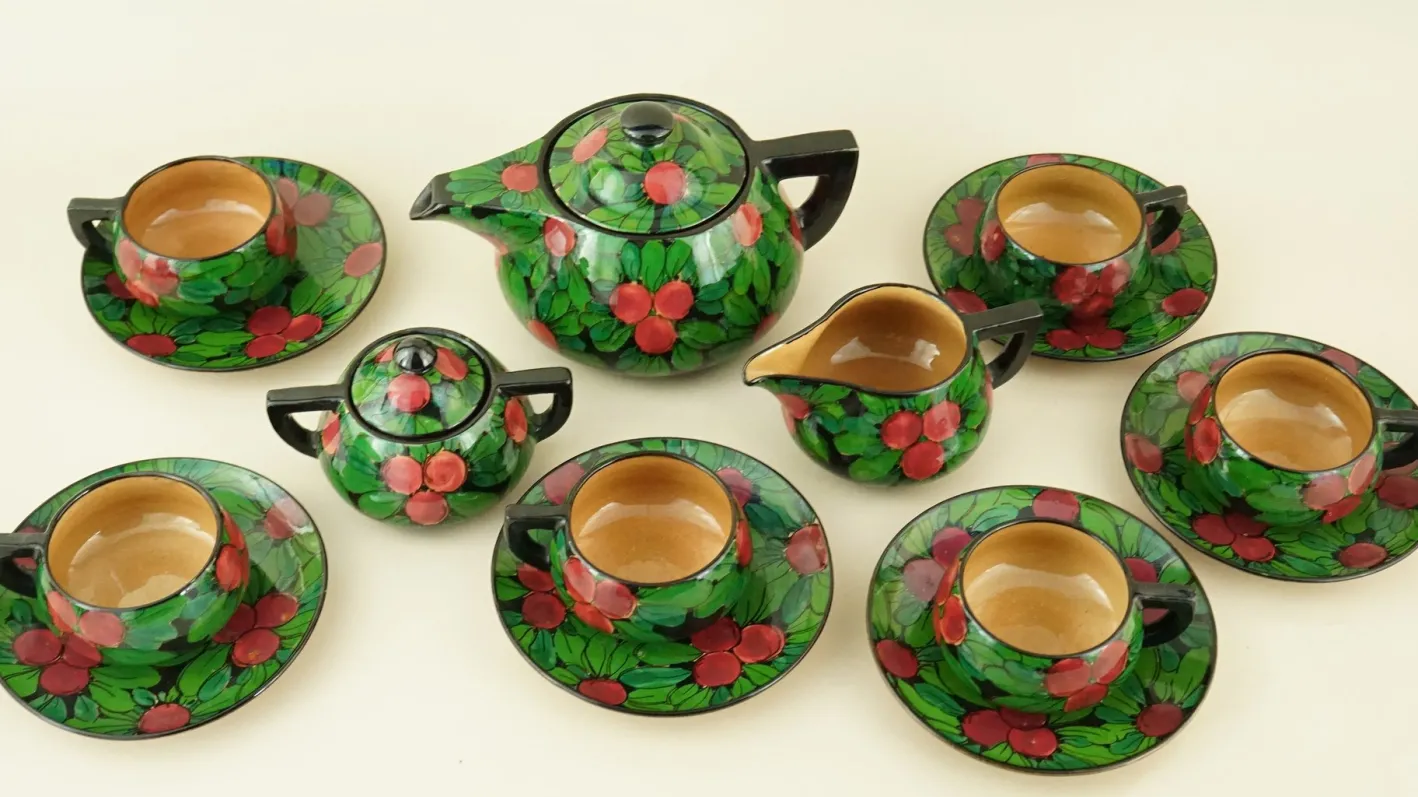
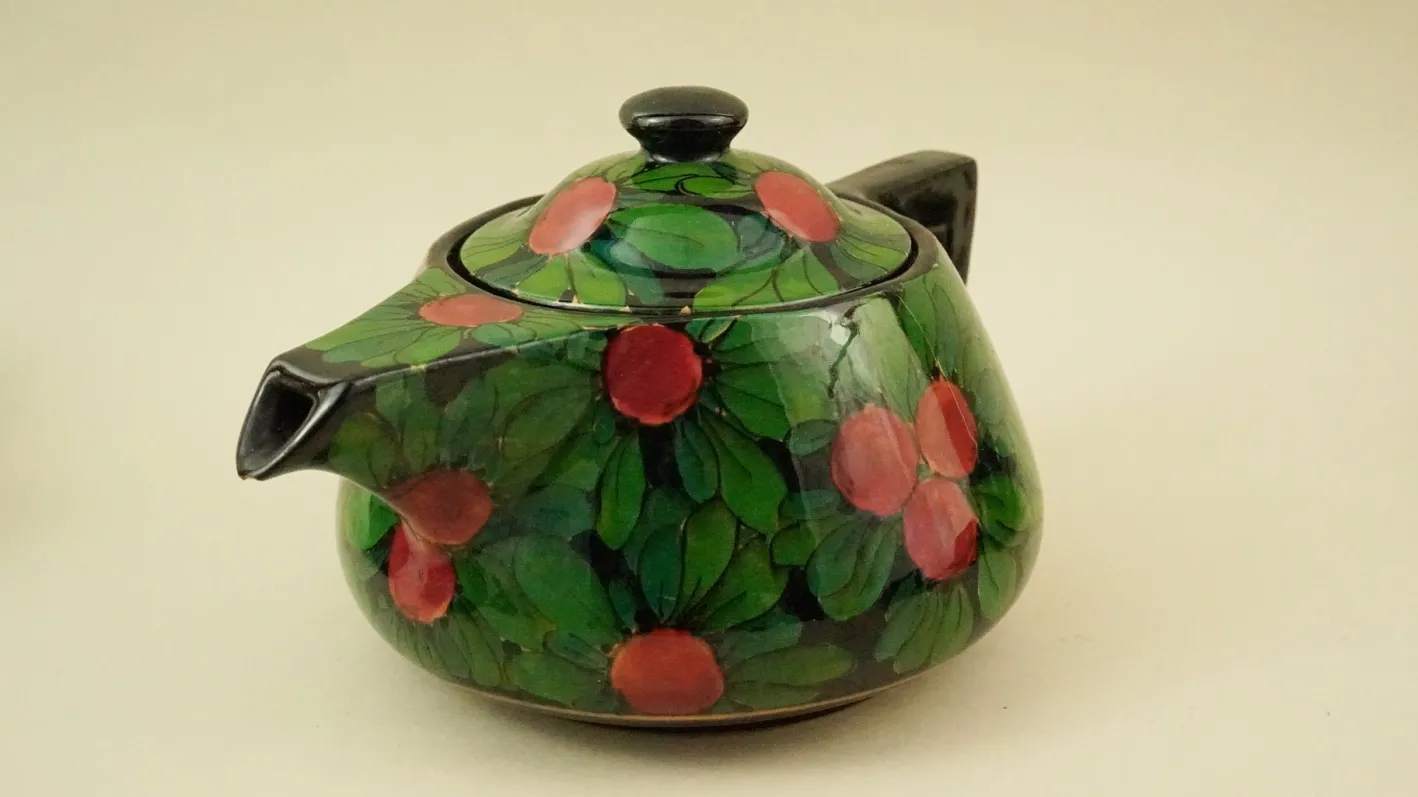
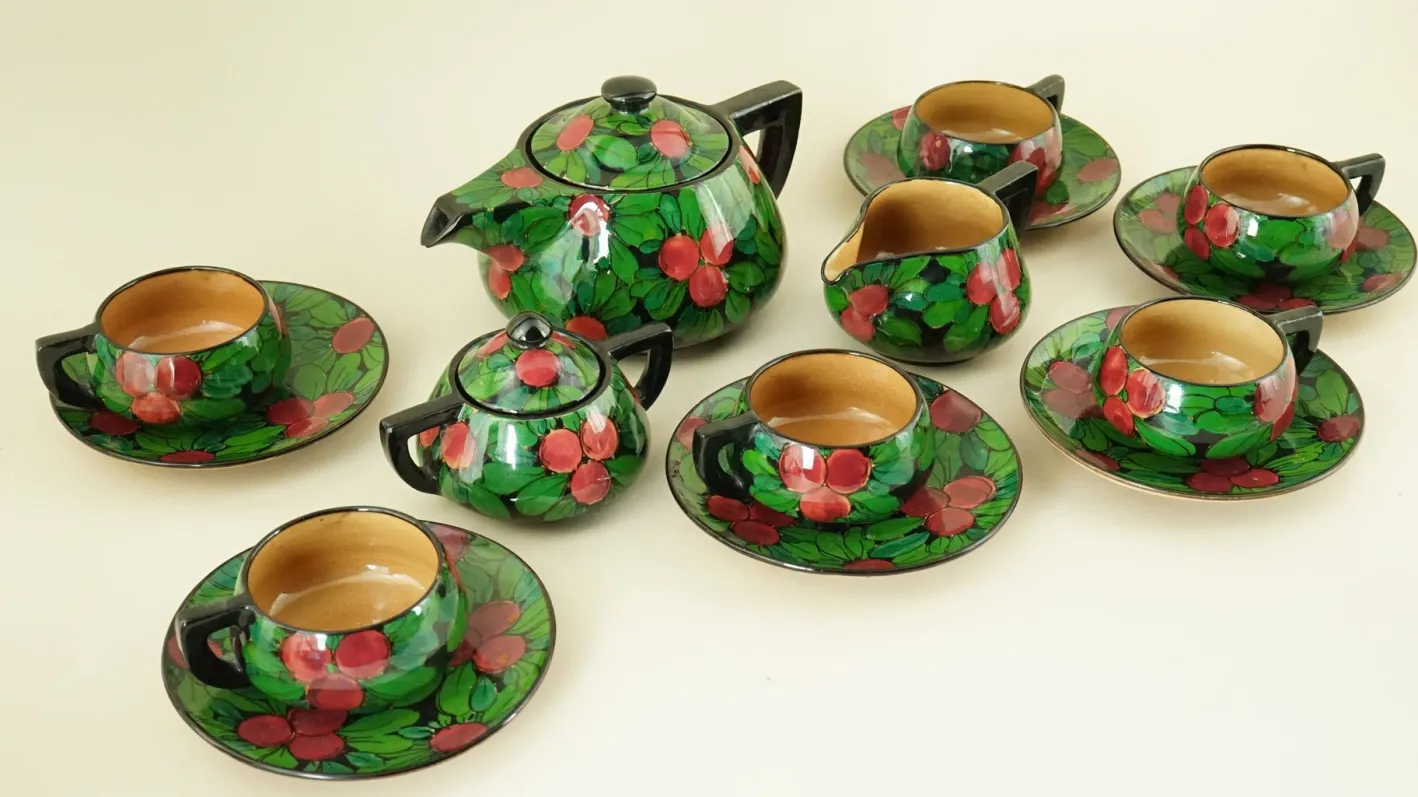
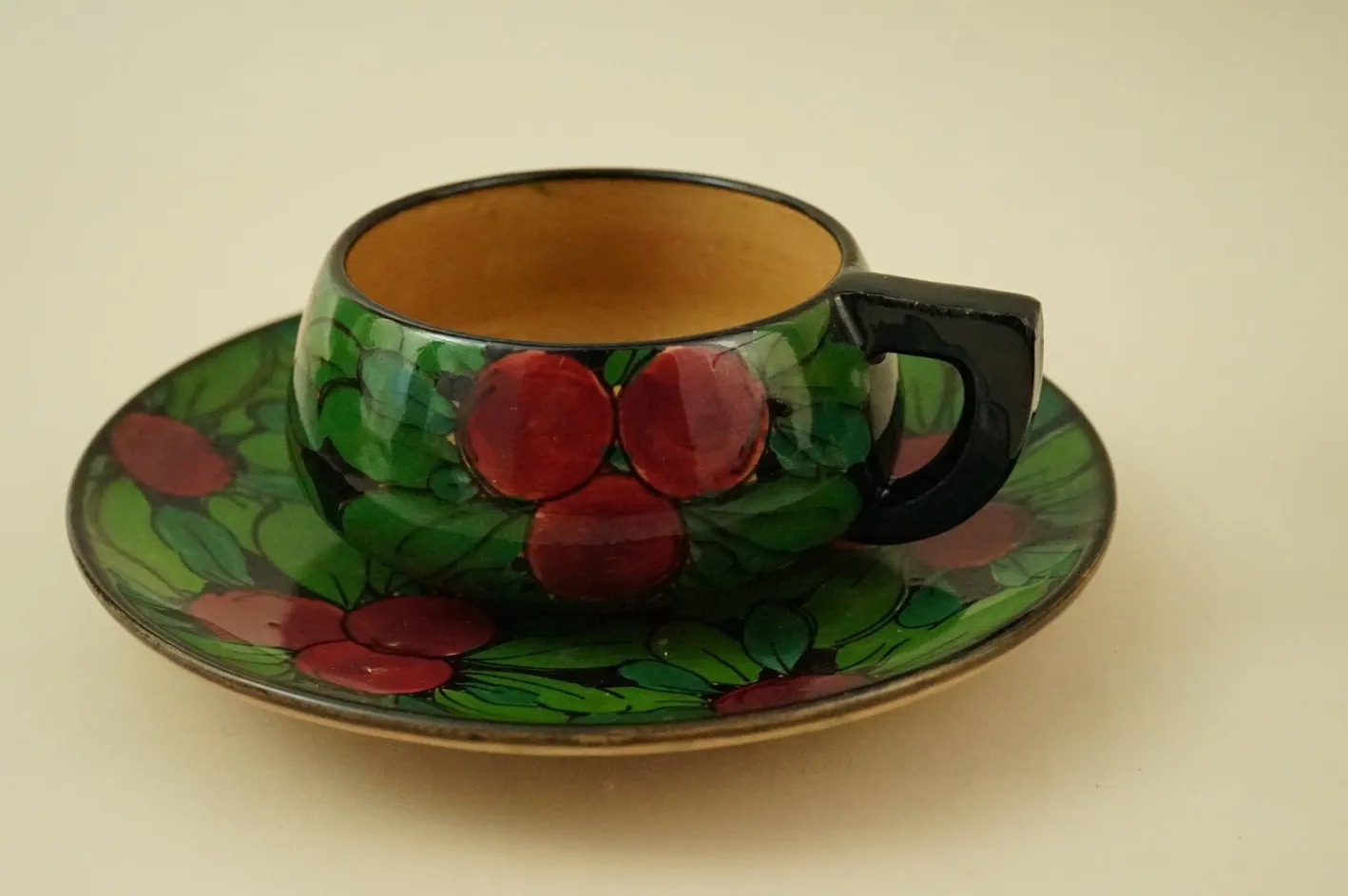
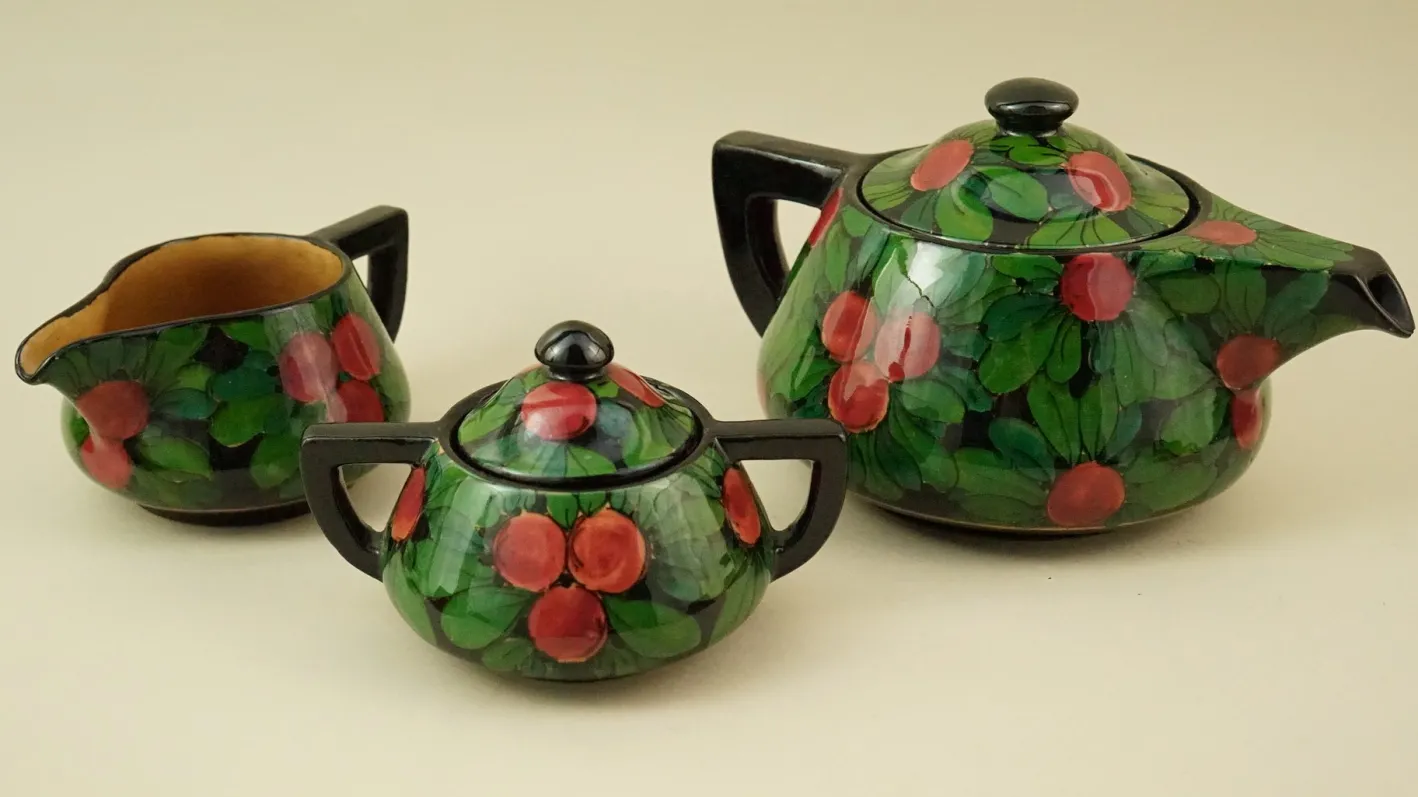
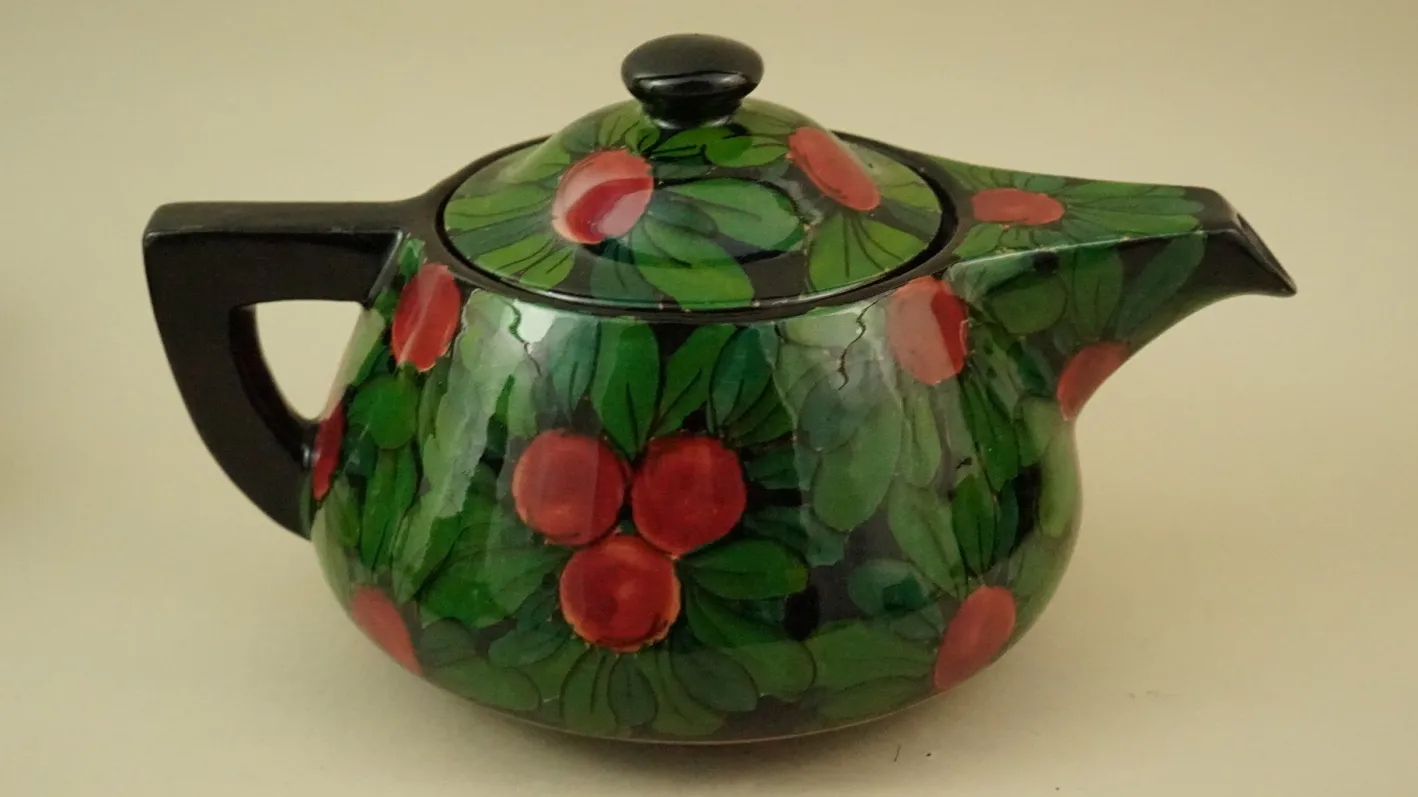
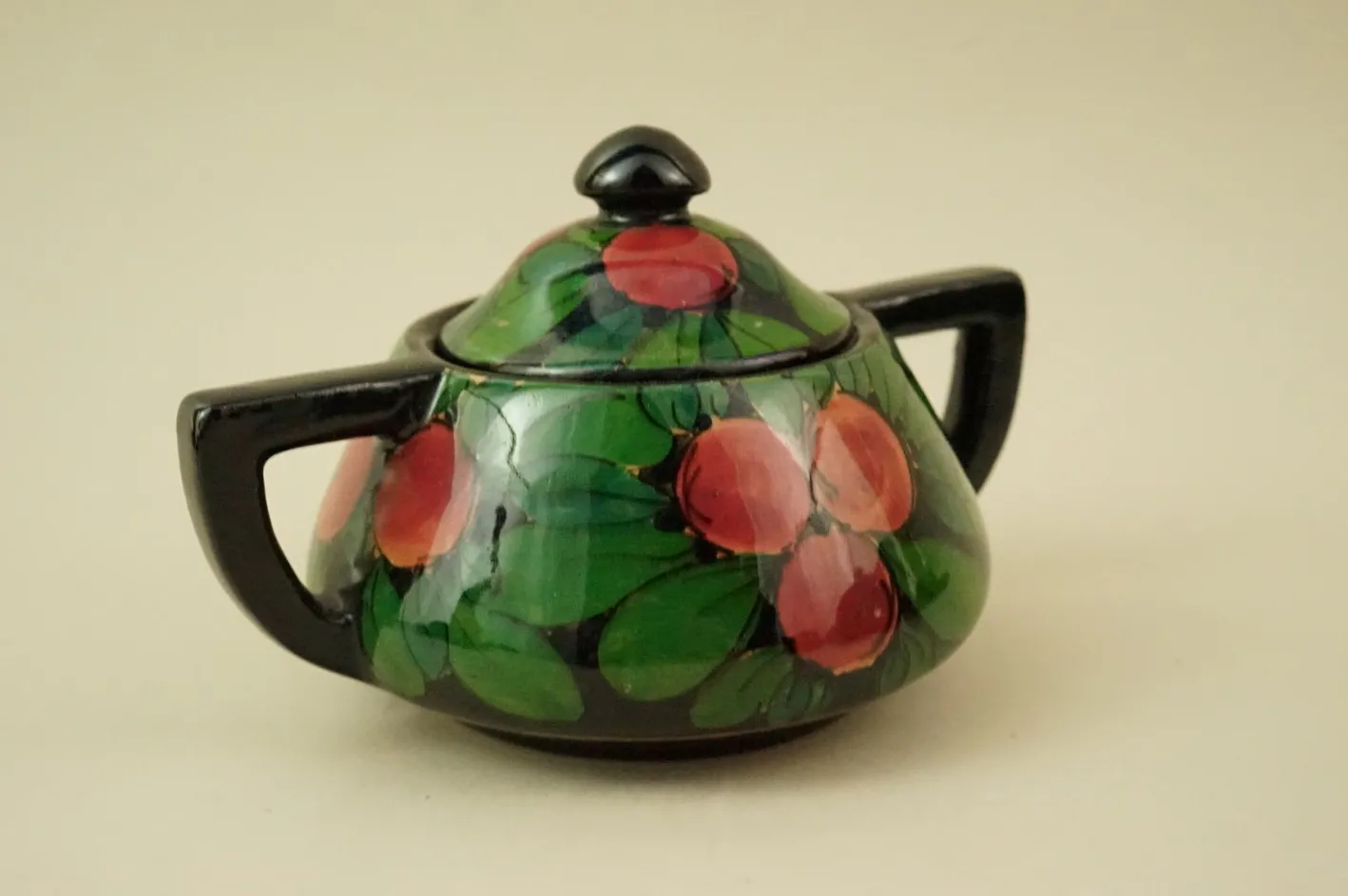
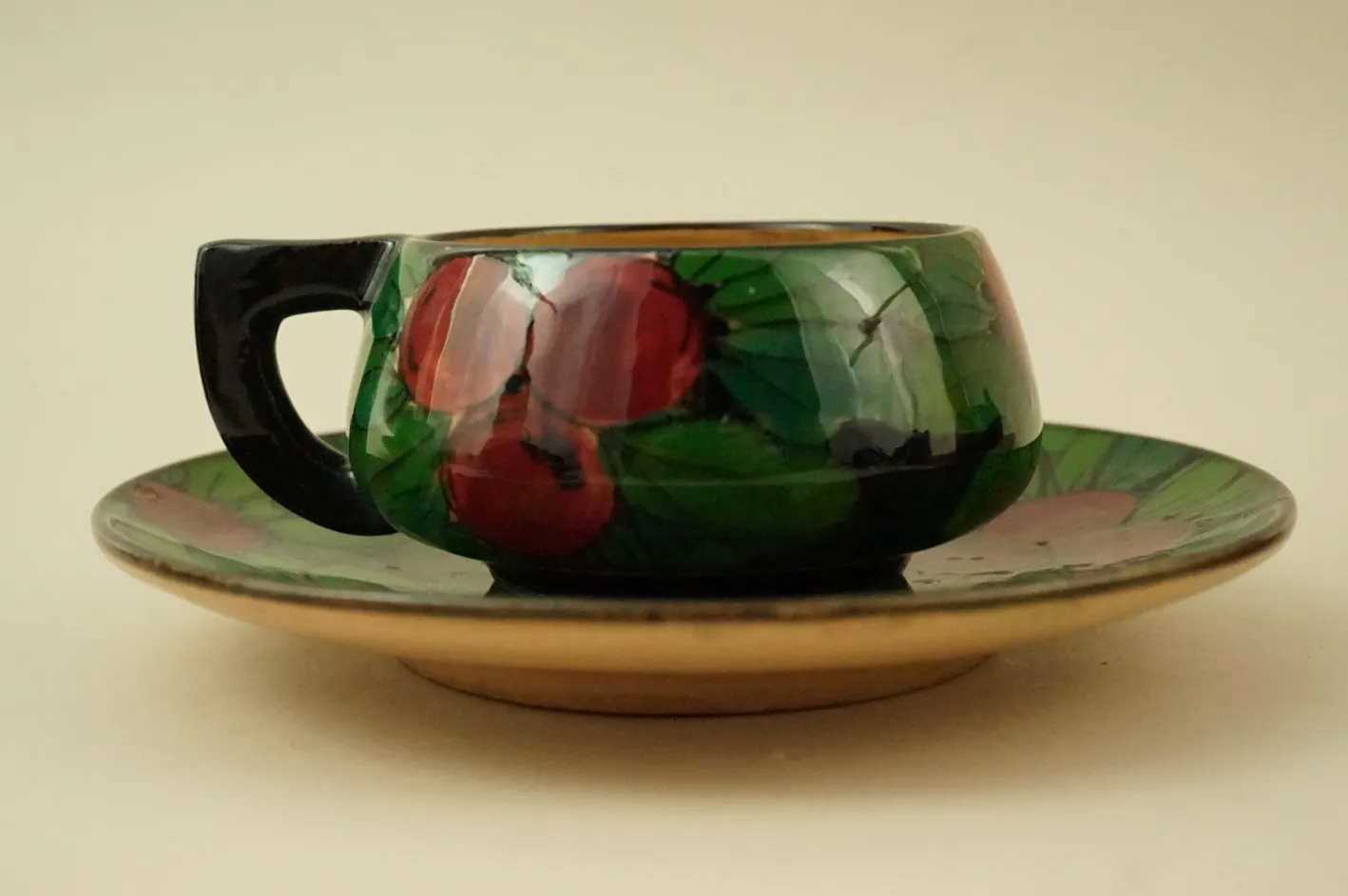
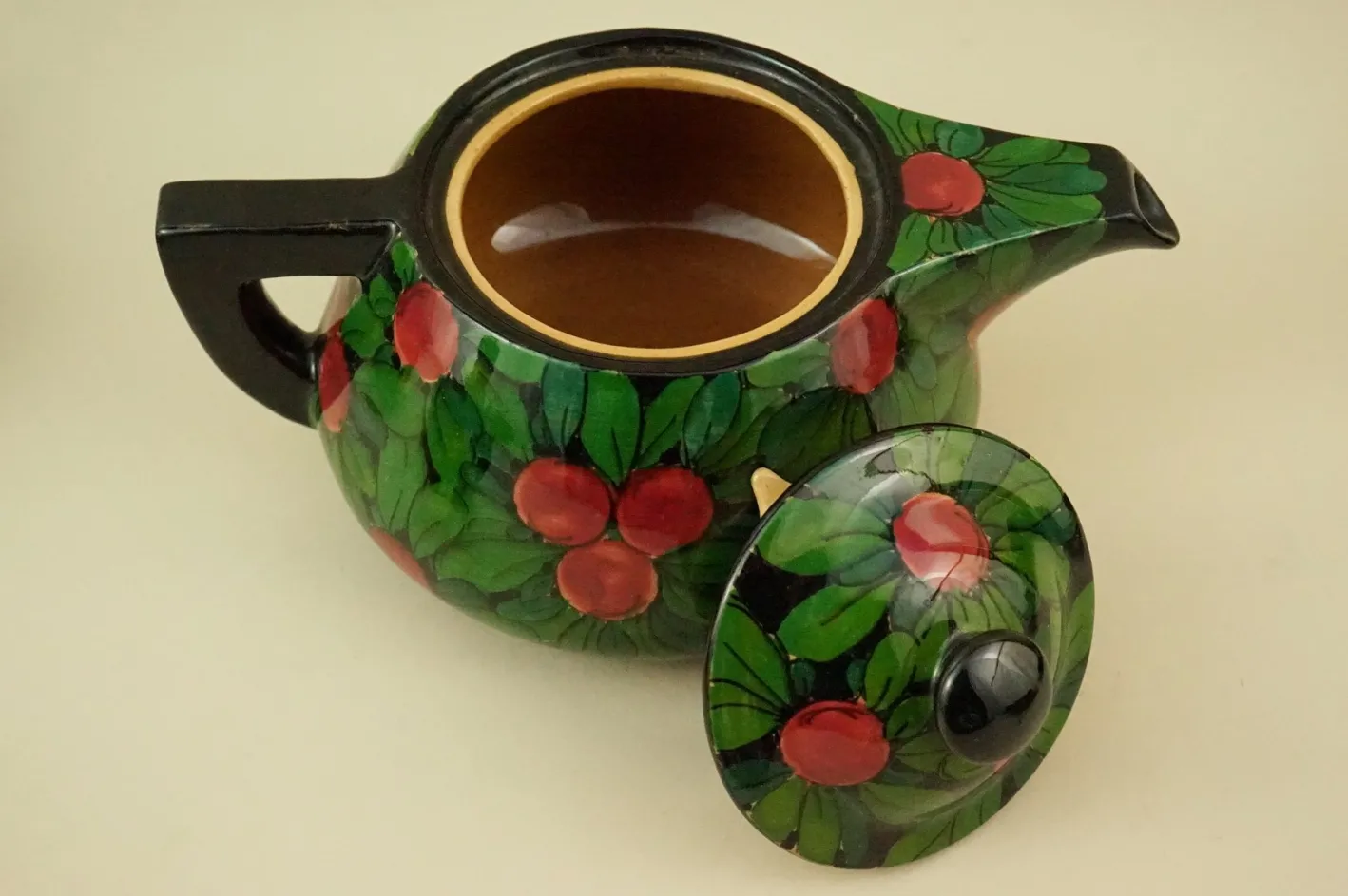
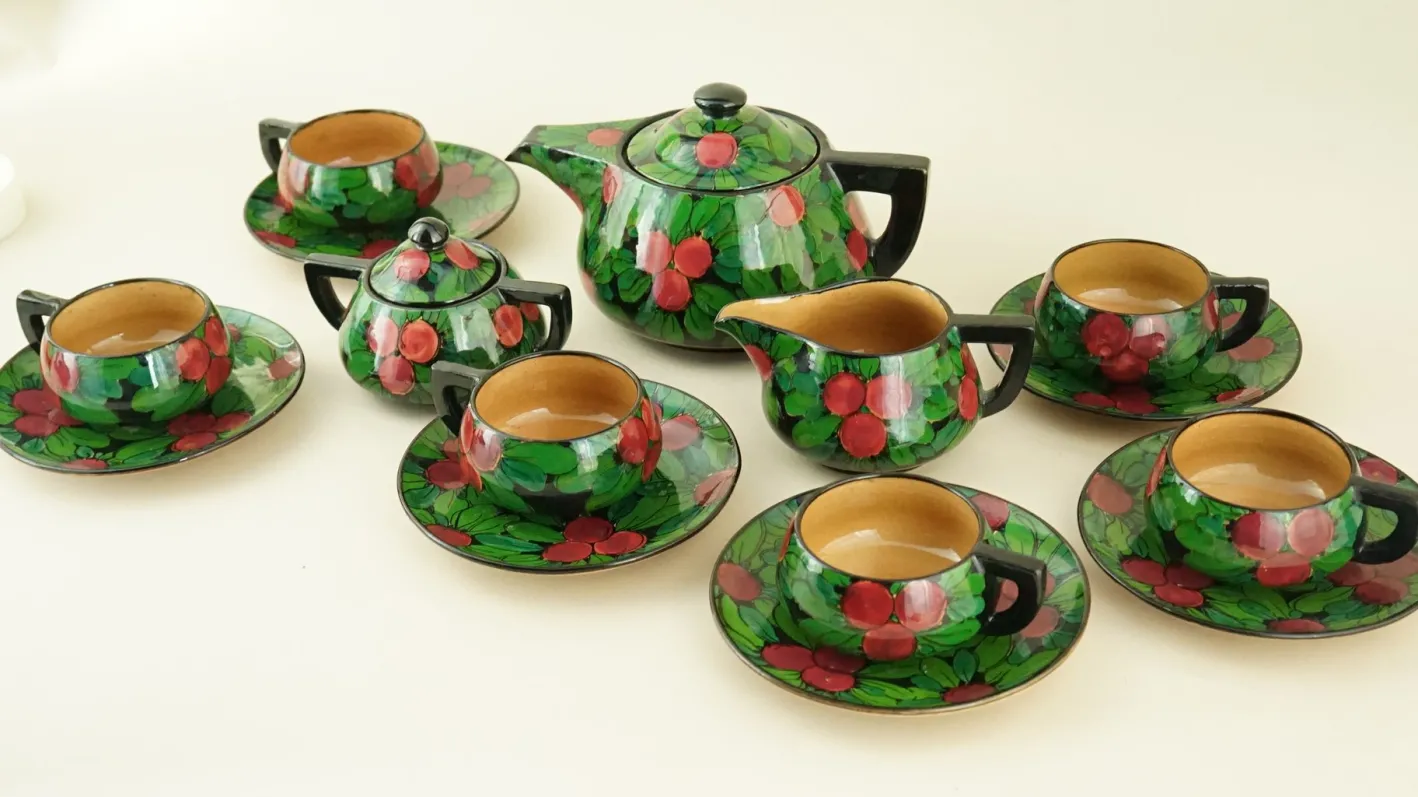
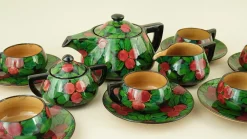
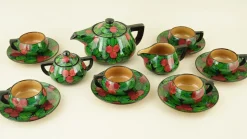
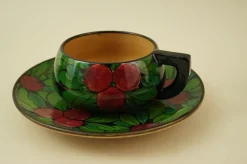
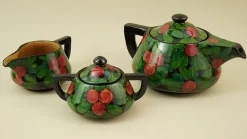
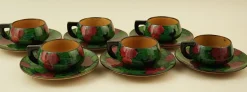
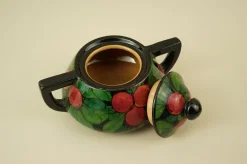
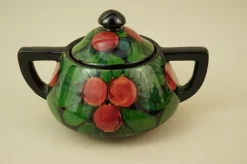
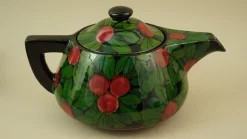
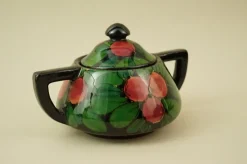
Futuristisches Keramik Teeservice von Renato Bassanelli für Keramos, Rome, Italy, 1920er, 15 Set
€116.09
MEASUREMENTS:
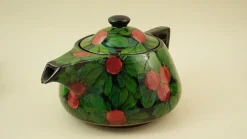
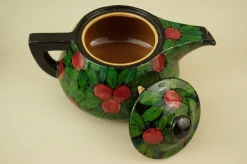
Teapot: Height: 12 cm; Width: 22.5 cm; Depth: 15 cm;
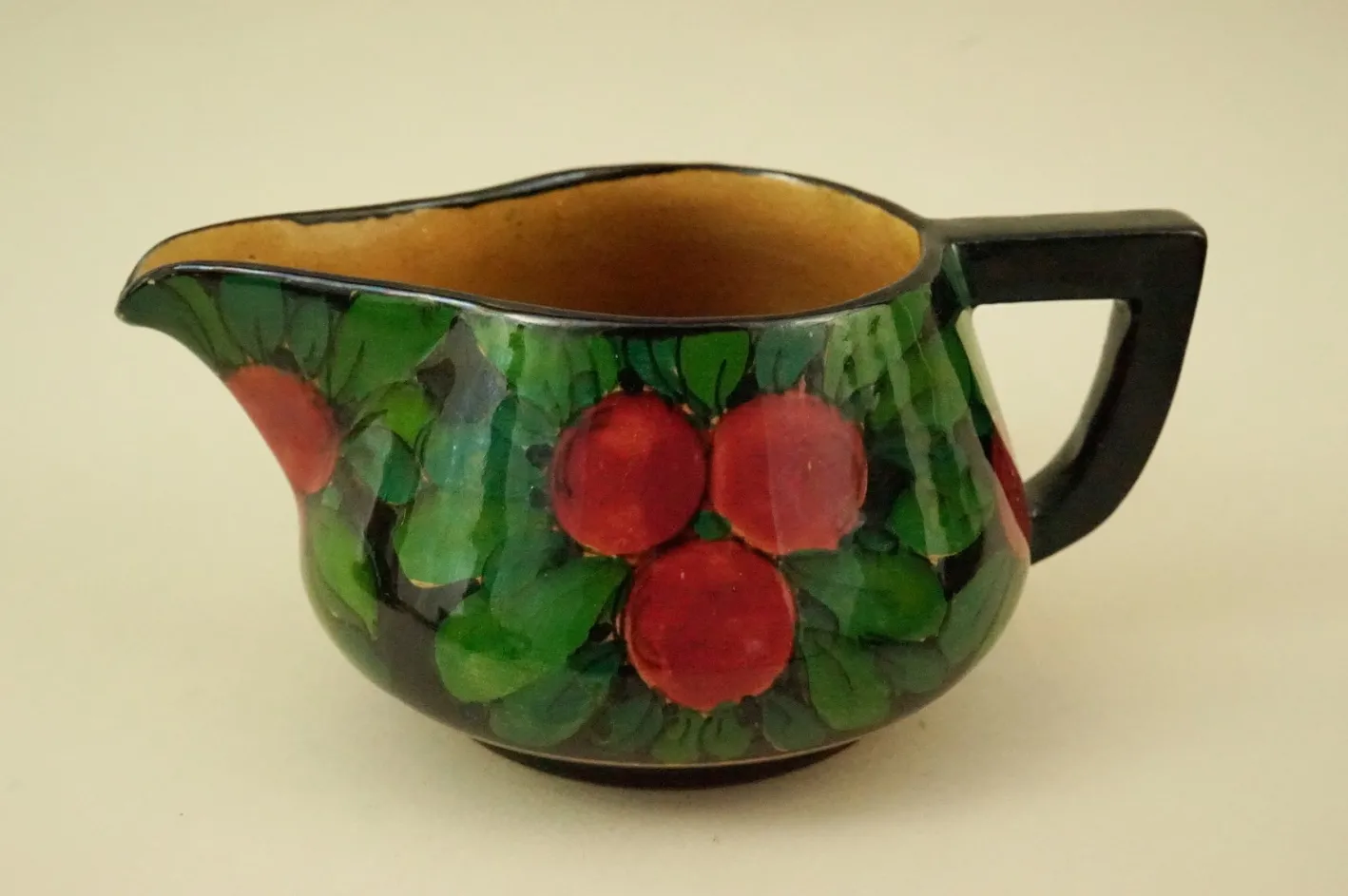
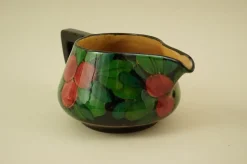
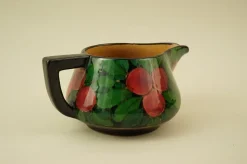
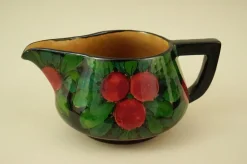
Milk jug: Height: 7 cm; Width: 15 cm; Depth: 10 cm;
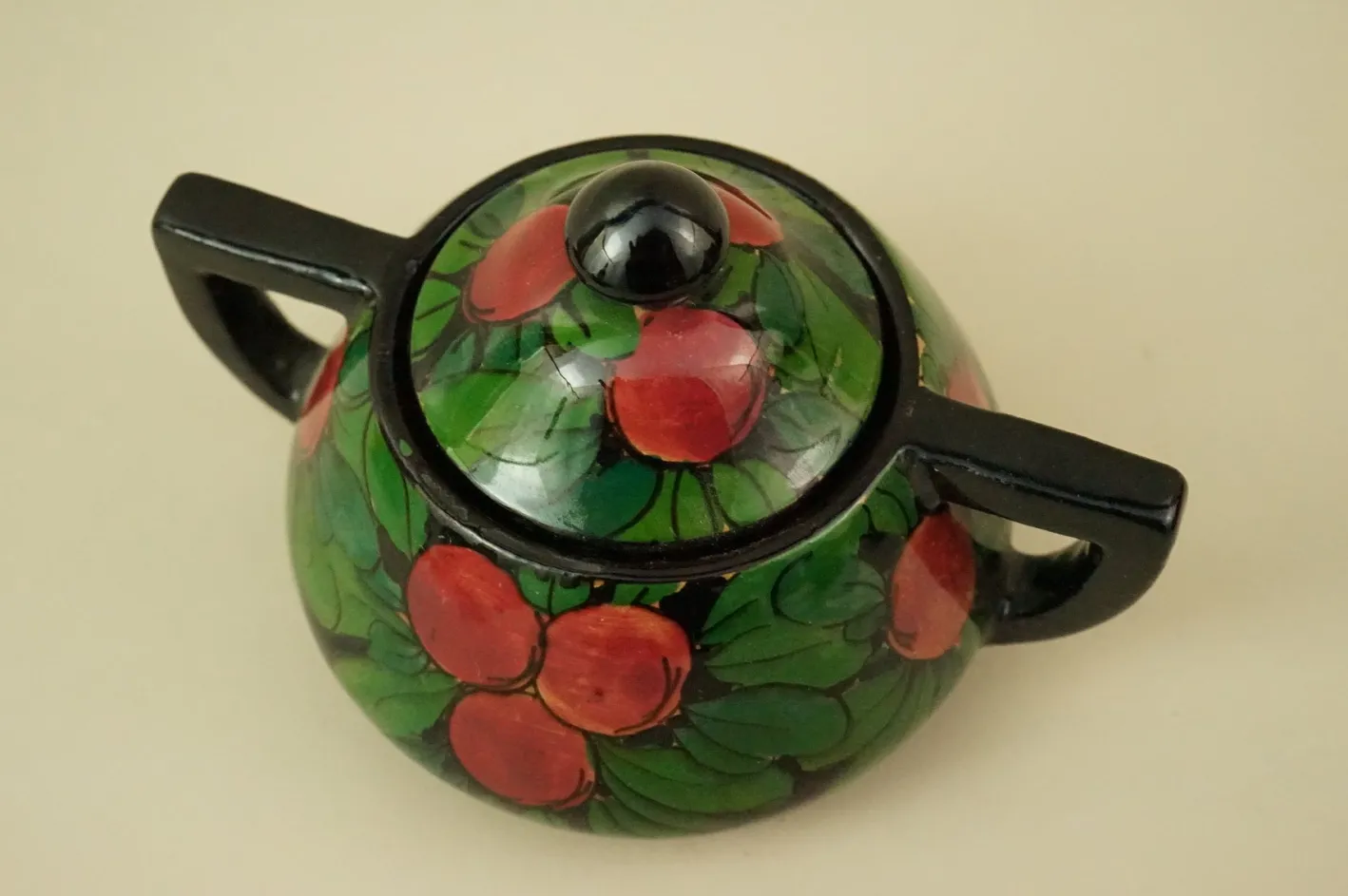
Sugar bowl: Height: 9 cm; Width: 14 cm; Depth: 11 cm;
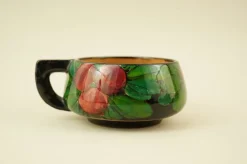
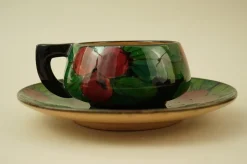
Cup: Height: 5 cm; Width: 11 cm; Depth: 9 cm;
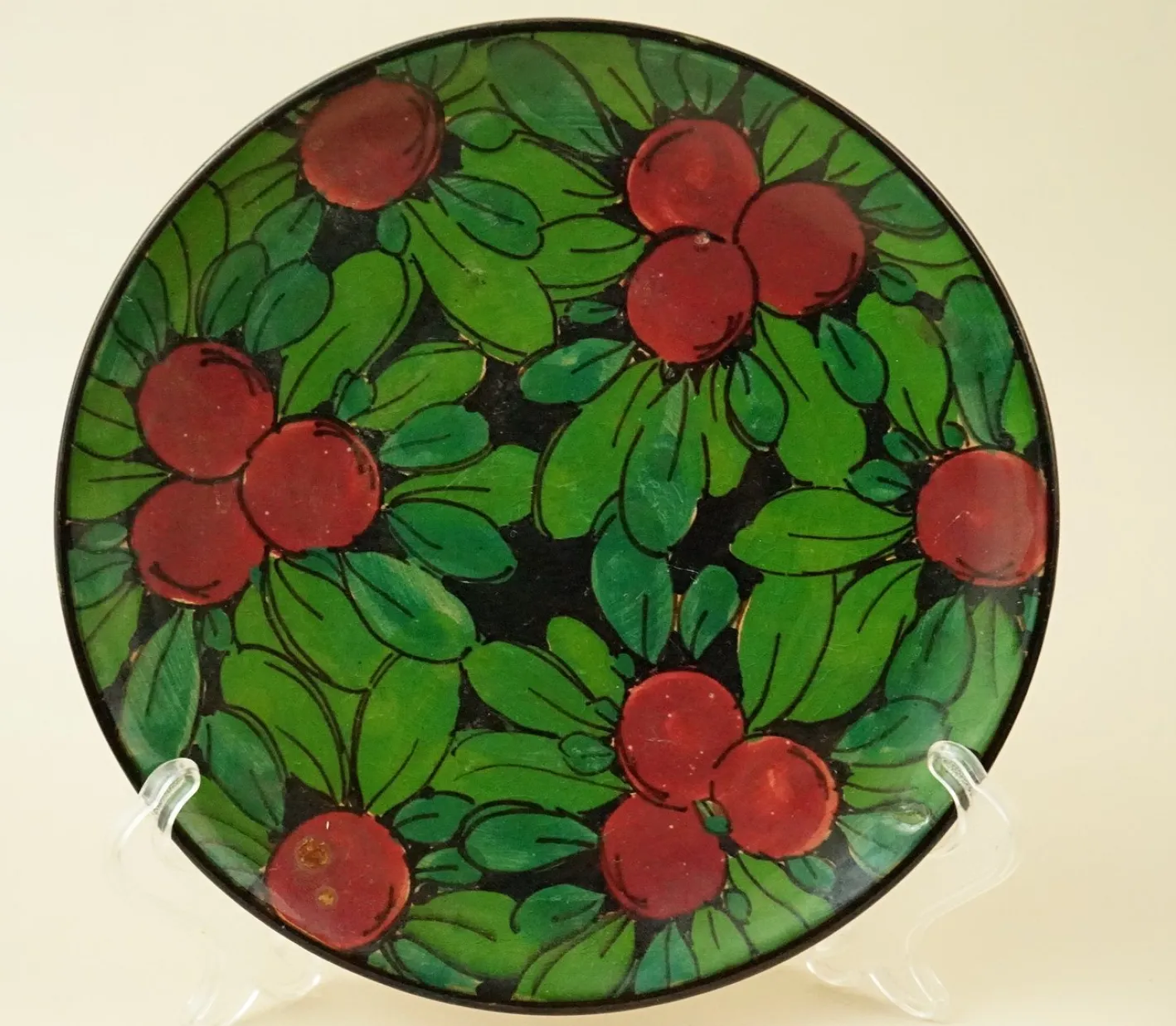
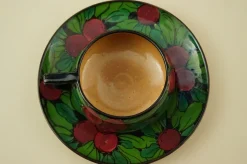
Saucer: Height: 2 cm; Diameter: 15.8 cm;
Total weight of set: 2.077 kg.
Description of the item:
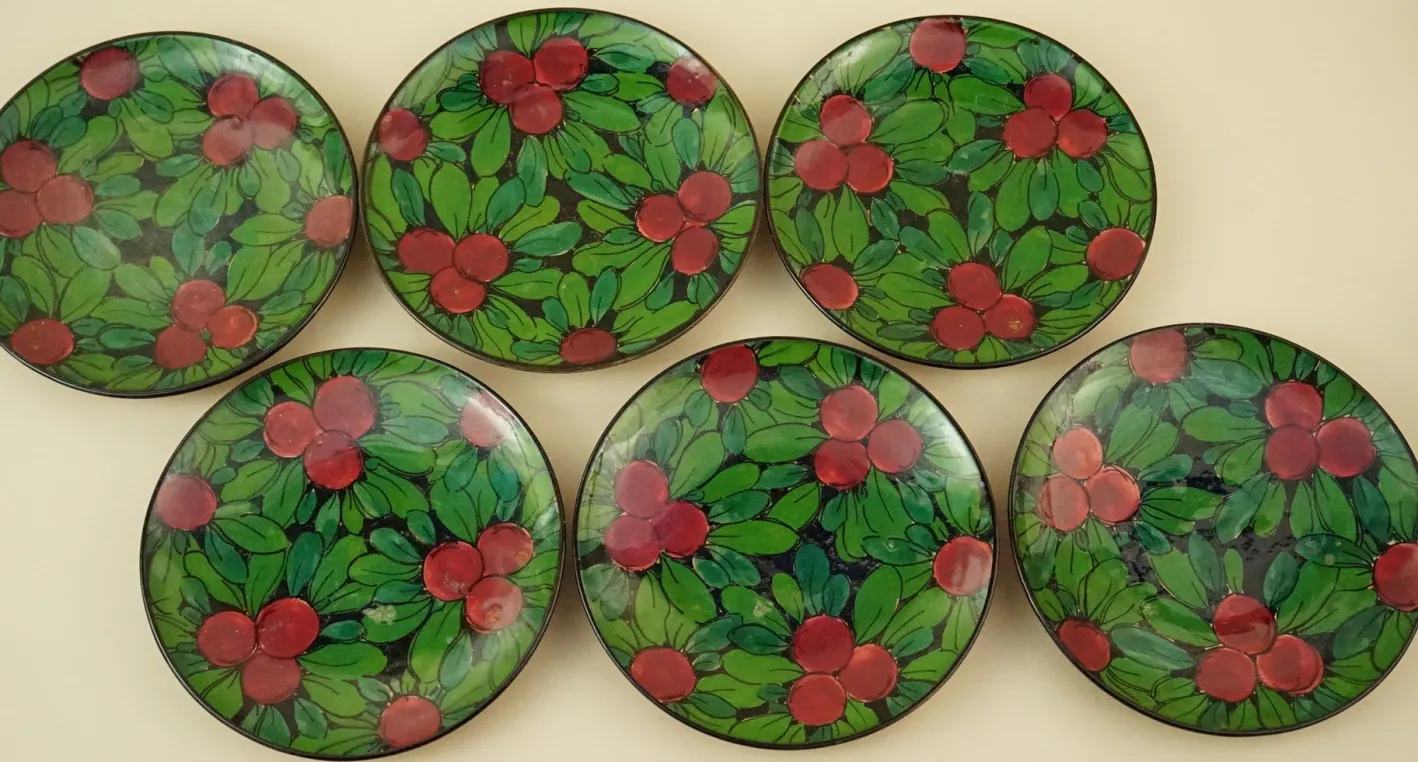
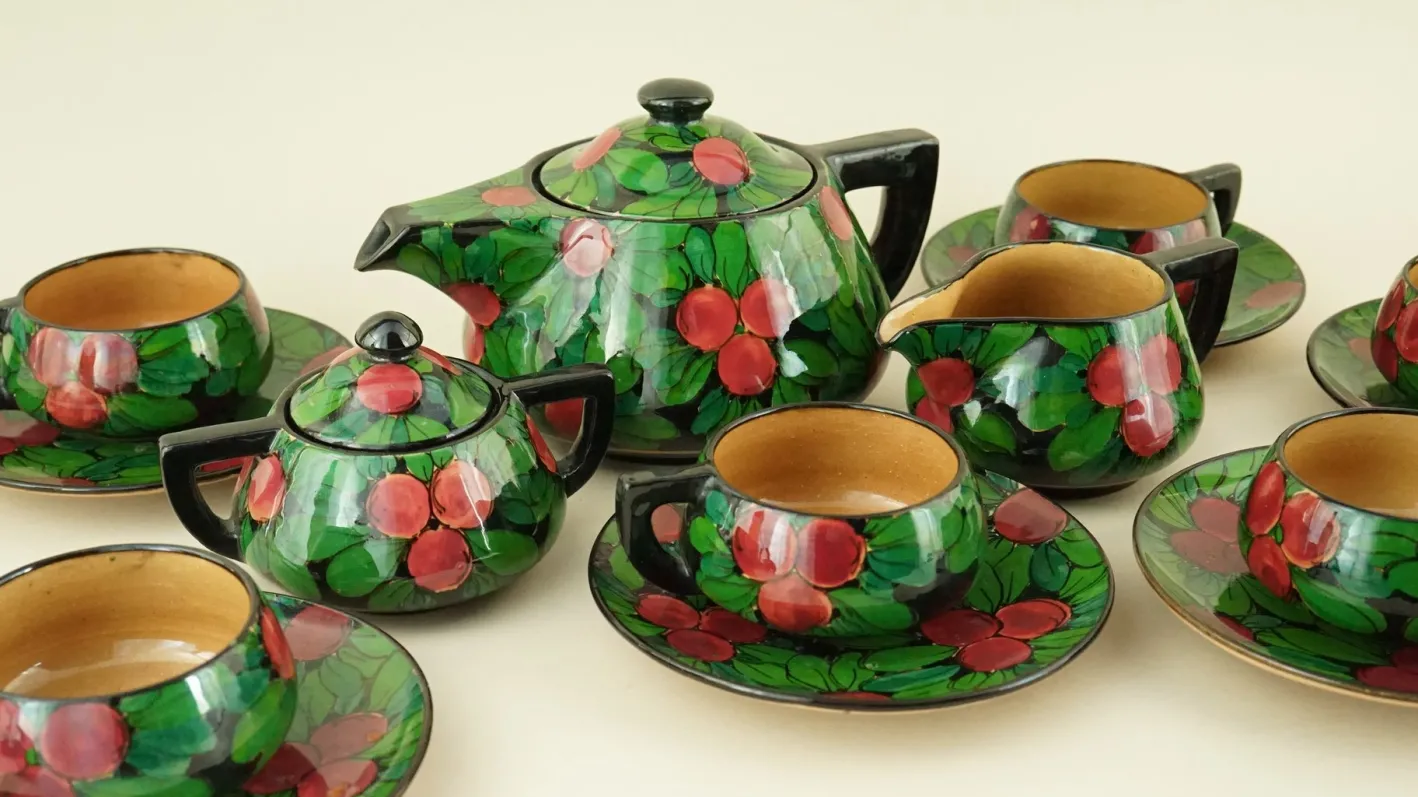
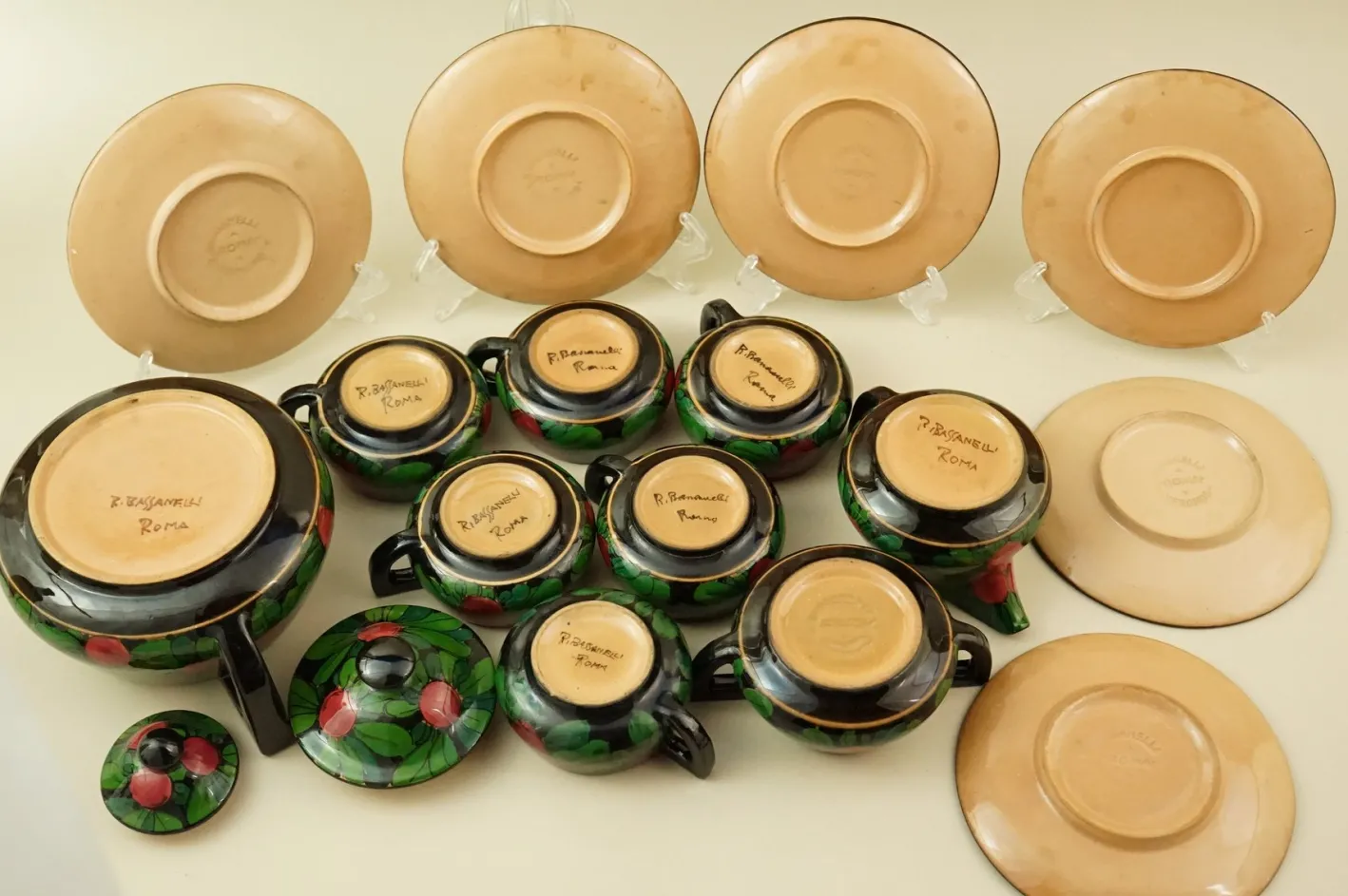
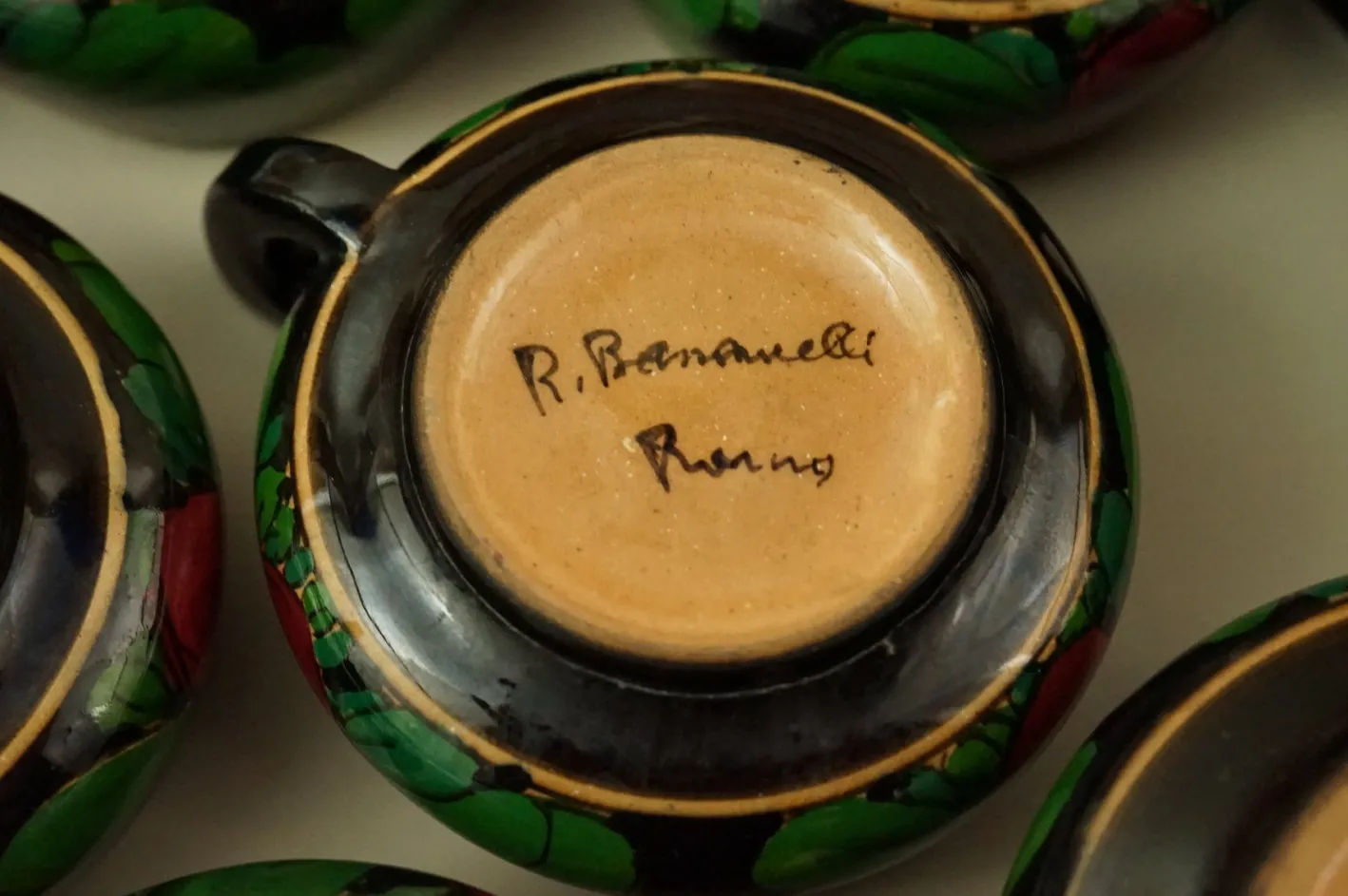
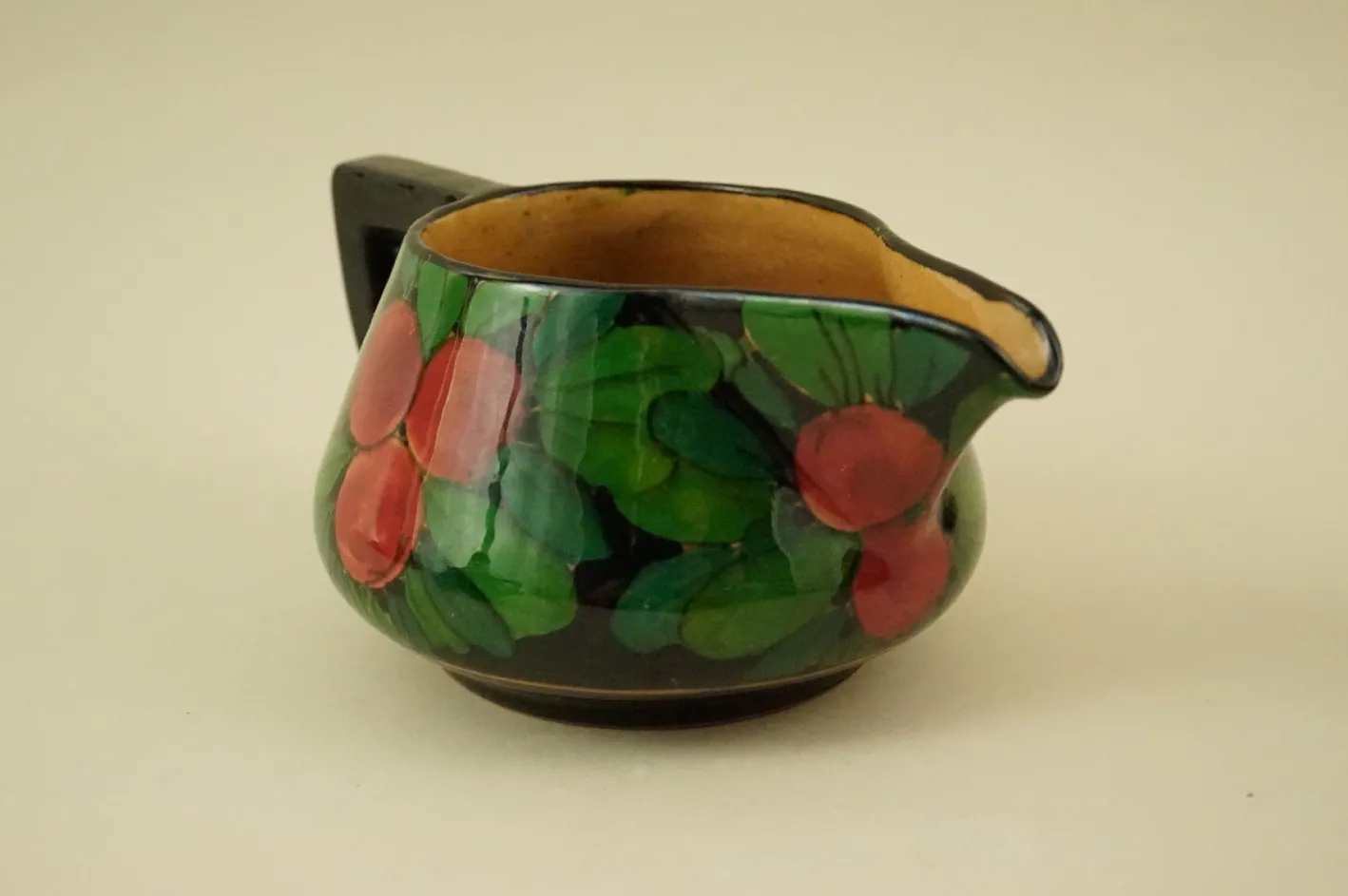
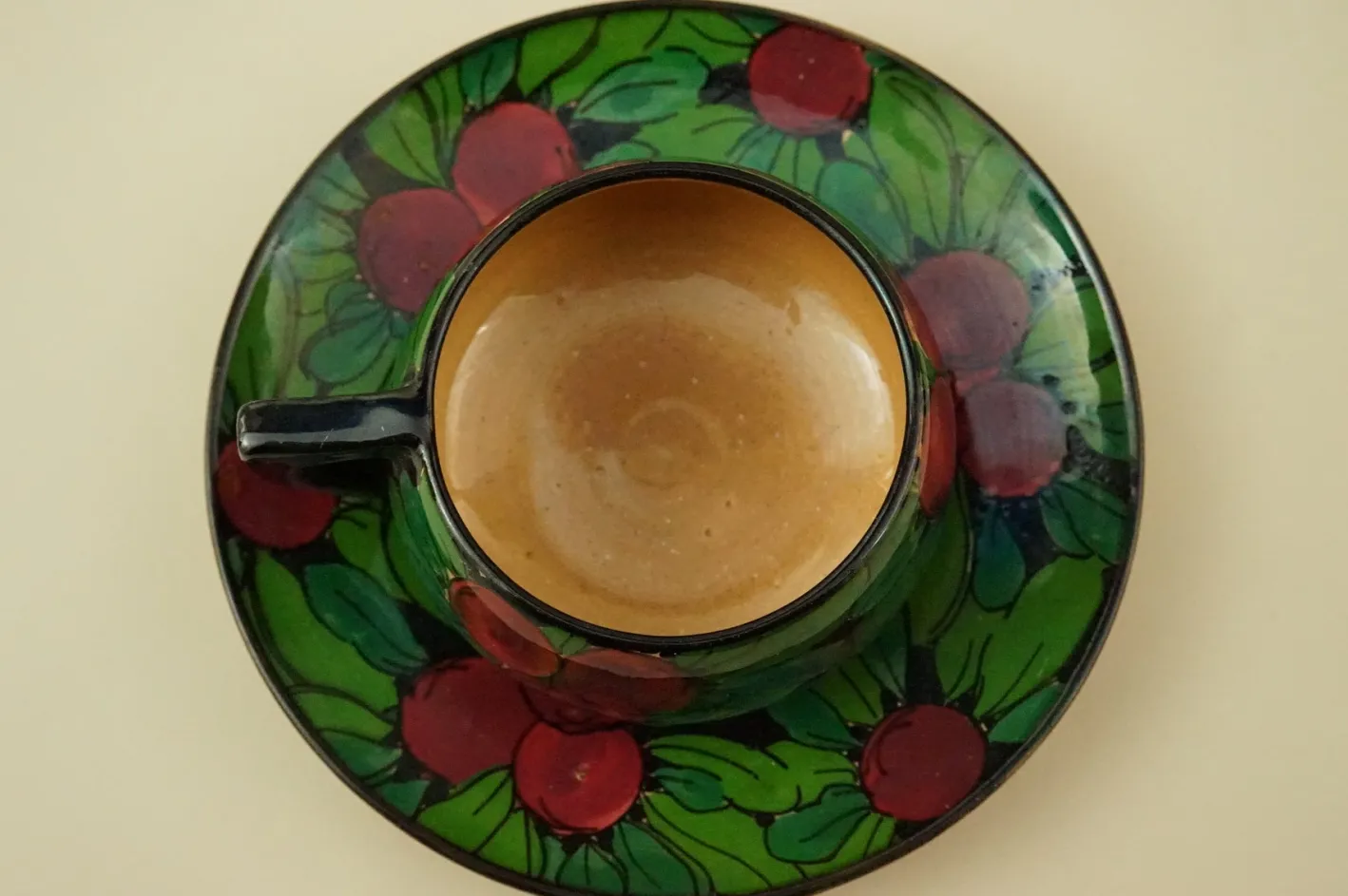
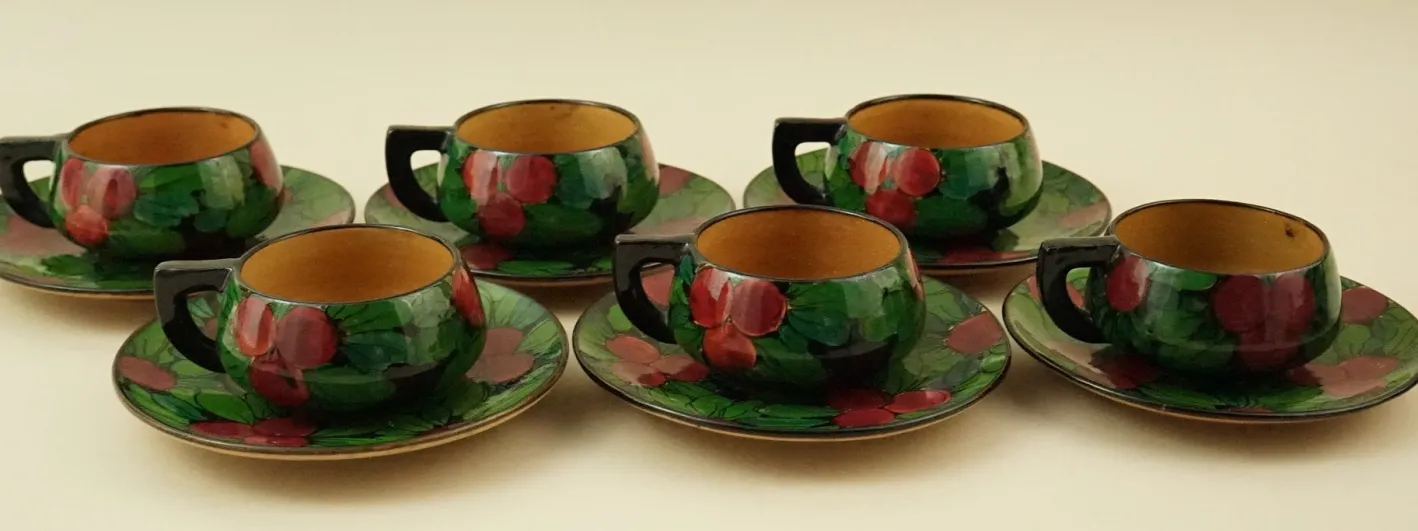
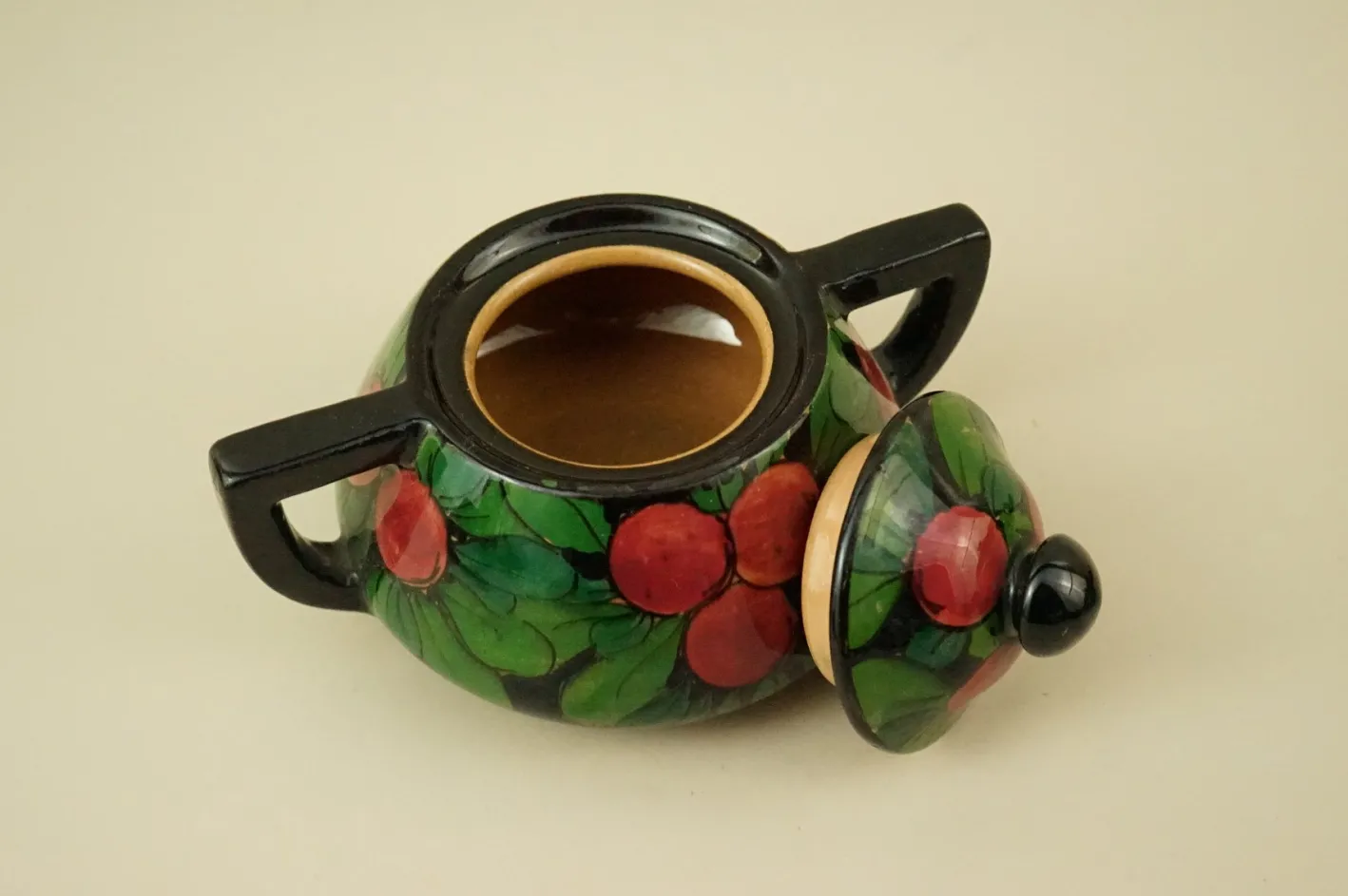
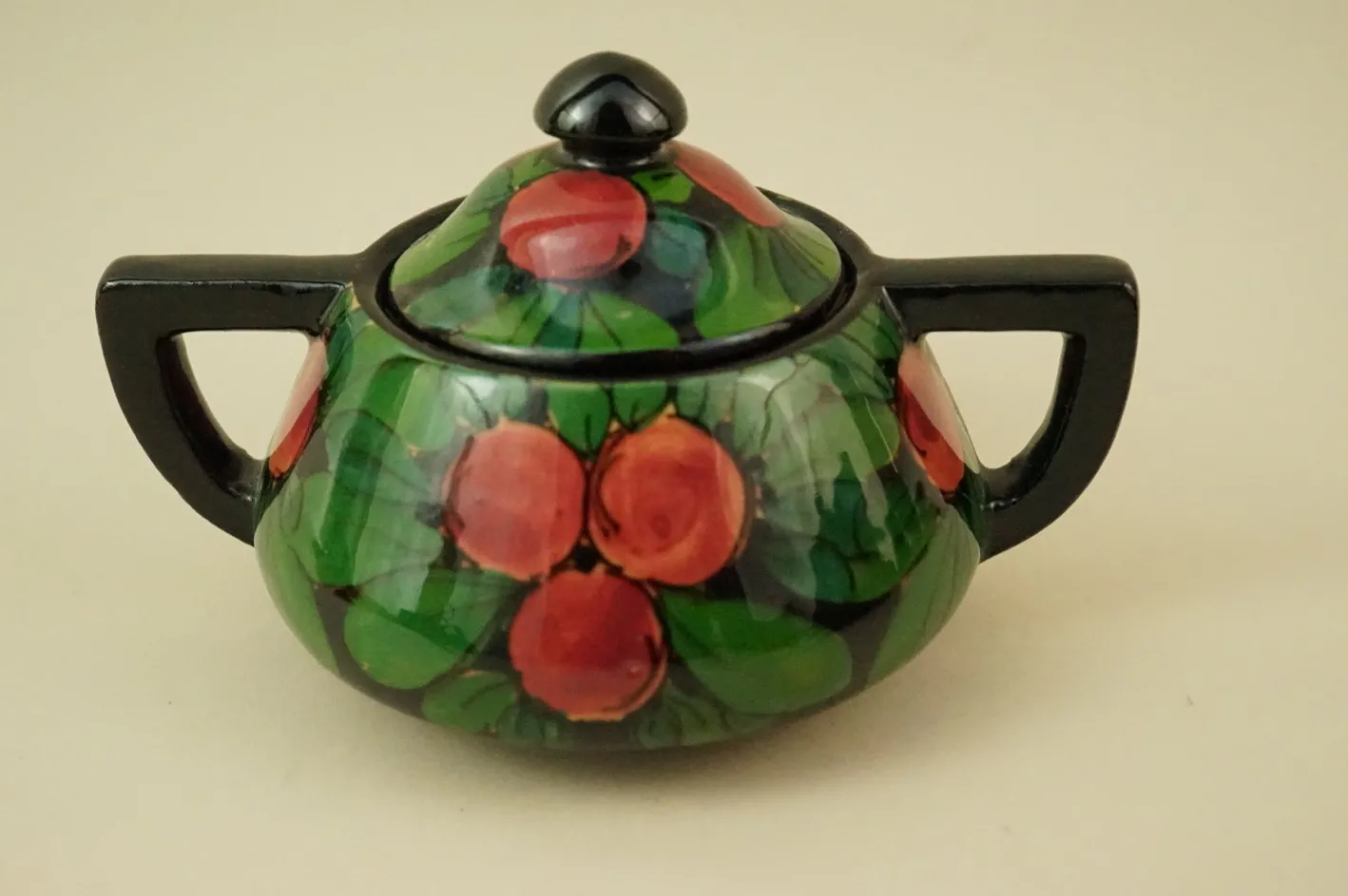
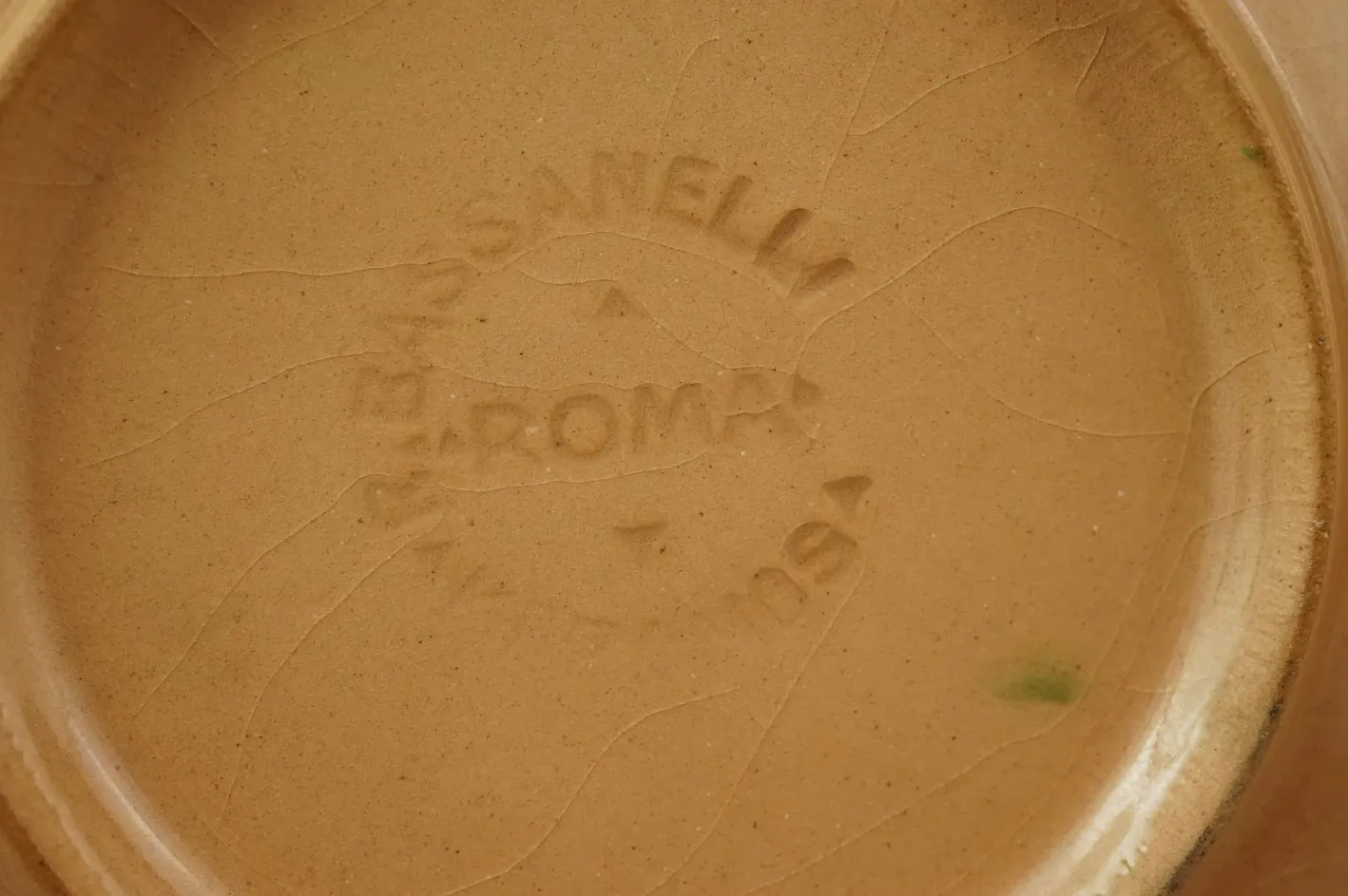
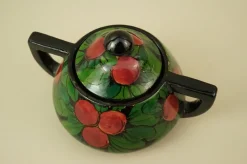
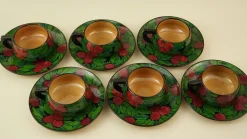
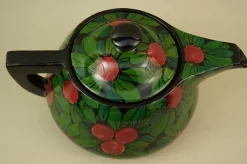
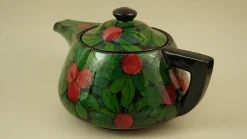
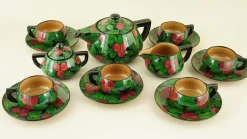
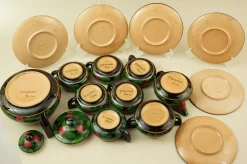
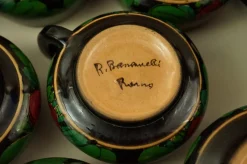
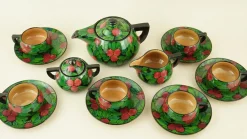
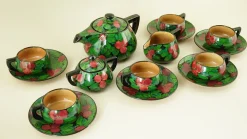
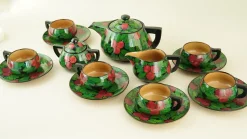
Beautiful glazed ceramic tea set, entirely decorated by hand, consisting of 6 cups with saucers, teapot, milk jug, and sugar bowl, for a total of 15 pieces, signed and made by Renato Bassanelli for his „Keramos“ factory in Rome. The set is entirely decorated with an airbrush with red leaves and flowers on a black background, while the inside of the pieces is decorated in light brown. The glazes used are of high quality, rich in feldspars, which have made the vitrification particularly brilliant. The set is made in full futurist style, and the shape of the teapot, sugar bowl, milk jug, and cups is that of the ceramics of the Roman Secession.
Useful information for evaluating the item:
Our internet research shows that Renato Bassanelli’s ceramics, in addition to boasting considerable auction results, are offered on other leading online art sales sites for €200-300, with larger and more important ceramics fetching as much as €2,000-3,000. For ceramic services, on the other hand, prices range from €400-500 for the smallest and least elaborate items to €1,200-1,500 for the largest and most important services. This service features very rich and complex decoration, is complete and consists of 15 pieces in total, and is certainly one of the most valuable pieces created by the artist.
Information about the artist and/or manufacturer:
Renato Bassanelli was born in 1896 in Civita Castellana (VT), where he attended the Regia Scuola Professionale di Ceramica (Royal Professional School of Ceramics), graduating as a Master of Arts in 1918. In 1919, he moved to Rome and obtained a concession from the Ministry of Education for some premises in Vicolo della Rupe Tarpea, where he set up a kiln, the „Keramos Ceramiche d’Arte,“ in which, with the collaboration of some workers and the contribution of his artist friends, including Domenico Mastroianni, he began producing artistic ceramics. In 1923, he exhibited some of his works at the First Roman Exhibition of Industry, Agriculture, and Applied Arts, held in the gardens of Villa Borghese in Rome, winning a gold medal. In 1924, he participated in the International Exhibition in Brussels. In 1928, Bassanelli was forced to vacate his premises due to building demolitions ordered by the regime and moved to Biella where, in 1929, he founded „S.A.C.B.“ (Società Anonima Ceramiche Biellesi) and, in the same year, he collaborated in the foundation and start-up of the „C.A.A.R.“ factory in Ronco Biellese. The production up to the 1930s is perhaps the most decorative and rich in particularly imaginative and evocative color combinations. In 1930, he presented several vases inspired by Etruscan and Renaissance culture at the Triennale di Arti Decorative in Monza, in the E.N.A.P.I. (Ente Nazionale per l’Artigianato e Piccole Imprese) section. These vases were designed by Tommaso Buzzi and signed with the graphic symbol of a rose. Another mark used during these years was „S.A.C.A.,“ which was easily confused with other similar marks used during the same period by other Italian ceramic manufacturers. In 1933, he exhibited at the Triennale in Milan. Back in Rome, he opened a studio first in Via Mondovì, then in Via Fregene and again in Via Baccarini, dedicating himself to the production of unique pieces of great stylistic and technical quality. In 1932, he was appointed director of the ceramics schools in Frosinone, Pontecorvo Arpino, and Ceprano. In 1936, he was appointed expert of the Ministry of Corporations and Industry. In 1937, he exhibited at the VII National Craft Exhibition in Florence. After World War II, he held the position of artistic director of the „Industria Ceramica Umbra“ in Città di Castello for two years. From 1949, for two years, he was artistic director of the „Ceramiche Bassanello“ factory owned by Marquis Misciattelli. In 1951, he opened a studio in Rome at Via Sorano 5, called „Bassanelli Ceramiche,“ which remained active until 1970, where he devoted himself mainly to the creation of unique pieces. Renato Bassanelli died in Rome in 1973.
MASSNAHMEN:
Teekanne: Höhe: 12 cm; Breite: 22,5 cm; Tiefe: 15 cm;
Milchkännchen: Höhe: 7 cm; Breite: 15 cm; Tiefe: 10 cm;
Zuckerdose: Höhe: 9 cm; Breite: 14 cm; Tiefe: 11 cm;
Tasse: Höhe: 5 cm; Breite: 11 cm; Tiefe: 9 cm;
Untertasse: Höhe: 2 cm; Durchmesser: 15,8 cm;
Gesamtgewicht des Sets: 2.077 kg.
Beschreibung des Artikels:
Wunderschönes Teeservice aus glasierter Keramik, vollständig von Hand dekoriert, bestehend aus 6 Tassen mit Untertassen, Teekanne, Milchkännchen und Zuckerdose, insgesamt 15 Stück, signiert und hergestellt von Renato Bassanelli für seine Fabrik „Keramos“ in Rom. Das Set ist vollständig mit Airbrush mit roten Blättern und Blumen auf schwarzem Grund dekoriert, während die Innenseiten der Stücke in hellbraunem Dekor gehalten sind. Die verwendeten Glasuren sind von hoher Qualität und reich an Feldspat, was die Verglasung besonders brillant macht. Das Set ist ganz im futuristischen Stil gehalten, und die Form der Teekanne, der Zuckerdose, des Milchkännchens und der Tassen erinnert an die Keramik der römischen Sezession.
Nützliche Informationen zur Bewertung des Artikels:
Unsere Internetrecherche hat ergeben, dass die Keramiken von Renato Bassanelli nicht nur beachtliche Auktionsergebnisse erzielen, sondern auch auf anderen führenden Online-Kunstseiten für 200-300 € angeboten werden, wobei größere und bedeutendere Keramiken bis zu 2.000-3.000 € erzielen. Die Preise für keramische Service hingegen reichen von 400-500 € für die kleinsten und am wenigsten aufwendigen Stücke bis zu 1.200-1.500 € für die größten und bedeutendsten Services. Dieses Service weist eine sehr reiche und komplexe Dekoration auf, ist vollständig und besteht aus insgesamt 15 Teilen und ist sicherlich eines der wertvollsten Stücke, die der Künstler geschaffen hat.
Informationen über den Künstler und/oder den Hersteller:
Renato Bassanelli wurde 1896 in Civita Castellana (VT) geboren, wo er die Regia Scuola Professionale di Ceramica (Königliche Berufsschule für Keramik) besuchte, die er 1918 als Master of Arts abschloss. 1919 zog er nach Rom und erhielt vom Bildungsministerium eine Konzession für einige Räumlichkeiten im Vicolo della Rupe Tarpea, wo er einen Brennofen, die „Keramos Ceramiche d’Arte“, einrichtete, in dem er in Zusammenarbeit mit einigen Arbeitern und unter Mitwirkung seiner Künstlerfreunde, darunter Domenico Mastroianni, mit der Herstellung von Kunstkeramik begann. Im Jahr 1923 stellte er einige seiner Werke auf der Ersten Römischen Ausstellung für Industrie, Landwirtschaft und angewandte Kunst in den Gärten der Villa Borghese in Rom aus und gewann eine Goldmedaille. Im Jahr 1924 nahm er an der Internationalen Ausstellung in Brüssel teil. 1928 musste Bassanelli aufgrund der vom Regime angeordneten Gebäudeabrisse seine Geschäftsräume räumen und zog nach Biella, wo er 1929 die „S.A.C.B.“ gründete (Società Anonima Ceramiche Biellesi) gründete und im selben Jahr an der Gründung und Inbetriebnahme der Fabrik „C.A.A.R.“ in Ronco Biellese beteiligt war. Die Produktion bis zu den 1930er Jahren ist vielleicht die dekorativste und reich an besonders fantasievollen und eindrucksvollen Farbkombinationen. 1930 stellte er auf der Triennale di Arti Decorative in Monza in der Sektion E.N.A.P.I. (Ente Nazionale per l’Artigianato e Piccole Imprese) mehrere Vasen vor, die von der Kultur der Etrusker und der Renaissance inspiriert waren. Diese Vasen wurden von Tommaso Buzzi entworfen und mit dem grafischen Symbol einer Rose signiert. Eine weitere Marke, die in diesen Jahren verwendet wurde, war „S.A.C.A.“, die leicht mit anderen ähnlichen Marken verwechselt werden konnte, die im gleichen Zeitraum von anderen italienischen Keramikherstellern verwendet wurden. Im Jahr 1933 stellte er auf der Triennale in Mailand aus. Zurück in Rom eröffnete er ein Atelier zunächst in der Via Mondovì, dann in der Via Fregene und schließlich in der Via Baccarini und widmete sich der Herstellung von Einzelstücken von großer stilistischer und technischer Qualität. Im Jahr 1932 wurde er zum Direktor der Keramikschulen in Frosinone, Pontecorvo Arpino und Ceprano ernannt. Im Jahr 1936 wurde er zum Experten des Ministeriums für Unternehmen und Industrie ernannt. Im Jahr 1937 stellte er auf der VII. Nationalen Handwerksausstellung in Florenz aus. Nach dem Zweiten Weltkrieg war er zwei Jahre lang künstlerischer Leiter der „Industria Ceramica Umbra“ in Città di Castello. Ab 1949 war er zwei Jahre lang künstlerischer Leiter der Fabrik „Ceramiche Bassanello“, die dem Marquis Misciattelli gehörte. 1951 eröffnete er in Rom in der Via Sorano 5 ein Atelier mit dem Namen „Bassanelli Ceramiche“, das er bis 1970 betrieb und in dem er sich hauptsächlich der Herstellung von Einzelstücken widmete. Renato Bassanelli stirbt 1973 in Rom.
Klicken Sie hier für die vollständige BeschreibungSchließen
| Kreateur | Renato Bassanelli |
|---|---|
| Hersteller | Keramos |
| Design Epoche | 1920 bis 1949 |
| Produktionszeitraum | 1920 bis 1929 |
| Hergestellt in | Italien |
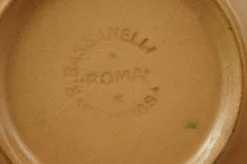
| Kennzeichnung vorhanden | Dieses Stück verfügt über eine Kennzeichnung |
| Stil | Futurist |
| Zustand | Ausgezeichnet — Dieses Vintage/antike Objekt ist in nahezu originalem Zustand. Es kann minimale Gebrauchsspuren und/oder kleinere Restaurierungen aufweisen. |
| Artikelnummer | LXG-2185783 |
| Details über Schäden und Restaurierungen |
Ausgezeichneter Gesamtzustand.
Ottime condizioni generali.
Automatisch generierte Übersetzung |
| Material | Keramik |
| Farbe | Mehrfarbig |
| Breite | 23 cm 22.5 cm |
| Tiefe | 15 cm 15 cm |
| Höhe | 12 cm 12 cm |
Be the first to review “Futuristisches Keramik Teeservice von Renato Bassanelli für Keramos, Rome, Italy, 1920er, 15 Set”
Related products
Architektonische Elemente
Dekoration

Dekoration
Dekoration
Dekoration
Besteck & Servierbesteck
Dekoration
Reviews
There are no reviews yet.