
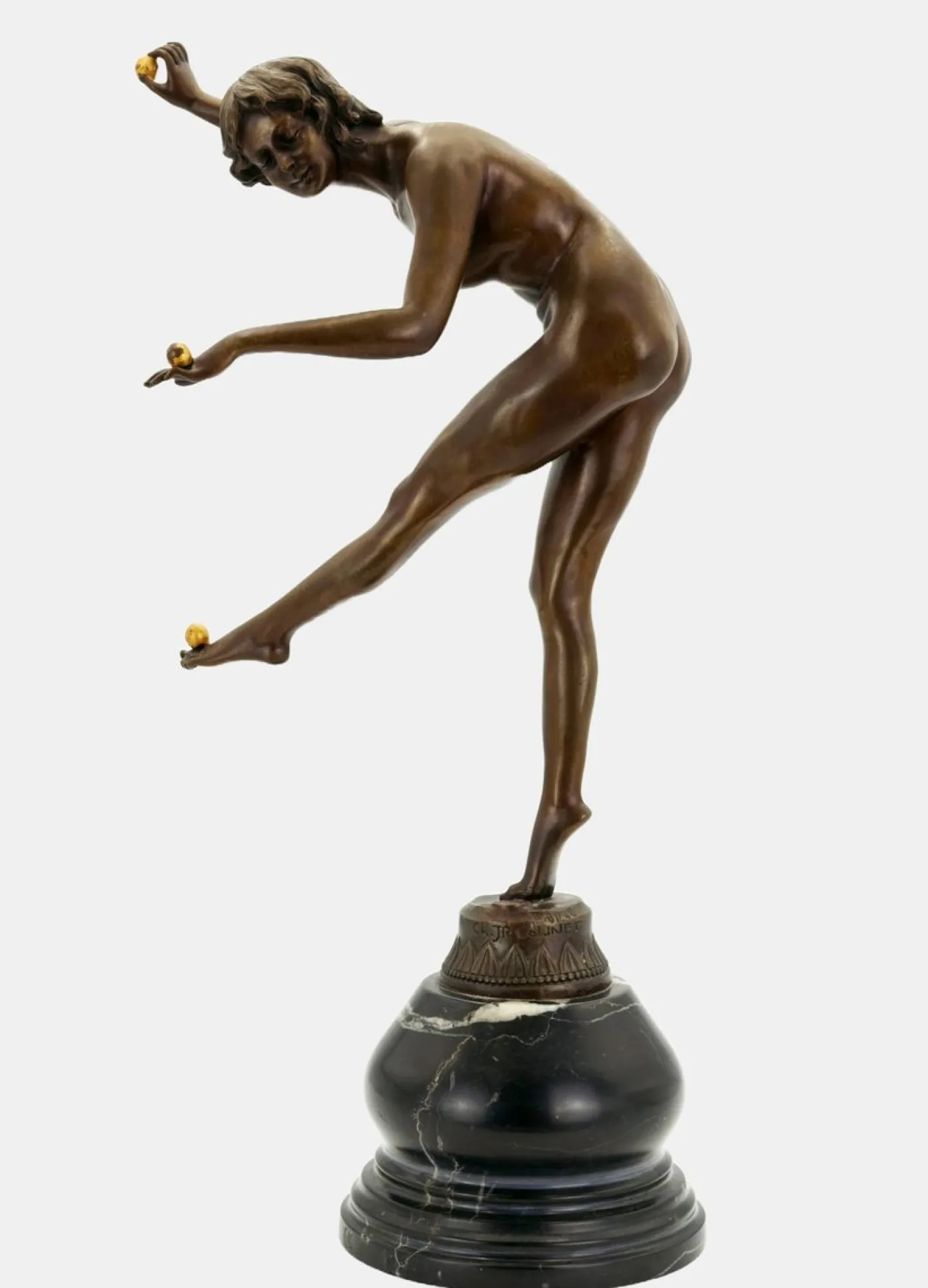
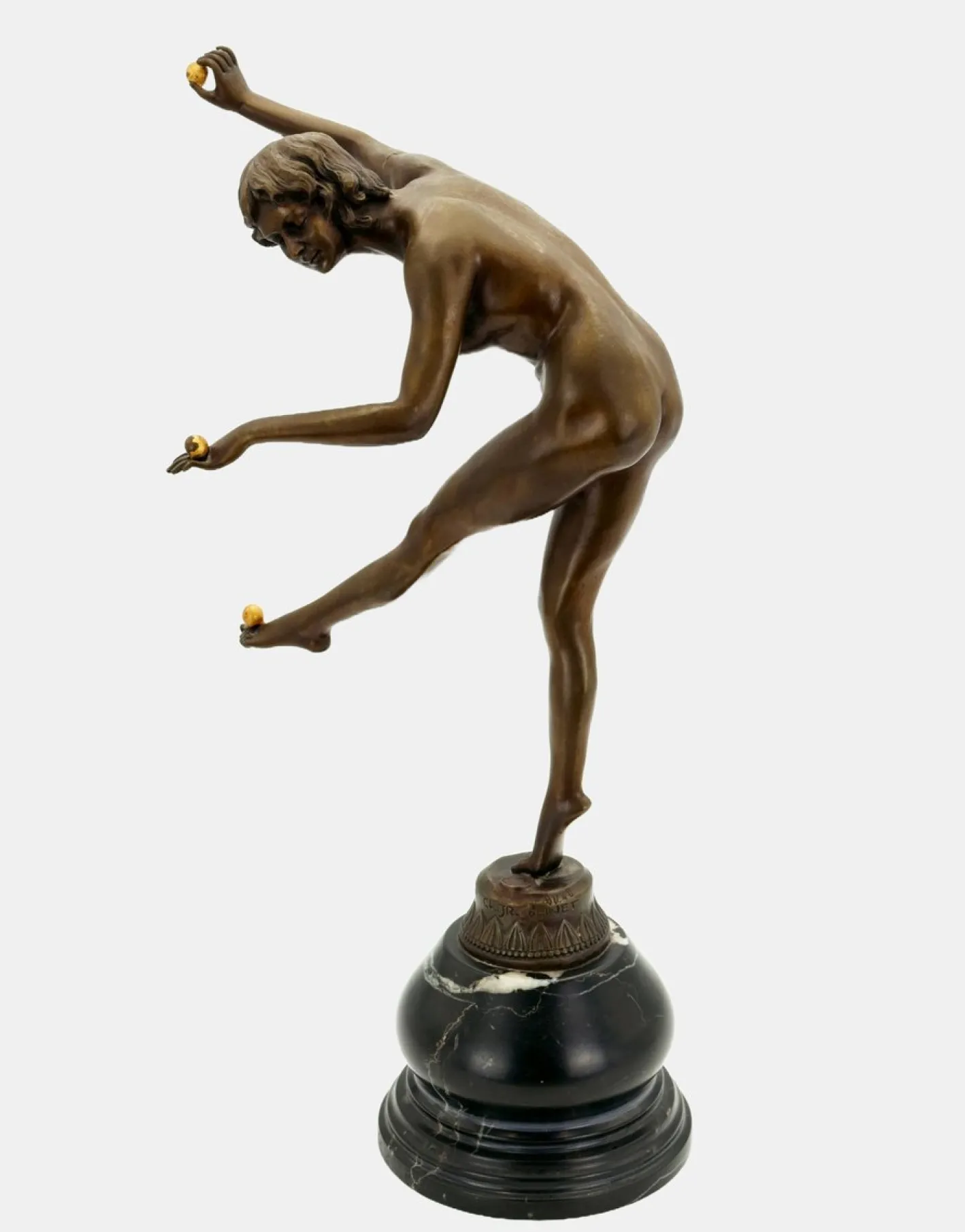
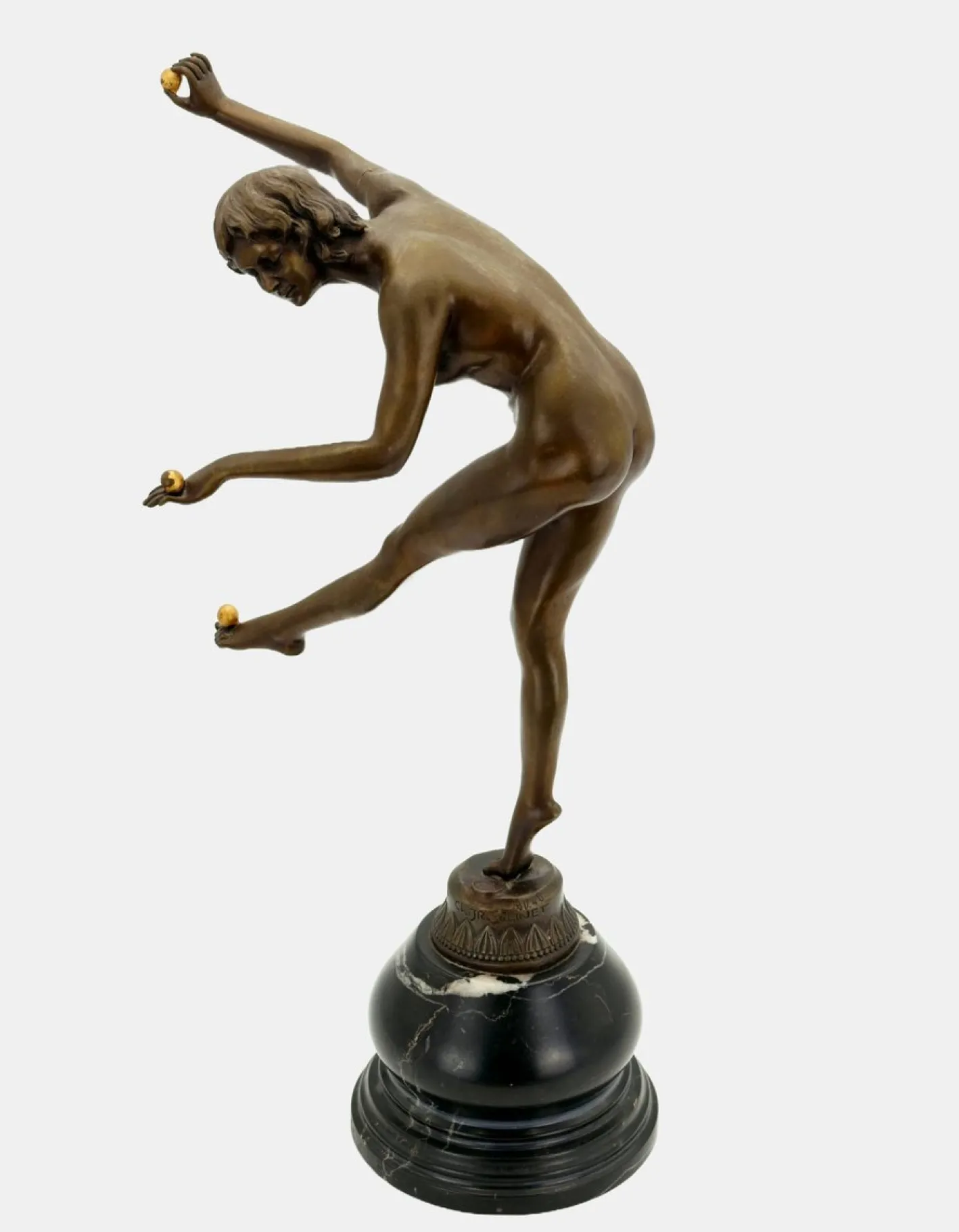
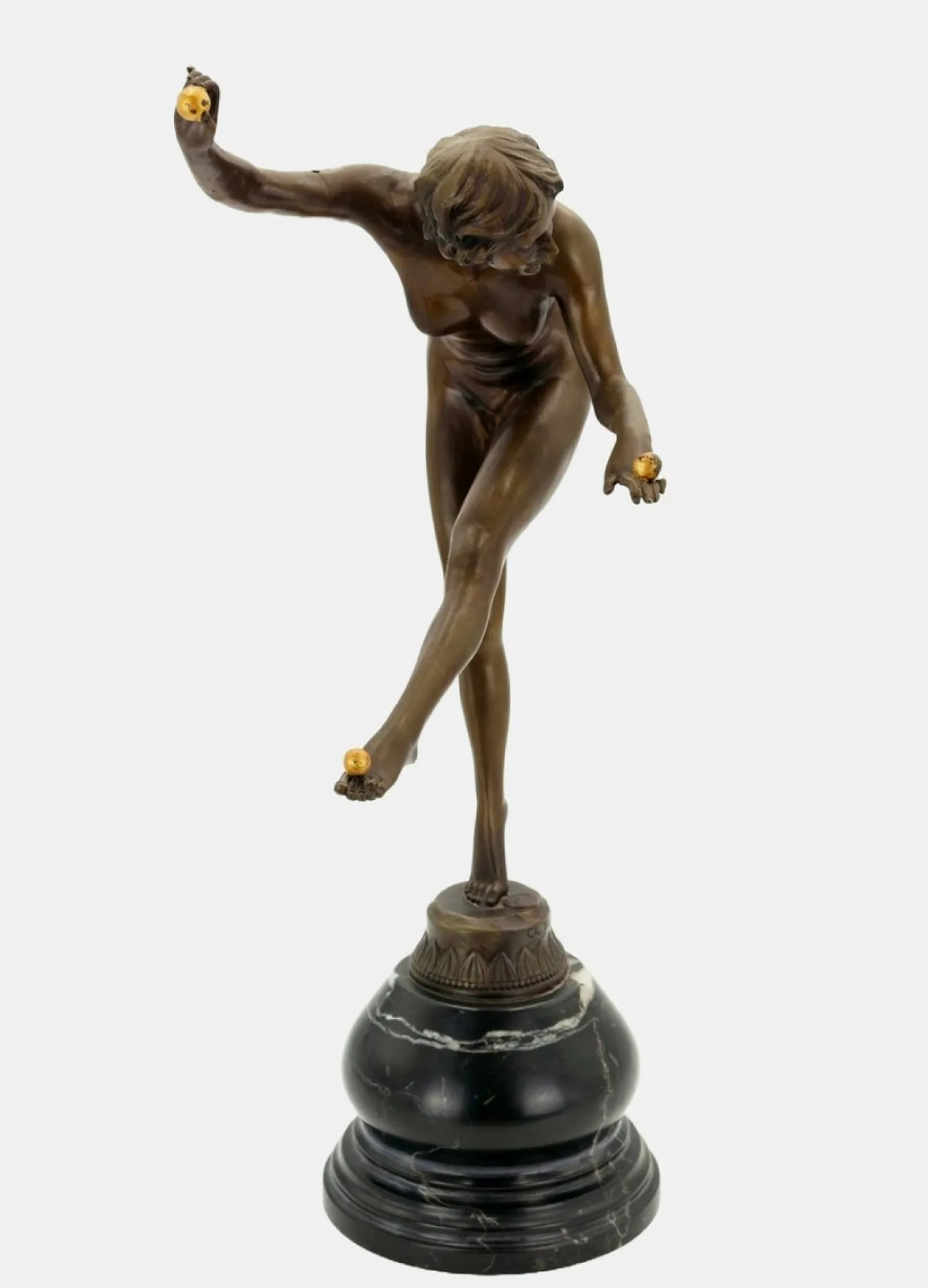
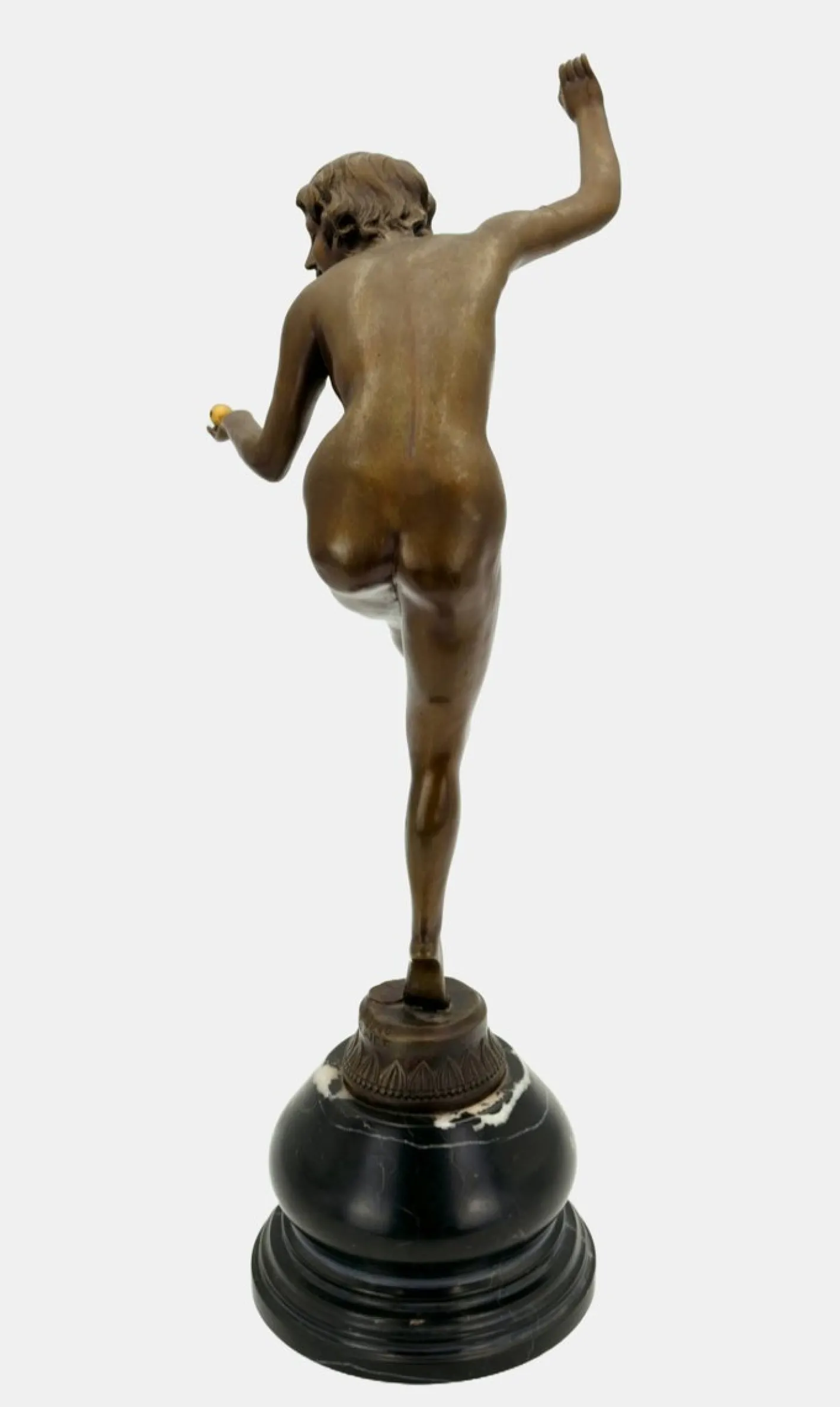
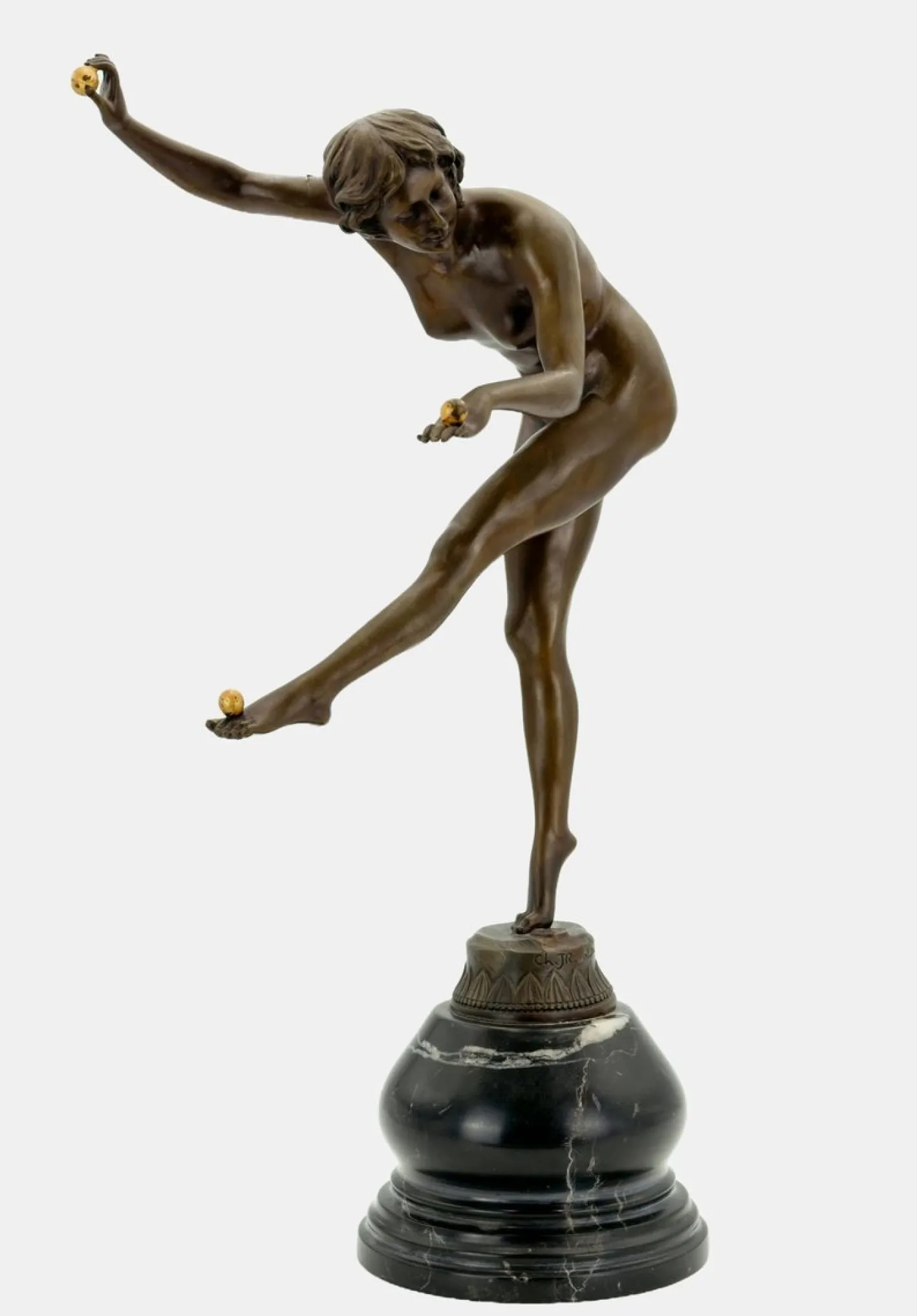
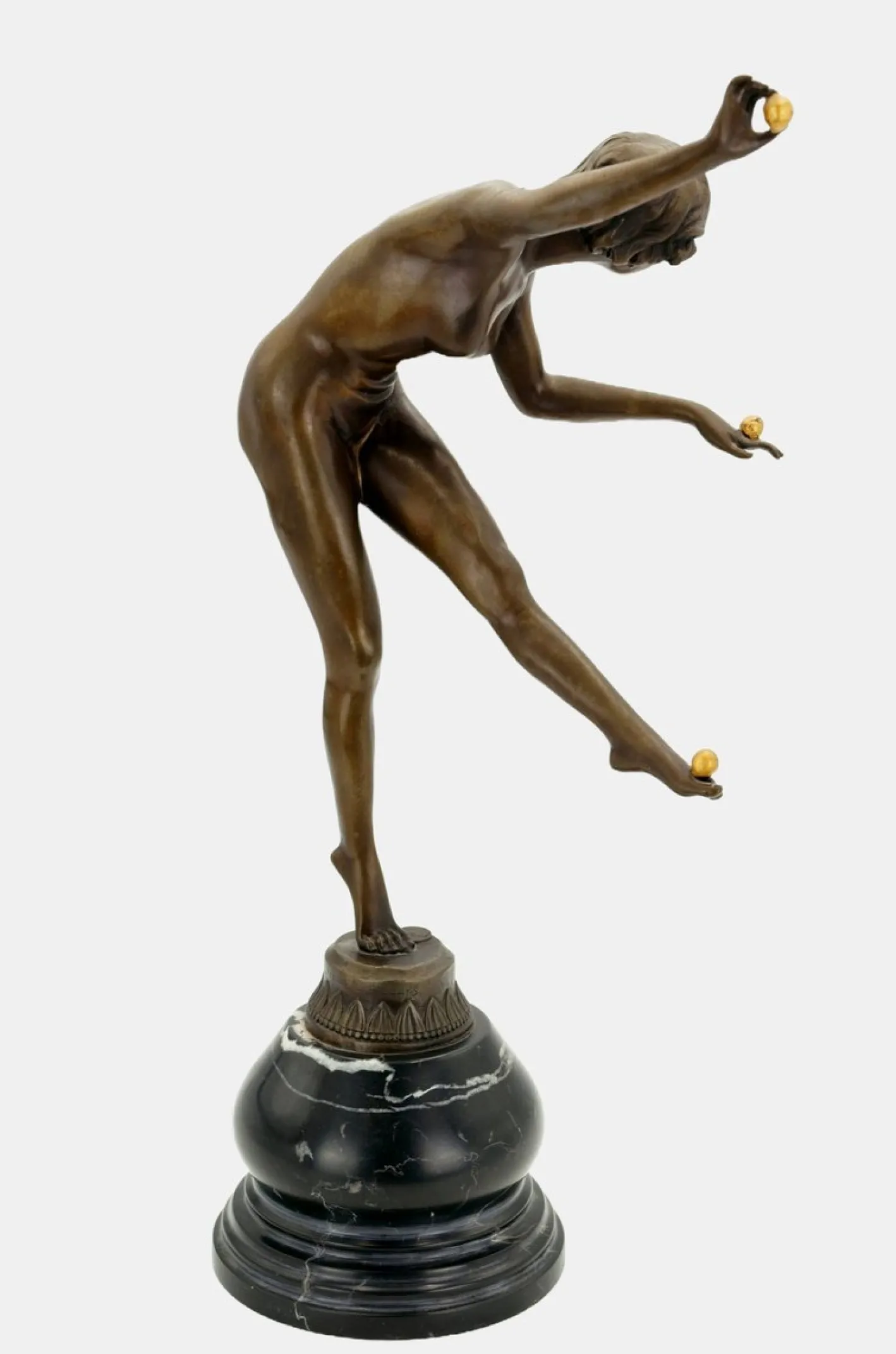
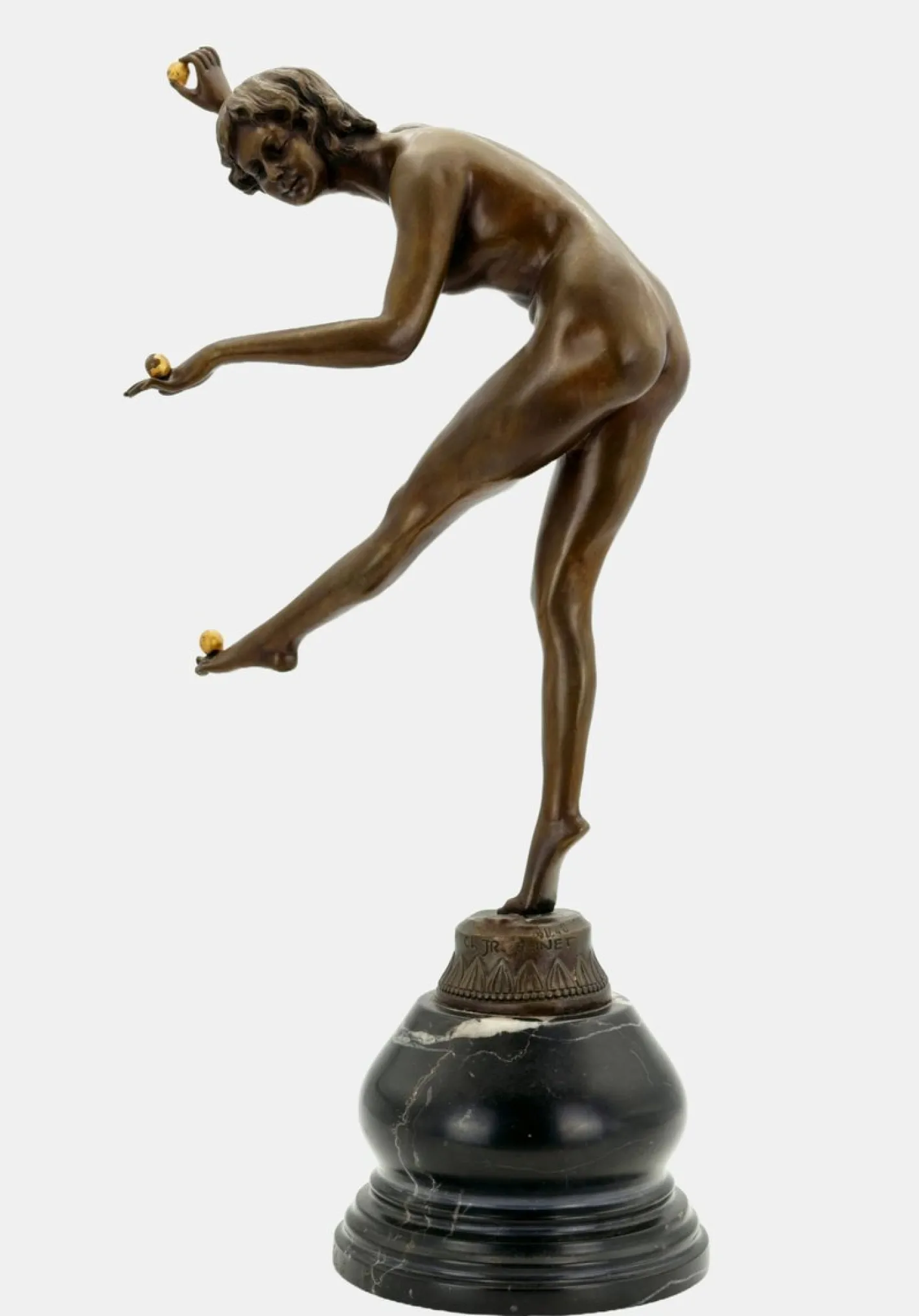
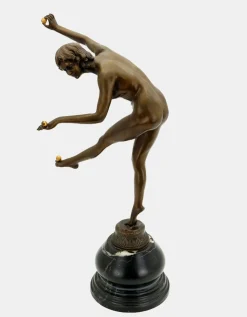
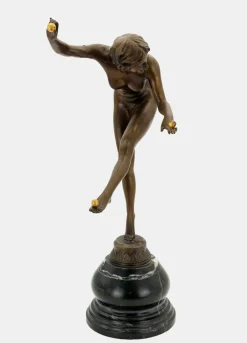
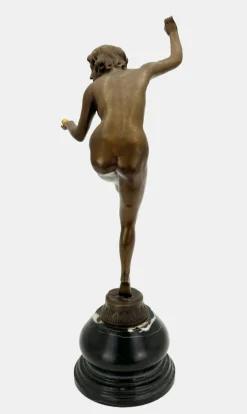
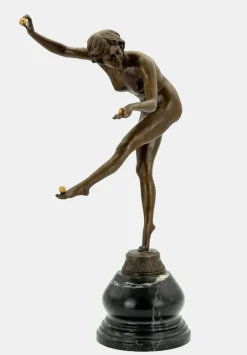
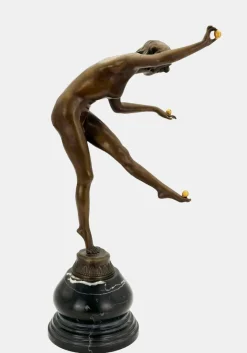
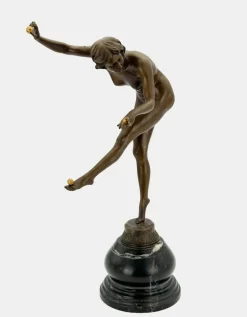
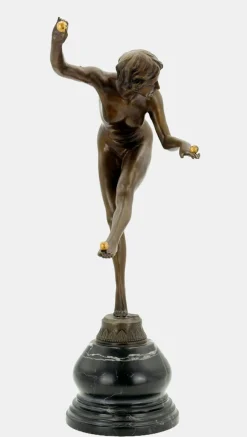
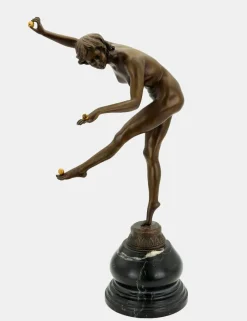
Claire Jeanne Robertine Colinet, Jongleur, 1920er, Bronze
€112.65
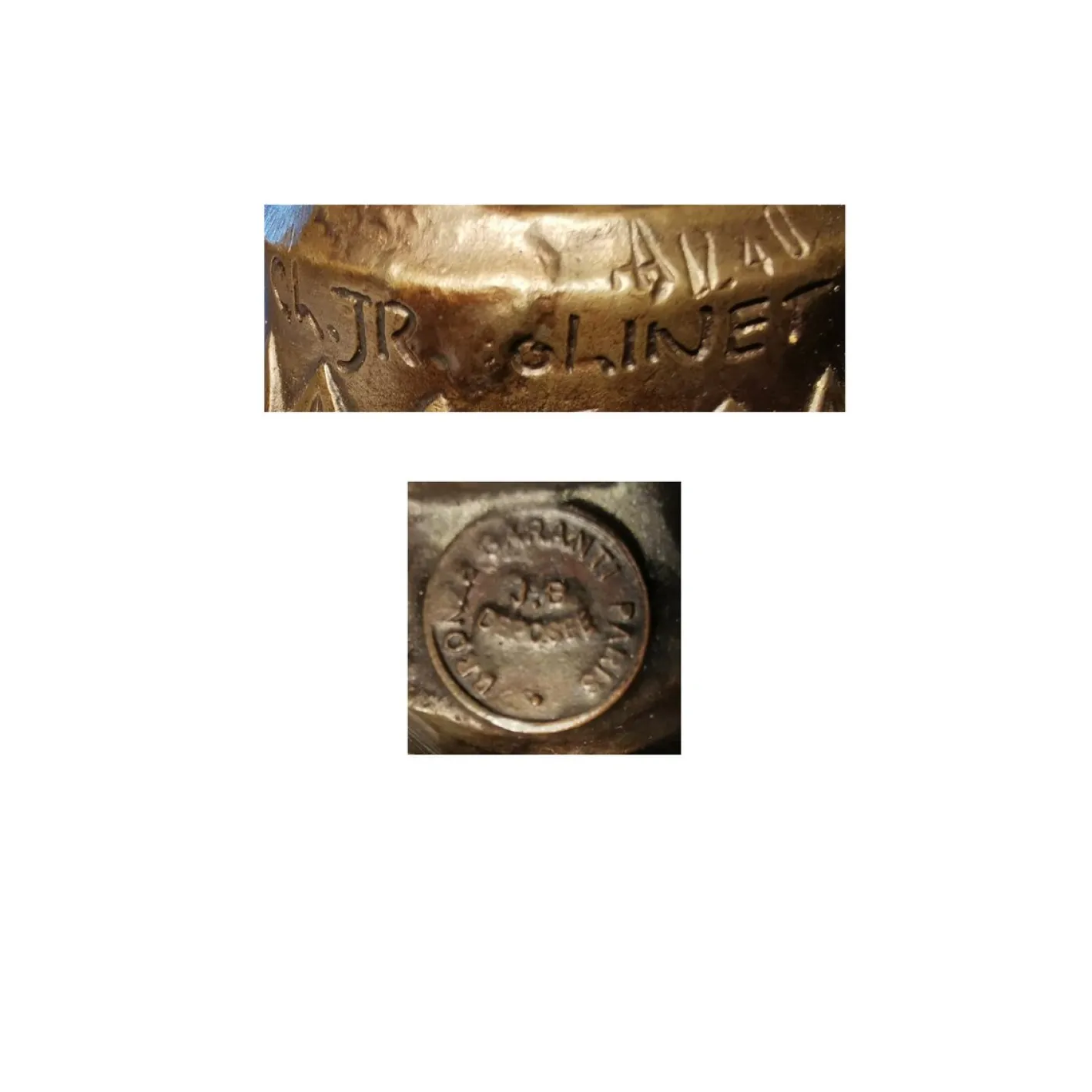
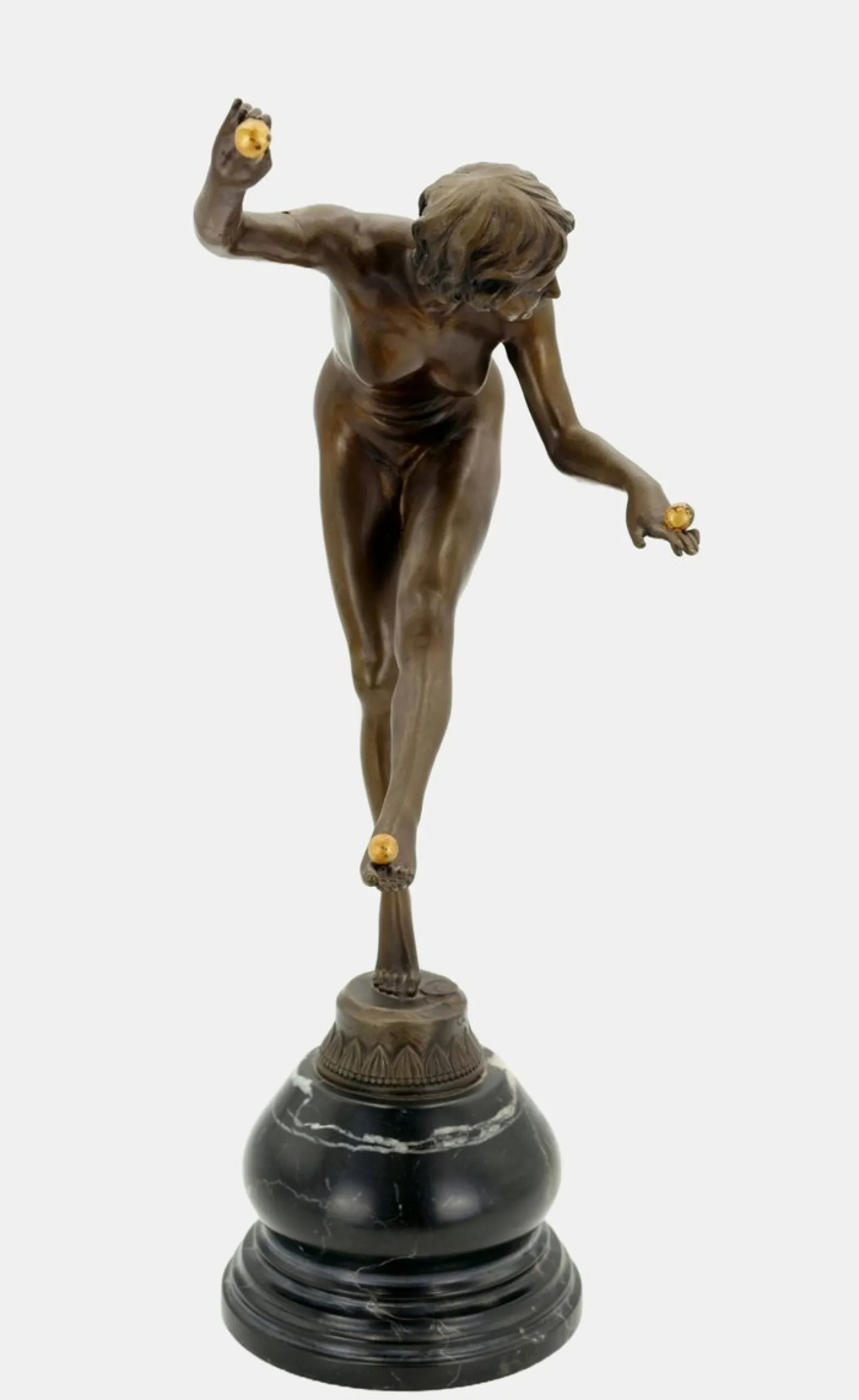
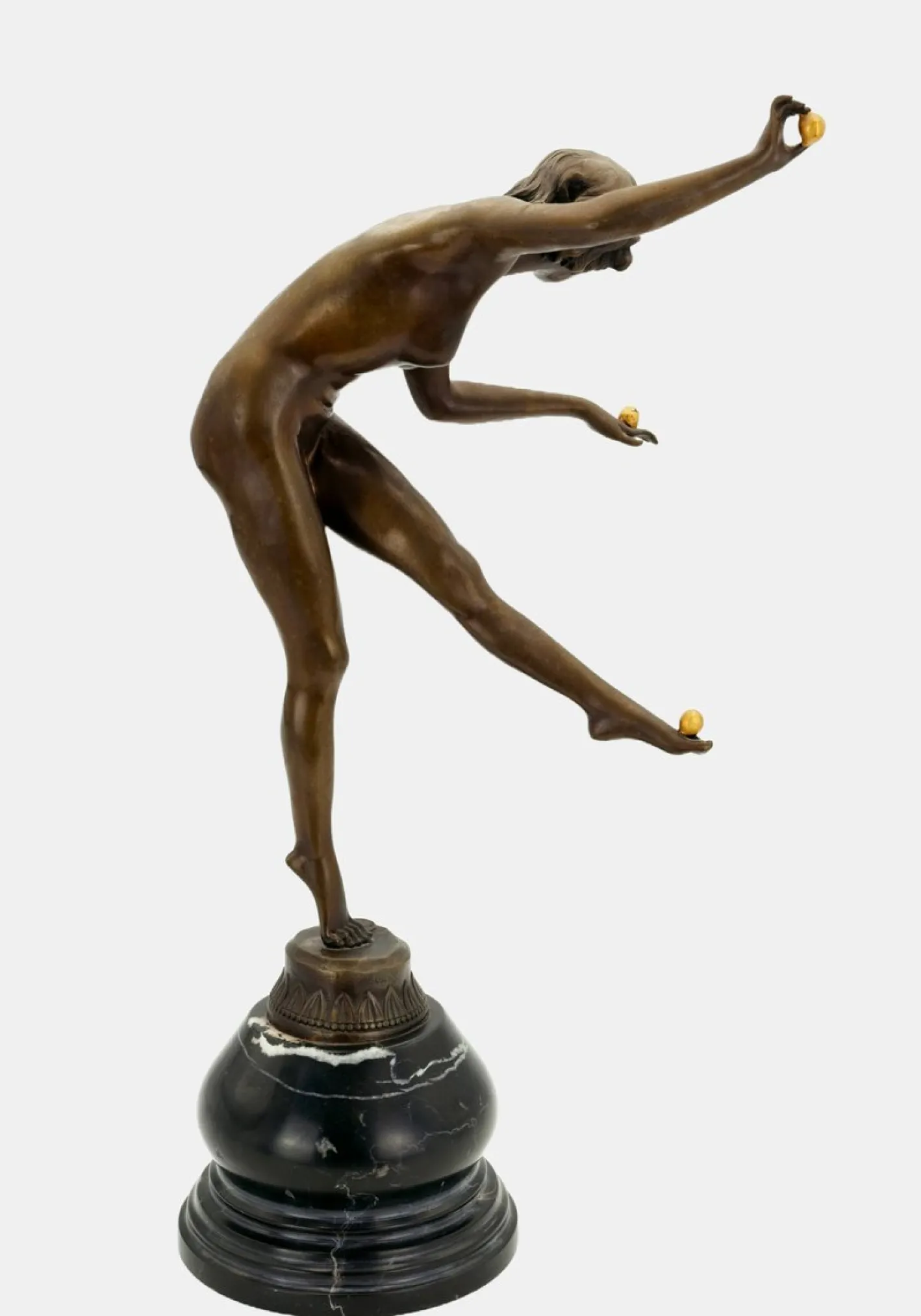
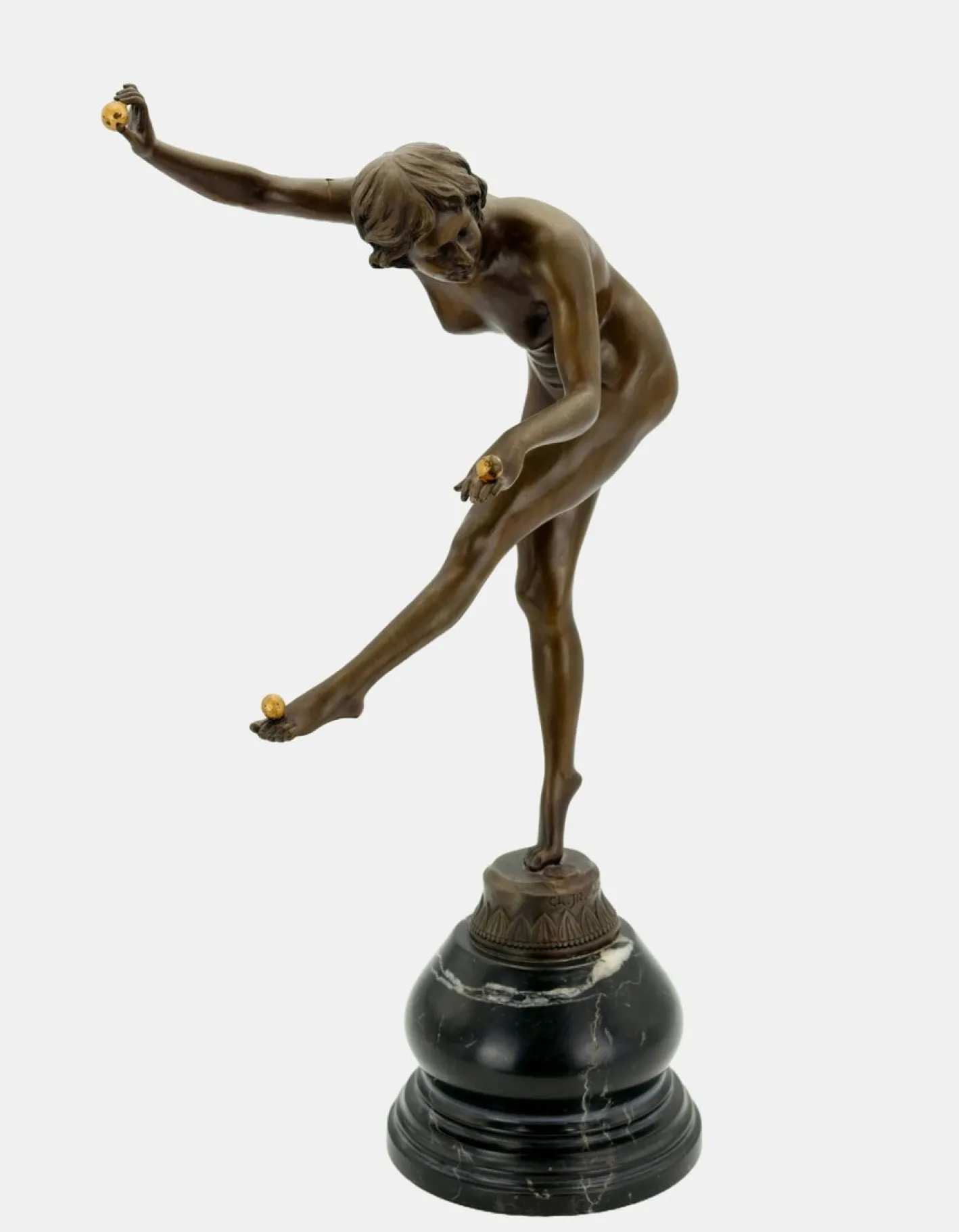
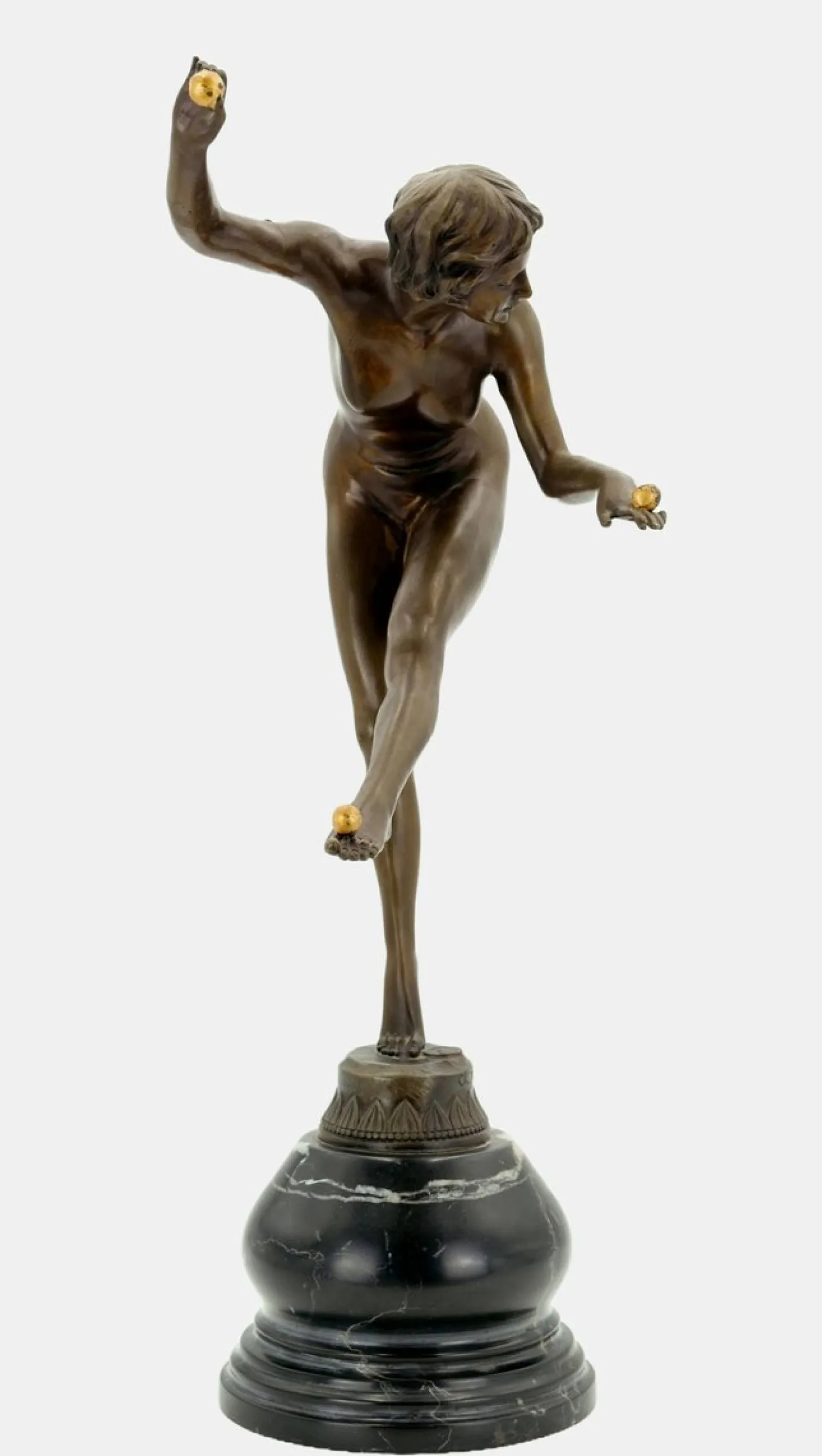
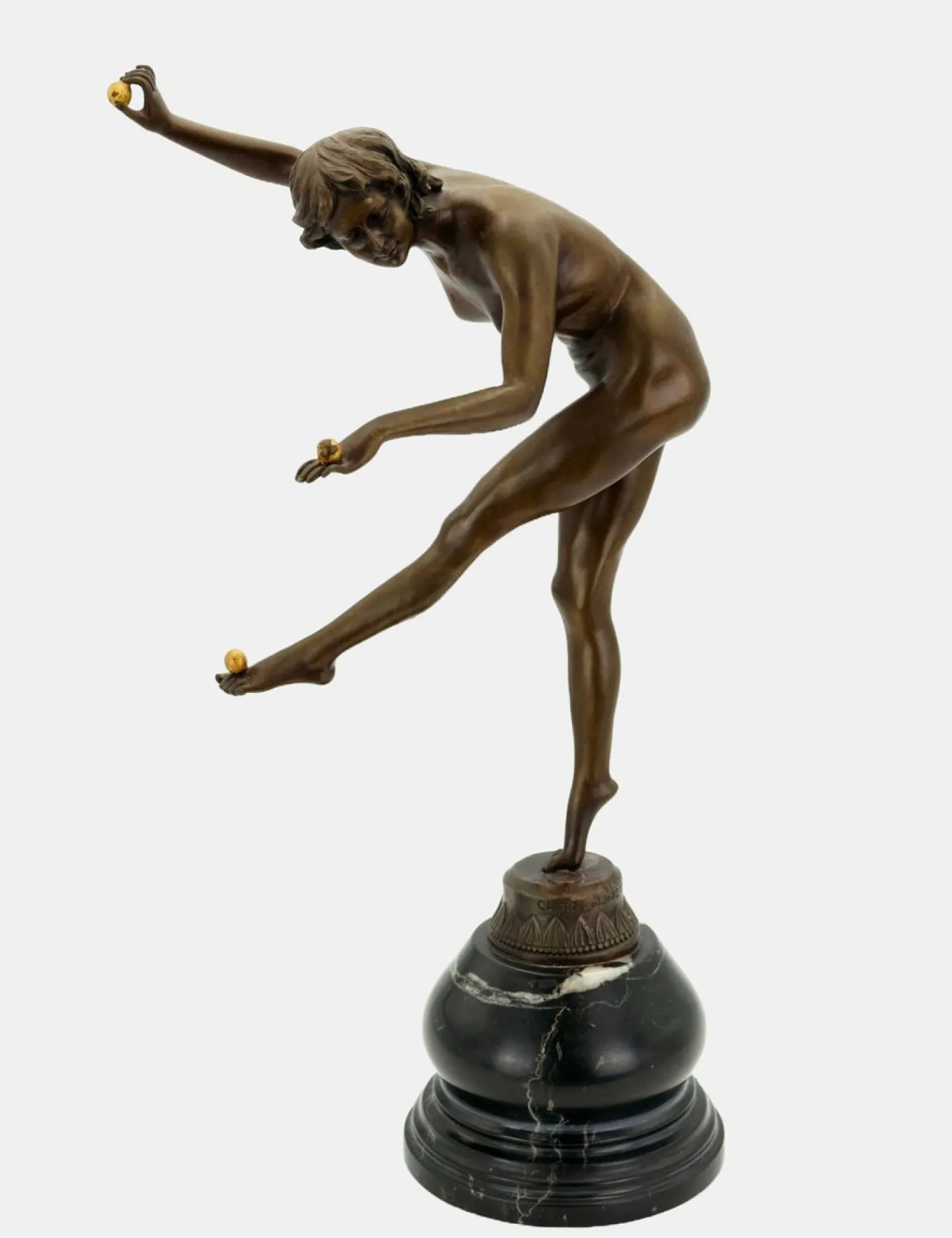
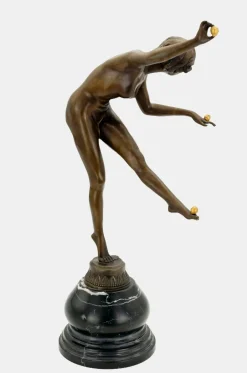
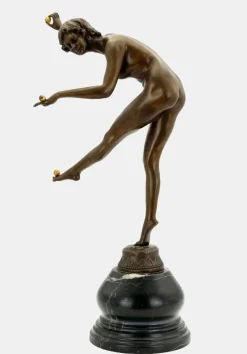
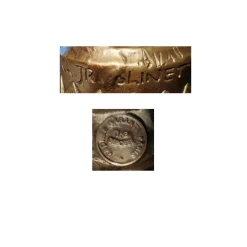
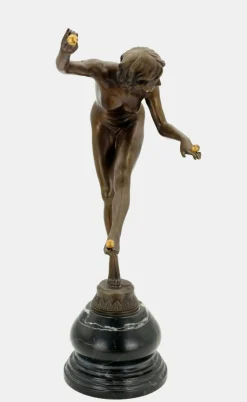
Claire Jeanne Robertine Colinet (1880 Brussels – 1950 Asnières-sur-Seine), Juggler, around 1920. Brownish patinated bronze with gilded balls on a round, multi-profiled stone base (10 cm high). 47 cm (total height) x 20 cm (width) x 25 cm (depth), weight 5.7 kg. Inscribed on the plinth “CL. JR. COLINET” on the plinth, numbered and with the foundry mark ‘J. B. Deposee, Paris’.
– Gilding on the balls partially lost, patina somewhat rubbed in places, hairline crack on the upper part of the left arm
– Artistic naturalness –
Balancing on one toe only, the naked beauty performs an acrobatic dance figuration with three golden balls. The posture of the fingers and toes shows the necessary body tension, yet the movement appears completely natural, as if it were performed by itself. It was precisely this effect of seemingly natural artificiality that the Italian Renaissance hailed as the highest art. Although the bronze figure itself does not move, when viewed from different perspectives, it performs an expansive choreography that unfolds with the grace of a juggling dancer. Her nearly closed eyes lend the movement a fluid, dreamlike quality, so that the harmonious movement seems to be a direct expression of her inner self.
About the artist
Claire Jeanne Robertine Colinet was a student of Jef Lambeaux in Brussels and subsequently worked as an independent sculptor. from 1913, she exhibited regularly at the Salon of the “Société des Artistes Français”. Her dancing, animated female figures made her an esteemed artist.
Claire Jeanne Robertine Colinet (1880 Brussels – 1950 Asnières-sur-Seine), Juggler, around 1920. Brownish patinated bronze with gilded balls on a round, multi-profiled stone base (10 cm high). 47 cm (total height) x 20 cm (width) x 25 cm (depth), weight 5.7 kg. Inscribed on the plinth “CL. JR. COLINET” on the plinth, numbered and with the foundry mark ‘J. B. Deposee, Paris’.
– Gilding on the balls partially lost, patina somewhat rubbed in places, hairline crack on the upper part of the left arm
– Artistic naturalness –
Balancing on one toe only, the naked beauty performs an acrobatic dance figuration with three golden balls. The posture of the fingers and toes shows the necessary body tension, yet the movement appears completely natural, as if it were performed by itself. It was precisely this effect of seemingly natural artificiality that the Italian Renaissance hailed as the highest art. Although the bronze figure itself does not move, when viewed from different perspectives, it performs an expansive choreography that unfolds with the grace of a juggling dancer. Her nearly closed eyes lend the movement a fluid, dreamlike quality, so that the harmonious movement seems to be a direct expression of her inner self.
About the artist
Claire Jeanne Robertine Colinet was a student of Jef Lambeaux in Brussels and subsequently worked as an independent sculptor. From 1913, she exhibited regularly at the Salon of the “Société des Artistes Français”. Her dancing, animated female figures made her an esteemed artist.
GERMAN VERSION
Claire Jeanne Robertine Colinet (1880 Brüssel – 1950 Asnières-sur-Seine), Jongleuse, um 1920. Bräunlich patinierte Bronze mit vergoldeten Bällen auf rundem mehrfach profilierten Steinsockel (10 cm Höhe). 47 cm (Gesamthöhe) x 20 cm (Breite) x 25 cm (Tiefe), Gewicht 5,7 kg. Auf der Plinthe mit „CL. JR. COLINET“ signiert, nummeriert und der Gießereimarke „J. B. Deposee, Paris“ versehen.
– Vergoldung der Bälle teilweise verloren, Patina mitunter etwas berieben, Oberseite des linken Armes mit Haarriss
– Kunstvolle Natürlichkeit –
Einzig auf einer Zehenspitze balancierend, vollführt die nackte Schönheit eine akrobatisch-tänzerische Figuration mit drei goldenen Bällen. Dabei ist der Haltung der Finger und Zehen die dazu notwenige Körperspannung abzulesen und doch wirkt die Bewegung ganz natürlich, als ob sie wie von selbst vollzogen werden würde. Gerade diese Wirkung einer wie natürlich erscheinenden Artifizialität wurde von der italienischen Renaissance als höchste Kunst gerühmt. Obwohl sich die Bronzefigur selbst nicht bewegt, vollführt sie bei ihrer Wahrnehmung aus verschiedenen Perspektiven doch eine raumgreifendende Choreographie, die die Grazie der jonglierenden Tänzerin entfaltet. Ihre nahezu geschlossenen Augen verleihen der Bewegung etwas Fließend-Träumerisches, so dass die harmonische Bewegung der unmittelbare Ausdruck ihren Inneren zu sein scheint.
zur Künstlerin
Claire Jeanne Robertine Colinet war in Brüssel Schülerin von Jef Lambeaux und anschließend als selbstständige Bildhauerin tätig. Ab 1913 stellte sie regelmäßig im Salon der „Société des Artistes Français“ aus. Ihre tänzerisch-bewegten Frauenfiguren ließen sie zur geschätzten Künstlerin werden.
Klicken Sie hier für die vollständige BeschreibungSchließen
| Epoche | 1920 bis 1949 |
|---|---|
| Produktionszeitraum | 1920 bis 1929 |
| Hergestellt in | Frankreich |
| Stil | Belgian |
| Zustand | Gut — Dieser Vintage/antike Artikel kann einige Gebrauchsspuren wie Kratzer und andere Zeichen der Zeit aufweisen. |
| Details über Schäden und Restaurierungen |
Starke Gebrauchsspuren, Vergoldung an den Kugeln teilweise verloren, Patina stellenweise etwas berieben, Haarriss am linken Oberarm
Gilding on the balls partially lost, Patina somewhat rubbed in places, Hairline crack on upper left arm
Automatisch generierte Übersetzung |
| Artikelnummer | TPH-2077979 |
| Material | Bronze |
| Farbe | Braun |
| Breite | 20 cm 20 cm |
| Tiefe | 25 cm 25 cm |
| Höhe | 47 cm 47 cm |
Be the first to review “Claire Jeanne Robertine Colinet, Jongleur, 1920er, Bronze”
Related products



Druckgraphiken Und Multiples
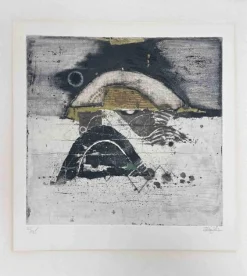
Johnny Friedlaender, Edition von 135 ohne Titel, 1970er, Radierung

Reviews
There are no reviews yet.