
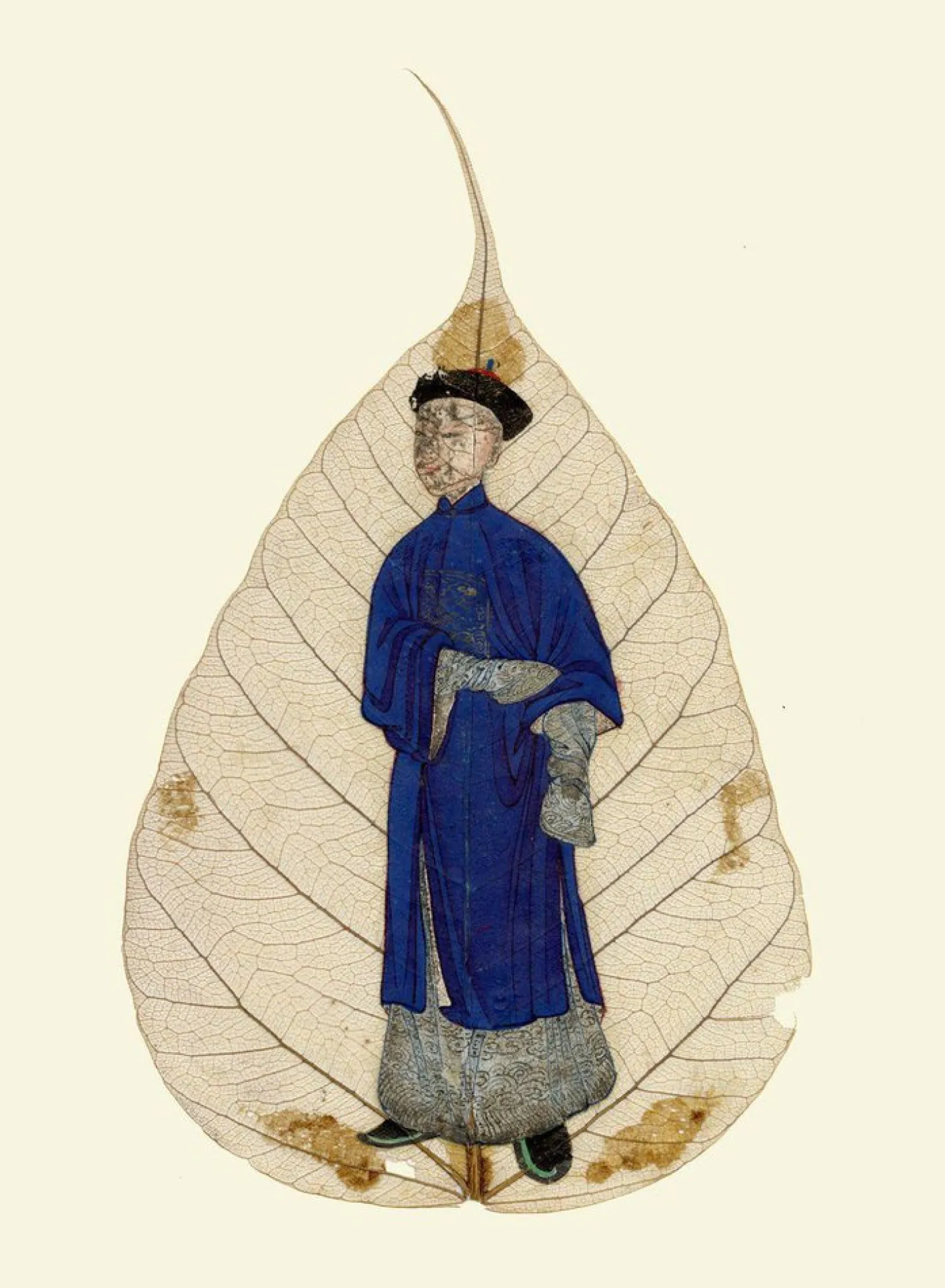
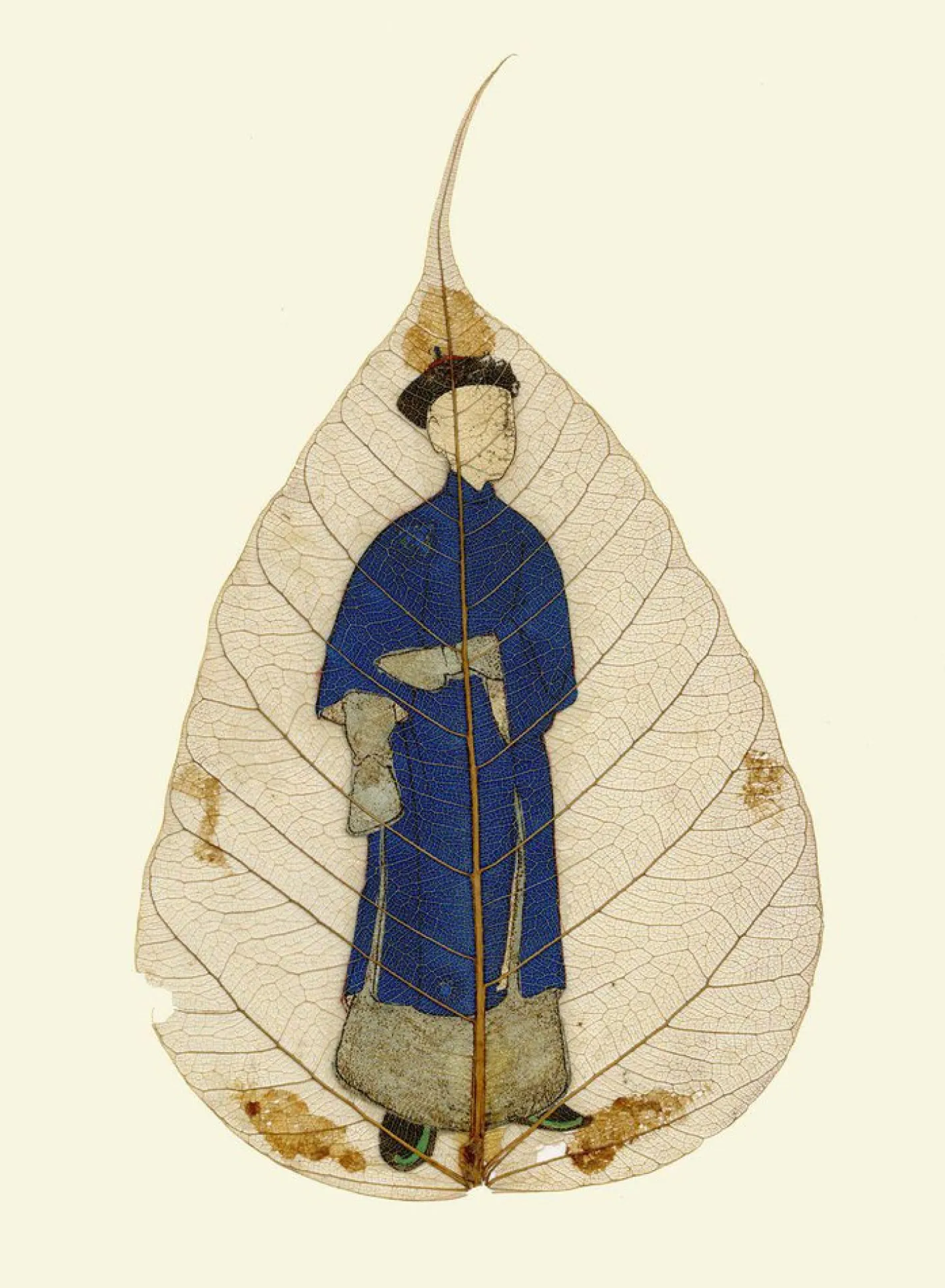
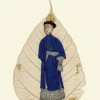
Chinesischer Künstler, kaiserlicher Beamter der Qing-Dynastie, Bodhi Peepal Blattmalerei, Ende 18. Jh.
Original price was: €200.38.€105.77Current price is: €105.77.
An original late 18th-century gouache painting on Bodhi leaf, Qing Dynasty Imperial Official.A particularly beautiful 18th-century Chinese painting on Bodhi leaf. The detail on the costume is exceptionally fine.This is one of a set of Chinese paintings on Bodhi leaf comprising figures of the Qing Dynasty court. The delicate painting style and fine facial features suggest that it was painted at the end of the 18th century, towards the end of the rule of Qianlong Emperor (1711–1799); a number of the male figures are bodyguards or officials of the Imperial court, wearing clothing that matches that of Qianlong Emperor’s staff.The peepal tree, otherwise known as sacred fig or Bodhi tree, is native to south-west China, Indochina and the Indian subcontinent. Its leaves form perfect, delicate, transparent skeletons once dried, and as such are uniquely suited to this art form. The skeleton would typically be varnished, before being painting with vivid, backgroundless genre scenes.Like Chinese paintings on pith, paintings on peepal leaves were produced for the export market in the late 18th and 19th century. By 1833 the monopoly of trade by the English East India Company had come to an end, opening the China trade to dozens of British companies and seeing the number of merchants and volume of trade flourish. Paintings were produced in port cities to meet increasingly high Western demands for Chinese souvenirs.Typically paintings on peepal leaves and on pith would depict attractive local subjects such as customs, costumes and trades, and indigenous flora and fauna. The painting style would combine a traditional Chinese approach of flattened sweeps of colour with aspects of Western influence in detail and realism.Please note that the leaf is loose and not mounted onto any backing.All artworks come with a Certificate of Authenticity and—if it is a collection artwork—its accompanying collection text or artist biography. Signed: No. Inscribed: No. Height: 18cm (7.1″) Width: 11cm (4.3″) Condition: Colours remain strong and vibrant. Slight cracking at the base of the central leaf vein, with a small hole to the left. Small staining patches due to historical glue, as shown. The white paint in the face area and to the paler clothing has oxidised causing some blackening.Please see photos for detail. Presented: Unframed.
Ein originales Gouache-Gemälde auf Bodhi-Blatt aus dem späten 18. Jahrhundert, ein kaiserlicher Beamter aus der Qing-Dynastie Ein besonders schönes chinesisches Gemälde auf Bodhi-Blatt aus dem 18. Es gehört zu einer Reihe von chinesischen Gemälden auf Bodhi-Blatt, die Figuren des Hofes der Qing-Dynastie zeigen. Der zarte Malstil und die feinen Gesichtszüge deuten darauf hin, dass es Ende des 18. Jahrhunderts, gegen Ende der Herrschaft des Kaisers Qianlong (1711-1799), gemalt wurde; einige der männlichen Figuren sind Leibwächter oder Beamte des kaiserlichen Hofes und tragen Kleidung, die zu der des Stabs des Kaisers Qianlong passt. Seine Blätter bilden nach dem Trocknen ein perfektes, zartes, transparentes Skelett und eignen sich daher besonders gut für diese Kunstform. Das Skelett wurde in der Regel lackiert, bevor es mit lebhaften, hintergrundlosen Genreszenen bemalt wurde. wie die chinesischen Bilder auf Mark wurden auch die Bilder auf Pepal-Blättern im späten 18. und 19. Jahrhundert für den Exportmarkt hergestellt. 1833 war das Handelsmonopol der englischen Ostindien-Kompanie zu Ende gegangen, was den Chinahandel für Dutzende britischer Unternehmen öffnete und die Zahl der Kaufleute und das Handelsvolumen ansteigen ließ. In den Hafenstädten wurden Gemälde hergestellt, um die steigende Nachfrage des Westens nach chinesischen Souvenirs zu befriedigen, wobei die Gemälde auf Peepal-Blättern und Markröhren in der Regel attraktive lokale Themen wie Bräuche, Trachten und Berufe sowie die einheimische Flora und Fauna darstellen. Alle Kunstwerke werden mit einem Echtheitszertifikat und – falls es sich um ein Sammlungskunstwerk handelt – mit dem dazugehörigen Sammlungstext oder der Künstlerbiografie geliefert. Signiert: Nein. Beschriftet: Nein. Höhe: 18cm (7,1″) Breite: 11cm (4,3″) Zustand: Die Farben sind kräftig und leuchtend. Leichte Risse an der Basis der zentralen Blattrippe, mit einem kleinen Loch auf der linken Seite. Kleine Flecken aufgrund von historischem Kleber, wie gezeigt. Die weiße Farbe im Gesichtsbereich und auf der helleren Kleidung ist oxidiert, was zu einer gewissen Schwärzung führt. Präsentiert: Ungerahmt.
Klicken Sie hier für die vollständige BeschreibungSchließen
| Produktionszeitraum | Vor 2010 |
|---|---|
| Hergestellt in | China |
| Stil | Chinese, Asian Antique |
| Zustand | Gut — Dieser Vintage/antike Artikel kann einige Gebrauchsspuren wie Kratzer und andere Zeichen der Zeit aufweisen. |
| Artikelnummer | XWO-2274634 |
| Material | Gouache |
| Farbe | Gold |
| Breite | 11 cm 11 cm |
| Höhe | 18 cm 18 cm |
| Gewicht | Standard — Zwischen 40kg und 80kg |
Be the first to review “Chinesischer Künstler, kaiserlicher Beamter der Qing-Dynastie, Bodhi Peepal Blattmalerei, Ende 18. Jh.”
Related products

Abstrakte Notizen
Jugendstil
Abstraction


Arbeiten Auf Papier
Reviews
There are no reviews yet.