
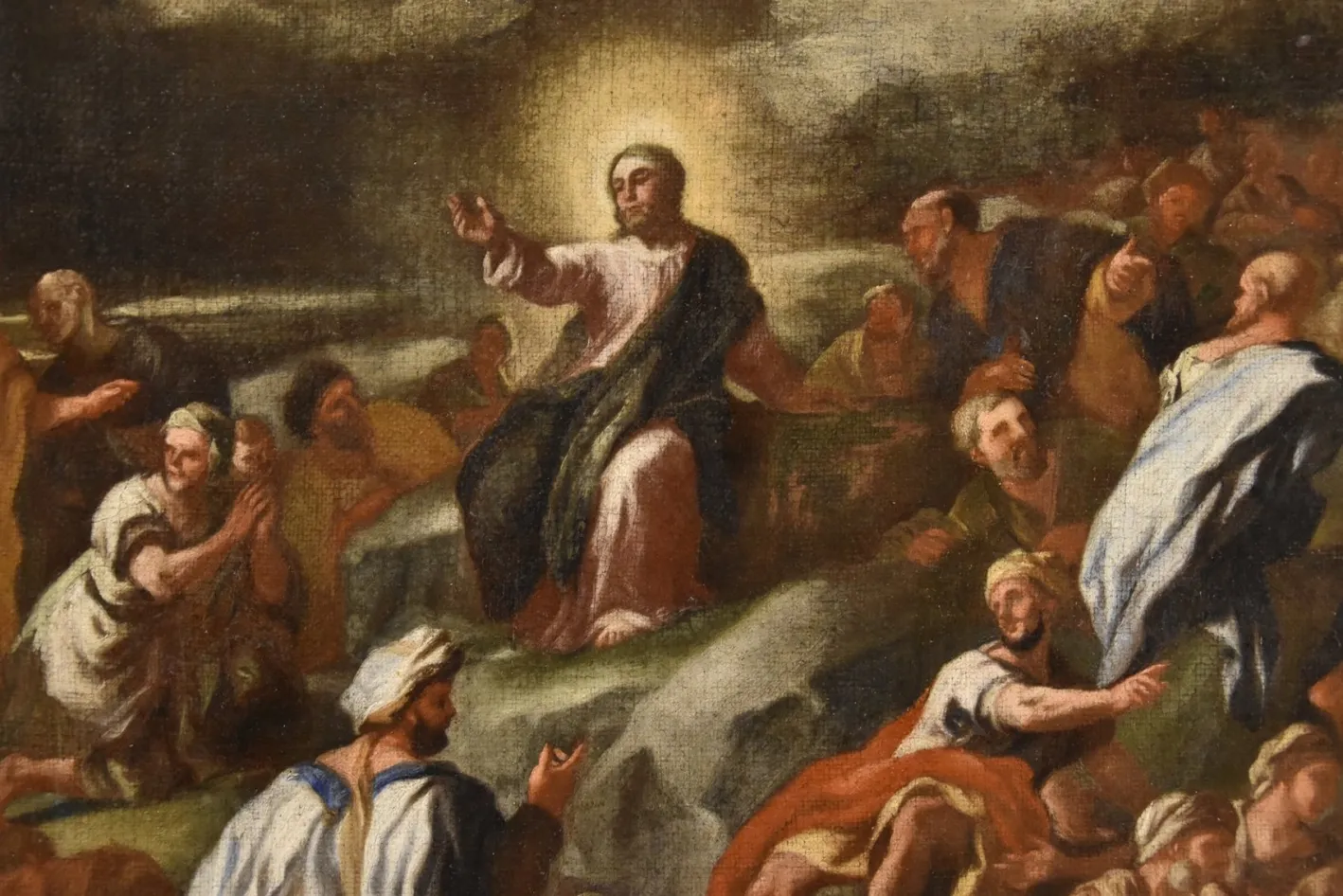
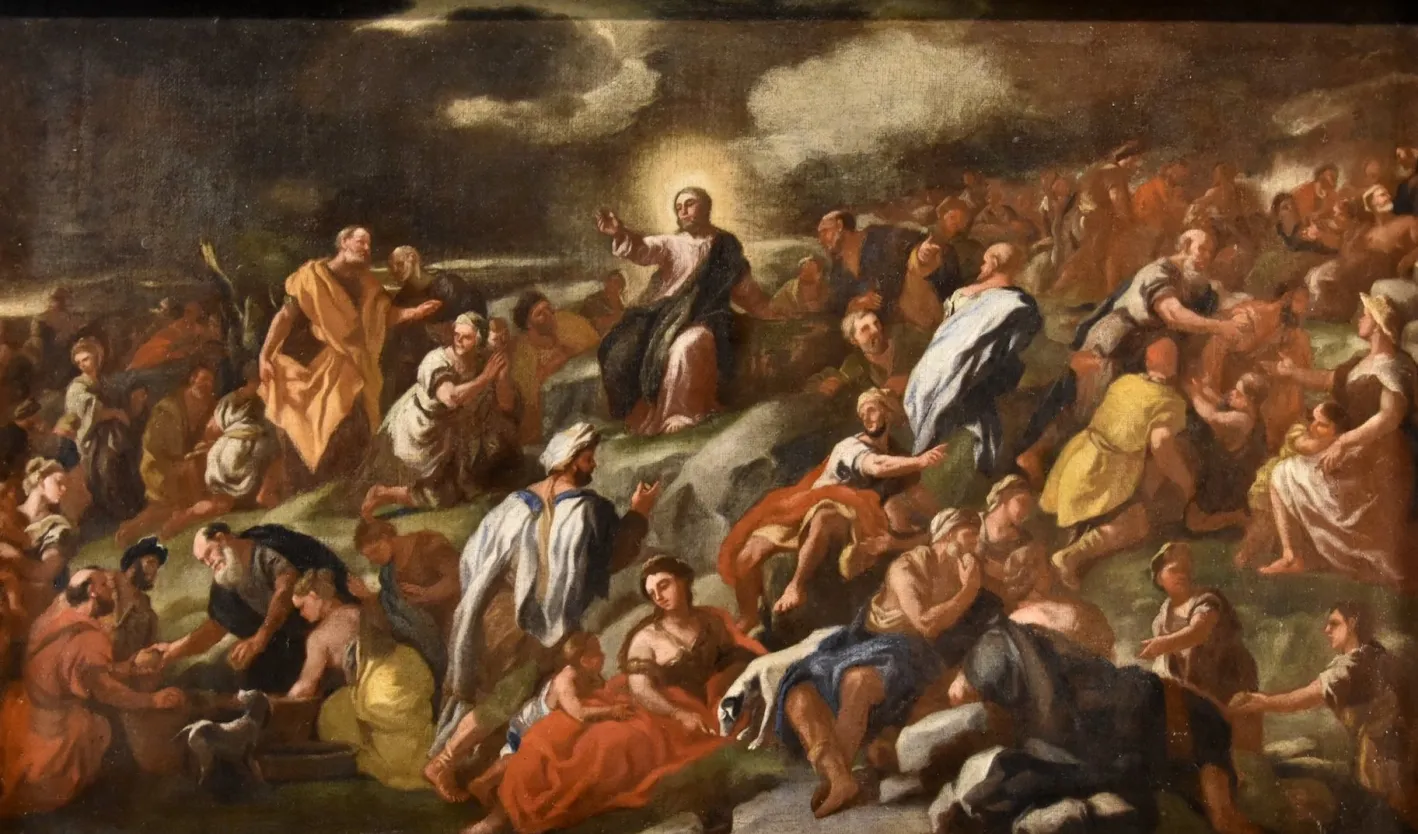
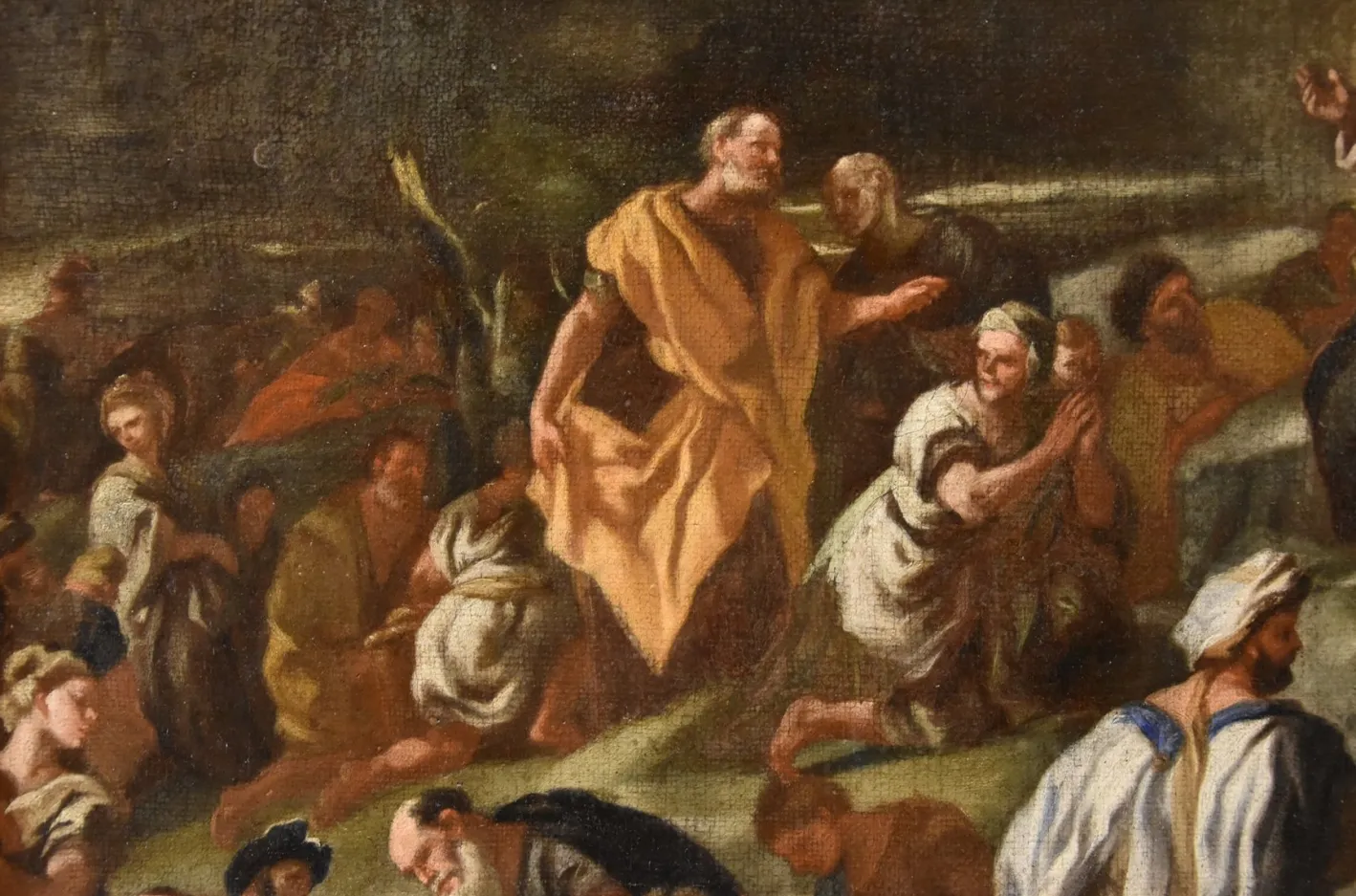
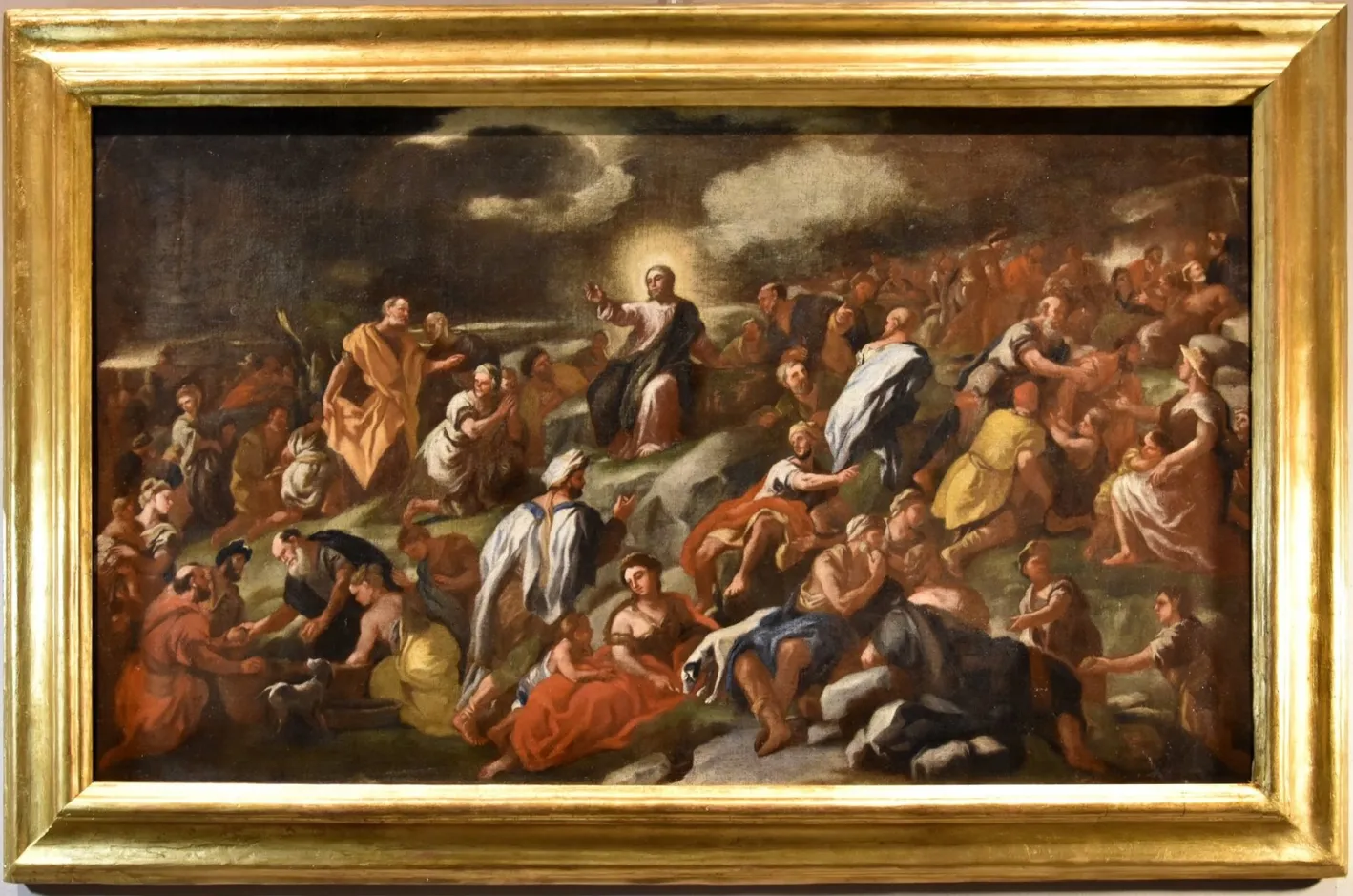
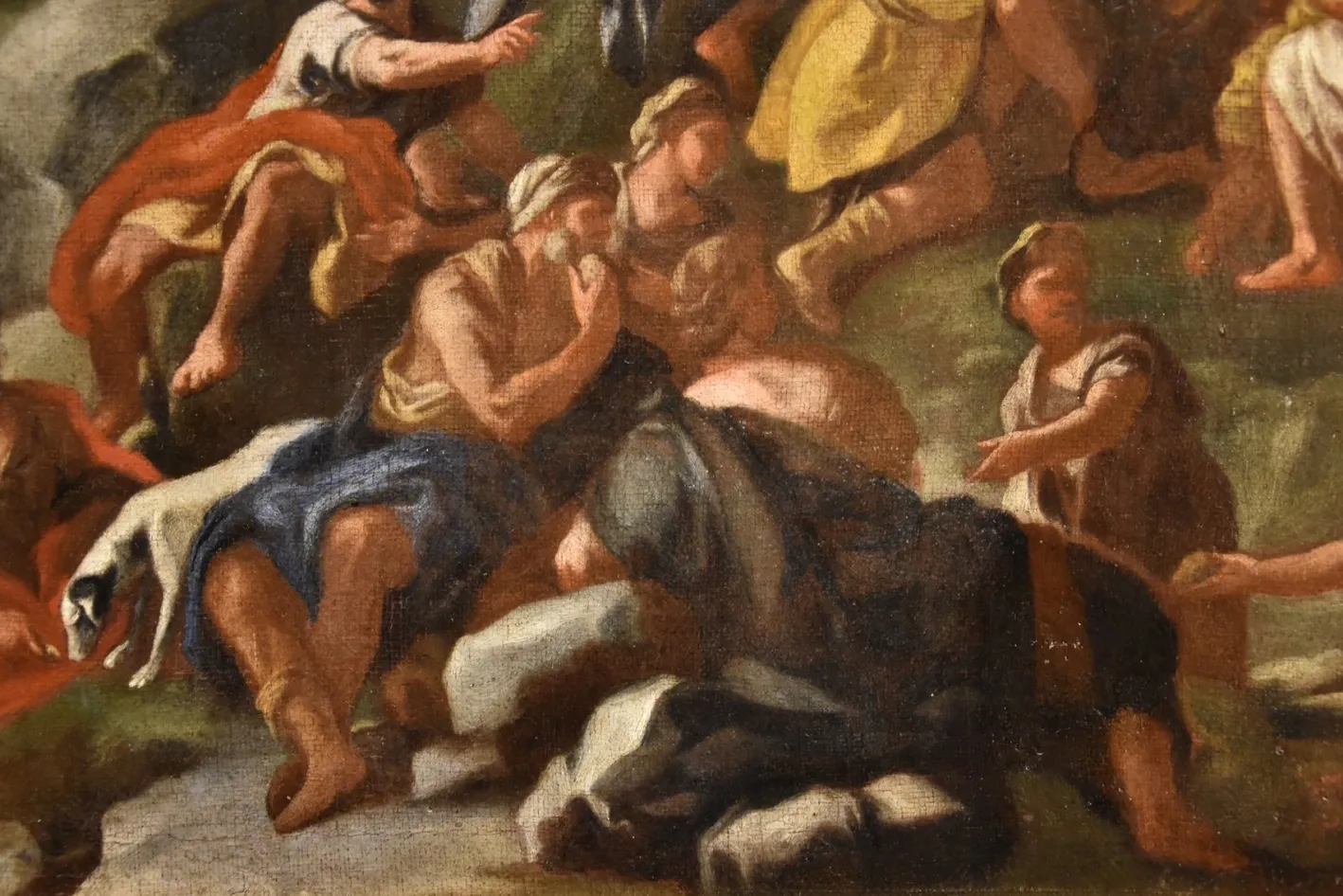
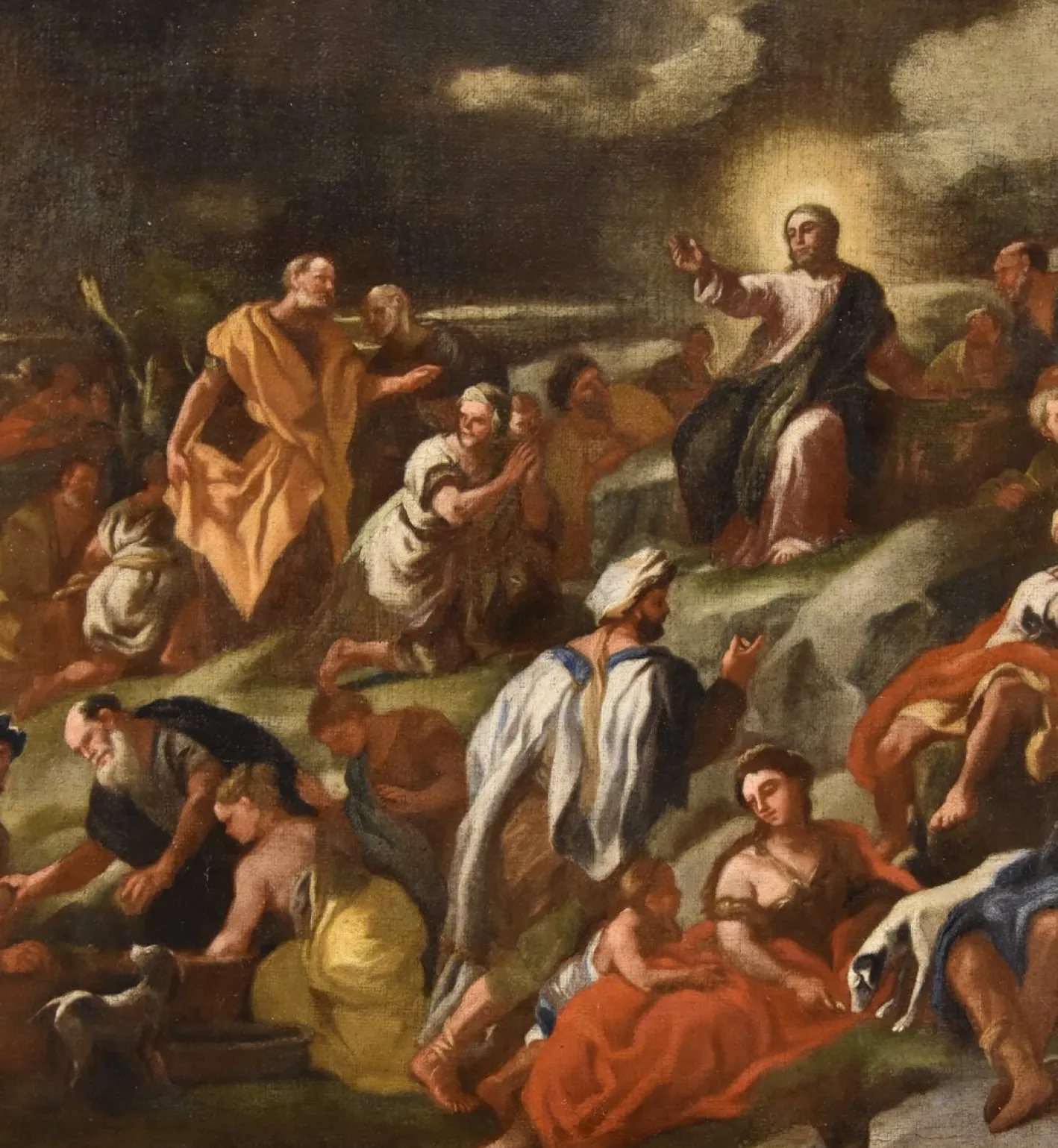
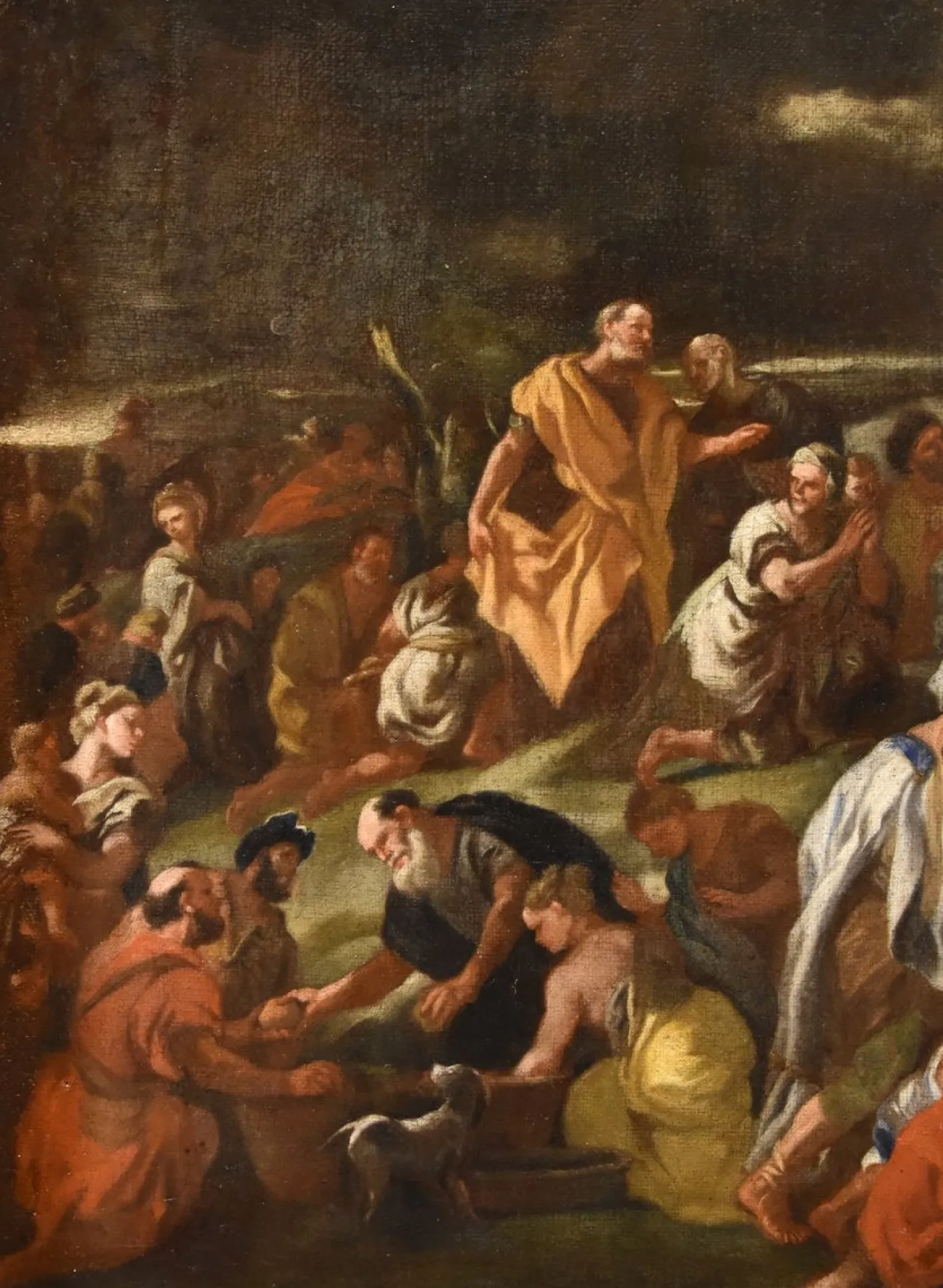
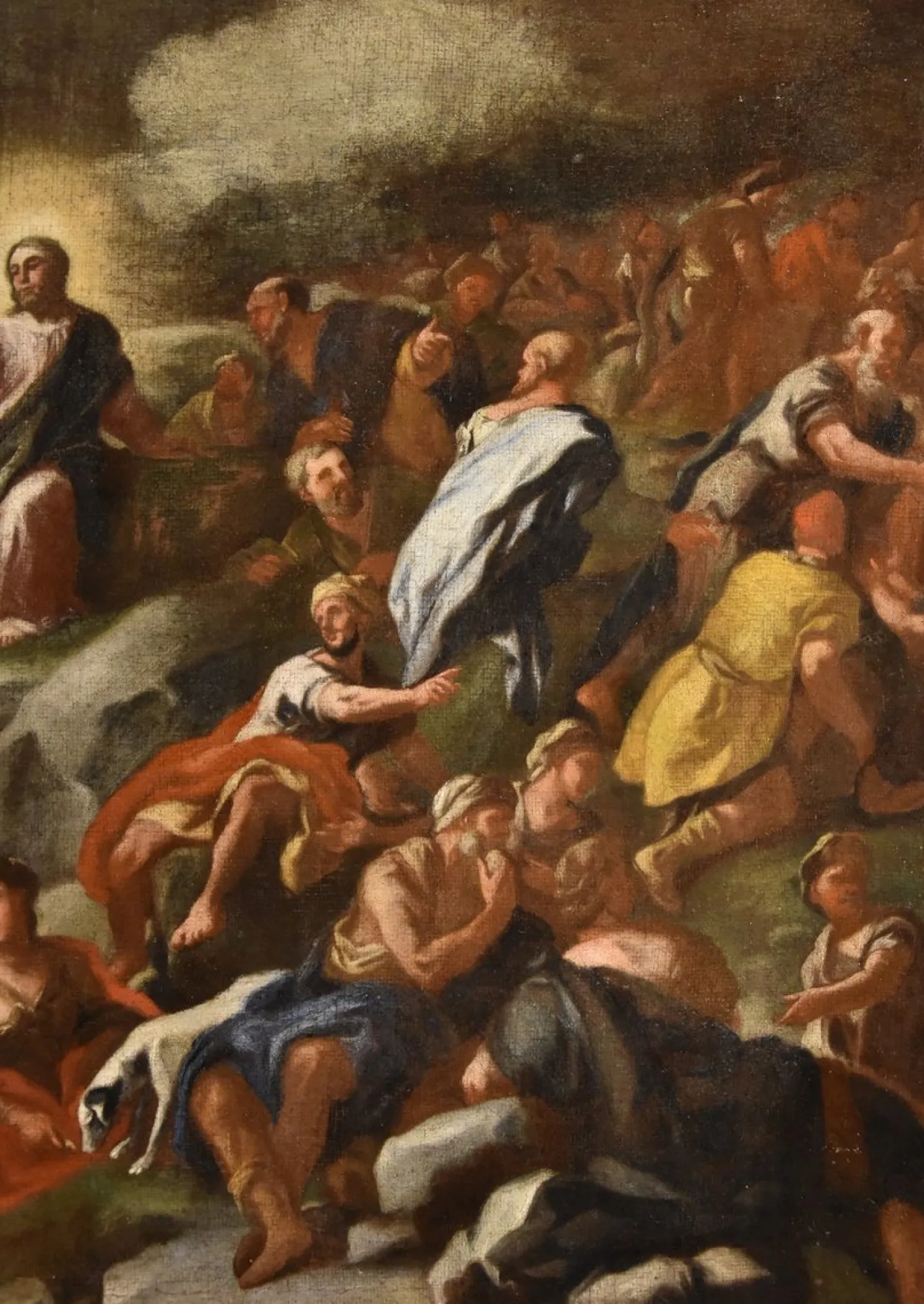
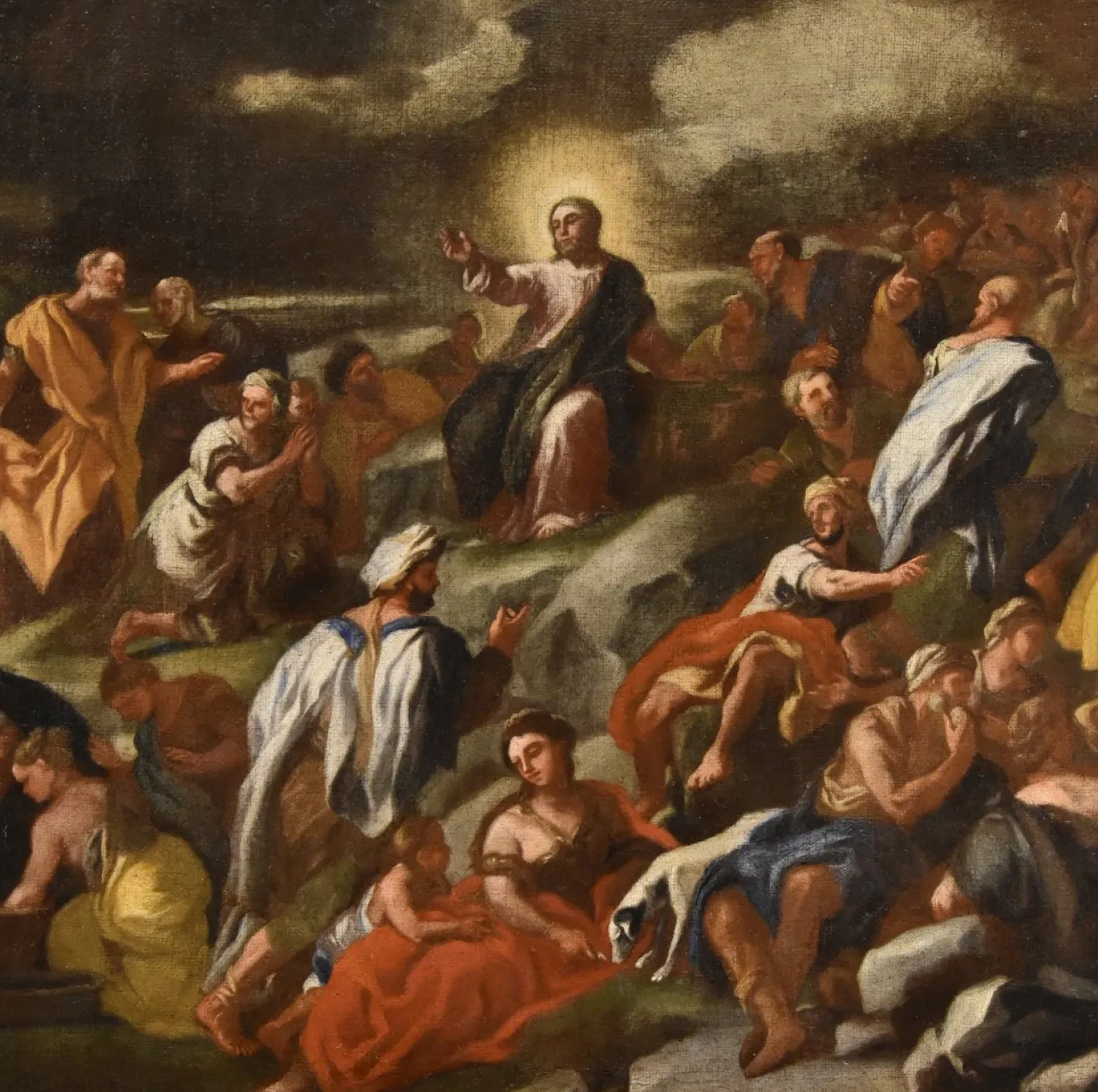
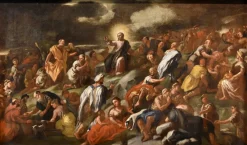
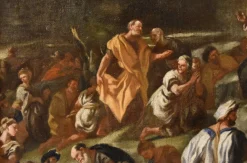
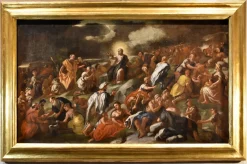
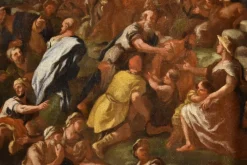
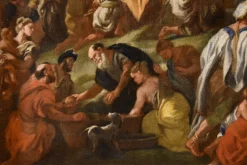
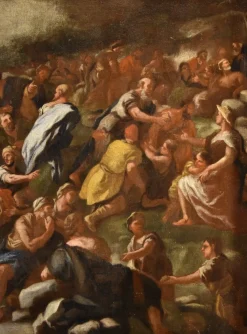
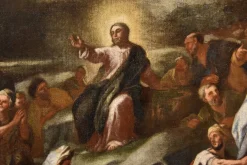
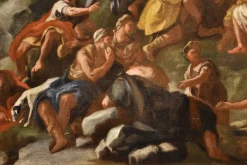
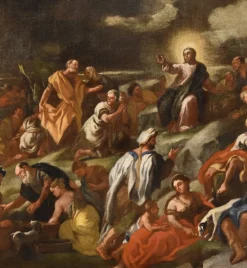
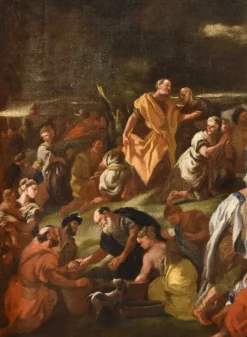
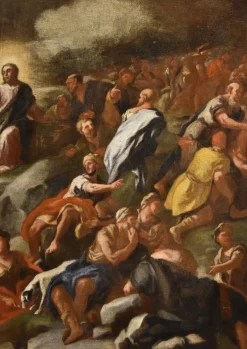
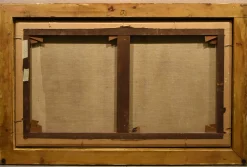
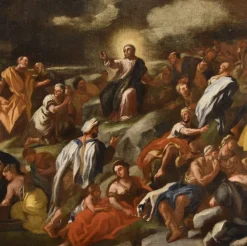
Angelo Solimena, Vermehrung der Brote und Fische, 1710, Öl auf Leinwand
Original price was: €10,182.40.€112.57Current price is: €112.57.
Angelo Solimena (Canale di Serino 1629 – Barra, 1716)
Multiplication of the Loaves and Fishes
Oil on canvas
60 x 102 cm. – Framed 76 x 116 cm.
This work is accompanied by an expert opinion by Prof. Emilio Negro.
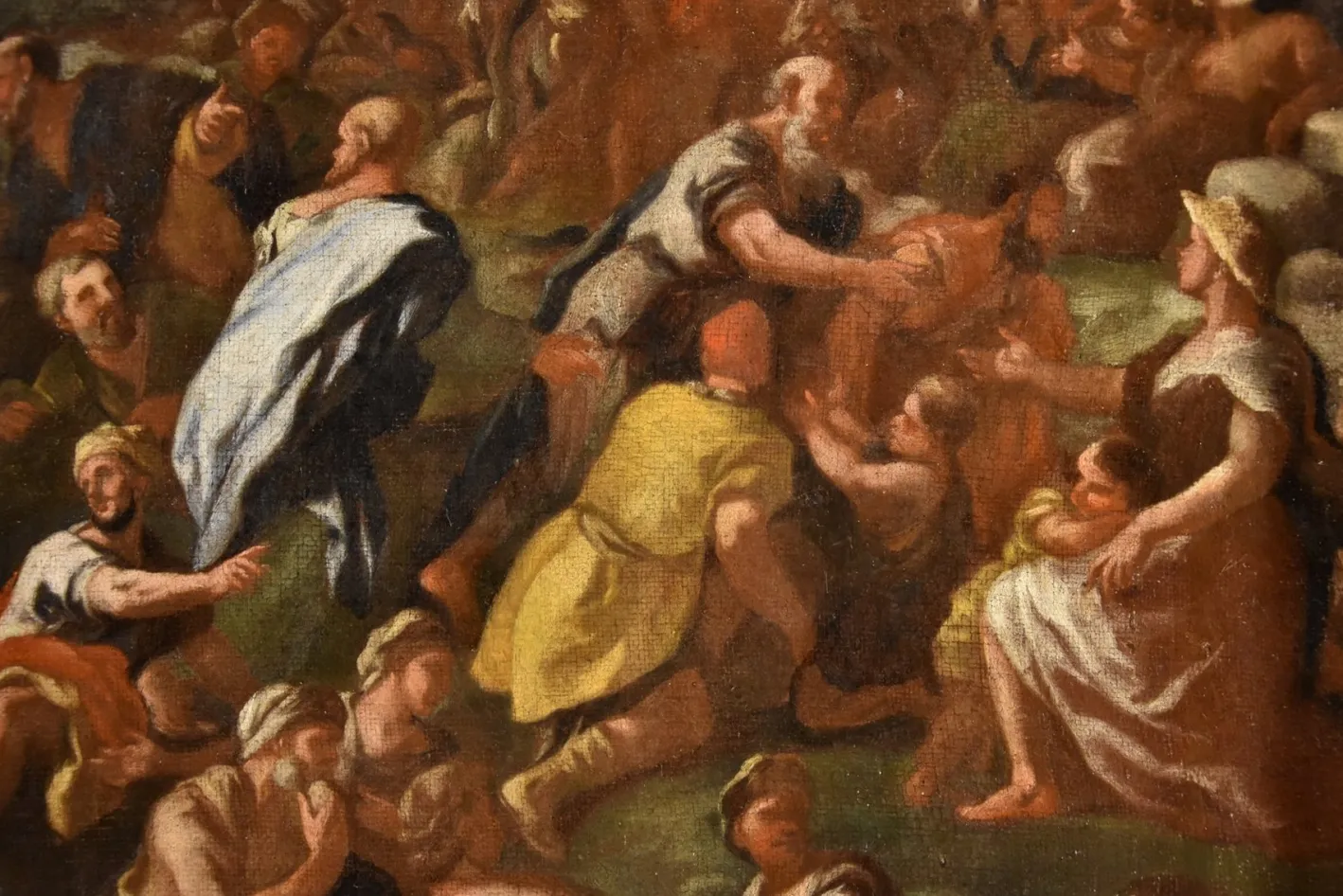
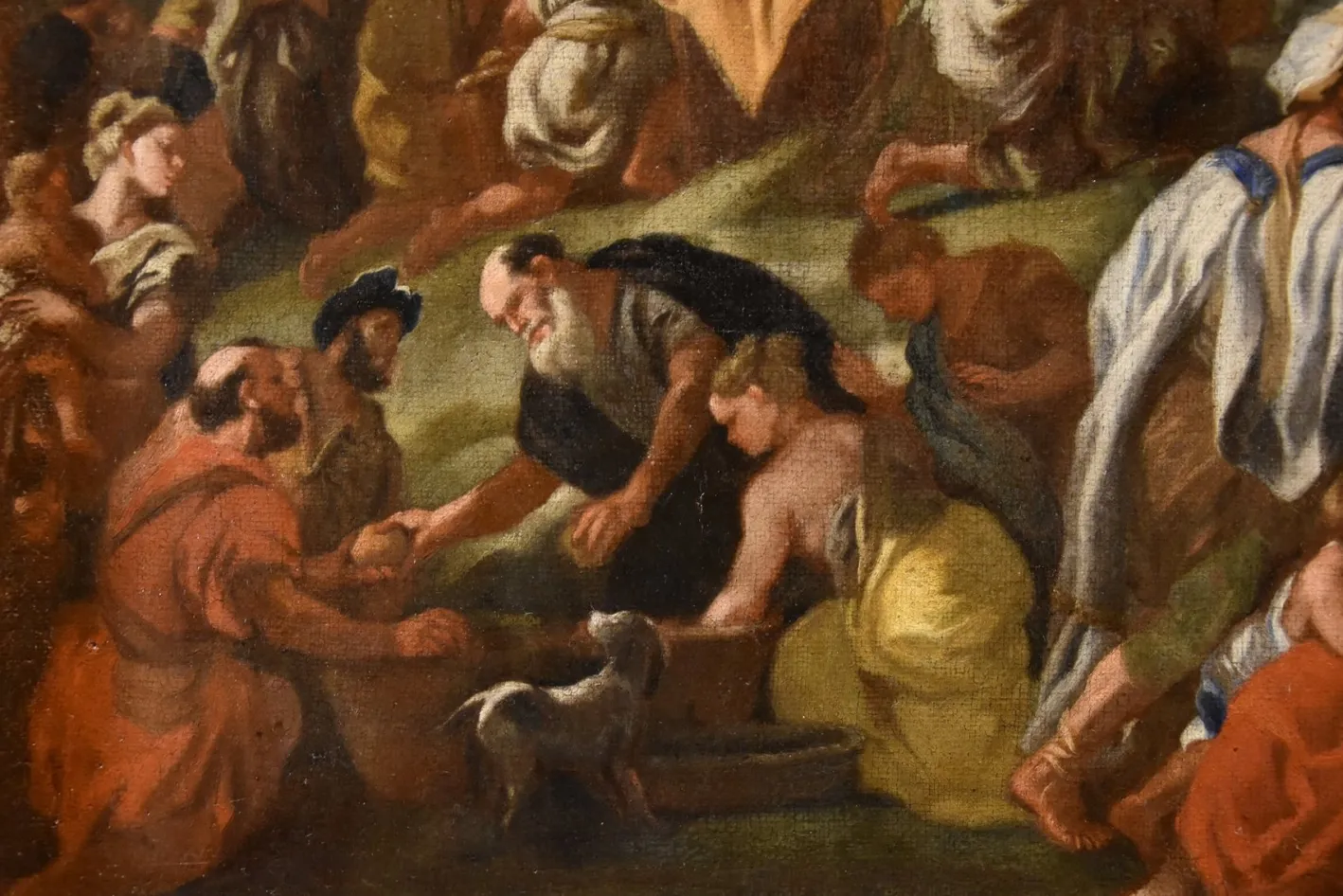
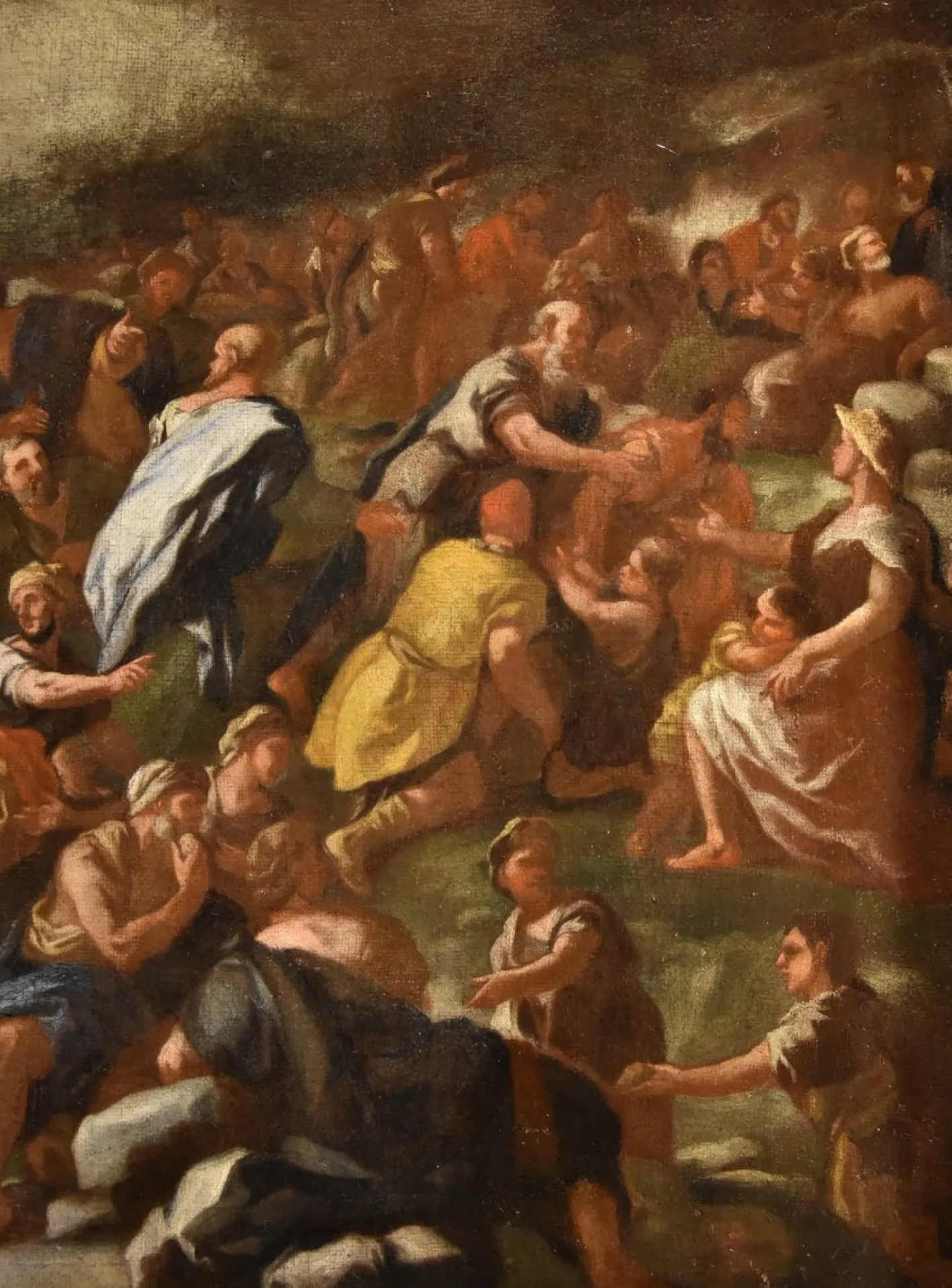
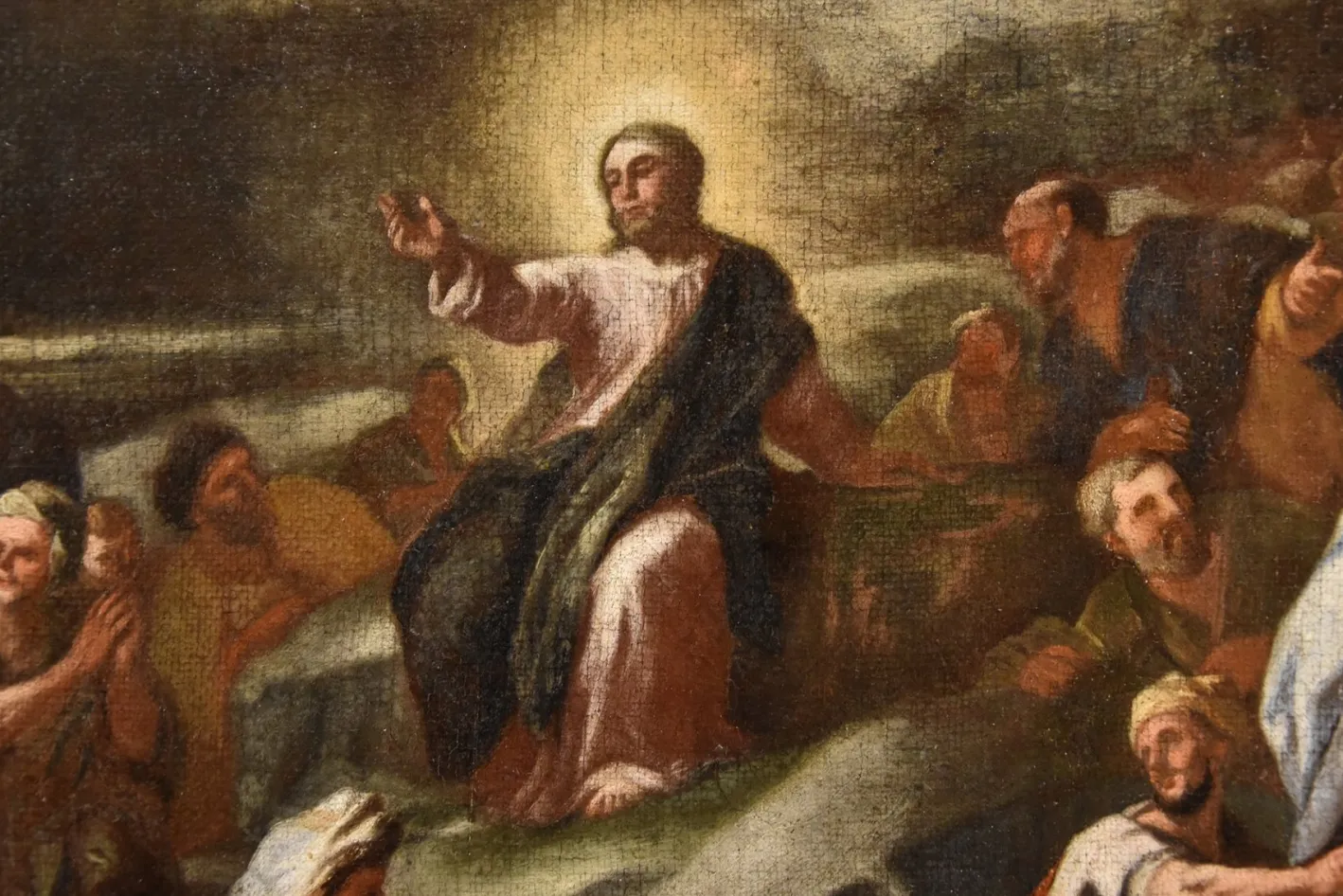
The painting depicts the miracle of the ‚Multiplication of the Loaves and Fishes,‘ a biblical episode recounted in all four Gospels and one of the most emblematic events of Jesus‘ ministry.
The iconography used for our painting draws inspiration from St. John (6:1-13), which tells how Christ, accompanied by his disciples, arrived in Tiberias, where a crowd of over five thousand people who had followed him, exhausted and in urgent need of food.
The only provisions available were five barley loaves and two fish that a boy kept in a basket, too few to feed all that crowd. Jesus asked them to bring them to him, ordered the people to sit down, took the five loaves, and looking up to heaven, gave thanks, and broke them. Then he instructed his disciples to distribute them to all present, who miraculously ate their fill.
Regarding the identification of the painting’s author, as Professor Emilio Negro clarified in his study on the work, we are in the presence of a depiction that highlights the stylistic features of Neapolitan Arcadian painting between the seventeenth and eighteenth centuries, derived from knowledge of the works of Francesco Guarino and, above all, those of Luca Giordano.
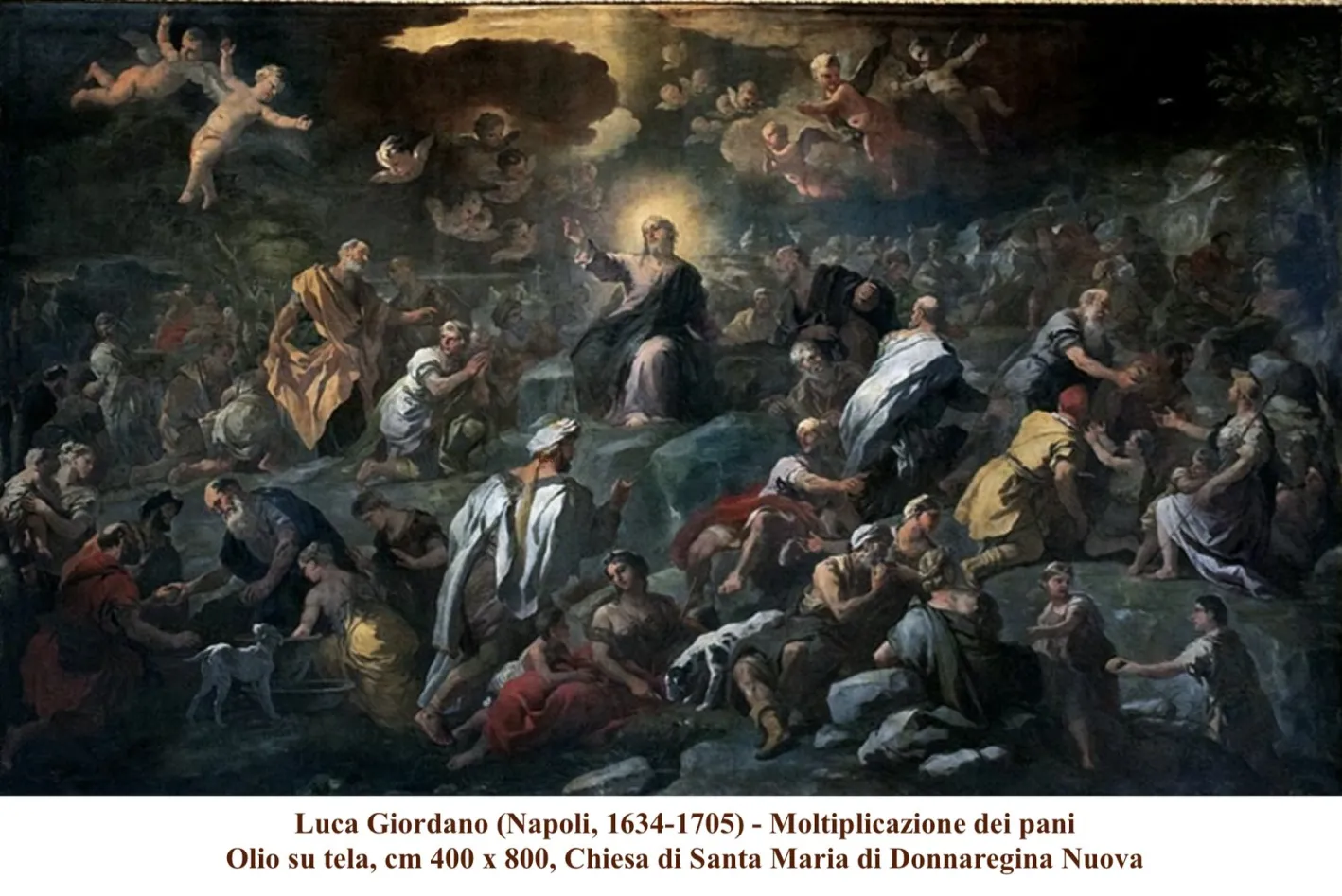
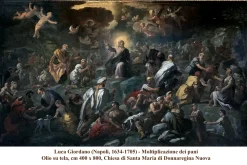
Our canvas replicates (albeit with variations: the flying angels are missing, the colors are different, the shape of the clouds is different, etc.) a similar, larger composition painted by Giordano in 1705 for the Neapolitan church of Santa Maria Donnaregina Nuova.
The differences should not be surprising, as it is well known that many artists often replicated, with certain modifications, the most famous works of other masters, from which they drew inspiration.
In particular, considering its stylistic characteristics, the canvas can be traced back to the work of Angelo Solimena (Canale di Serino 1629 – Barra, 1716), founder of a family of artists (father of Francesco Solimena, also known as Abbot Ciccio).
He worked primarily in the Salerno area, but it was his move to Nocera that brought about the most interesting phase of his artistic career. After receiving commissions from nobles and ecclesiastics, towards the end of his career he had the opportunity to work alongside his son Francesco, with whom he became acquainted with the dazzling pictorial solutions adopted by Luca Giordano.
His painting style is characterized by this singular style, with marked splashes of light and a dry yet effective draping. This painting is emblematic of his style, which therefore represents an ideal link between the methods of his teacher Francesco Guarino and the Baroque and Neo-Venetian pictorial language of Luca Giordano and later of Francesco Solimena himself.
ADDITIONAL INFORMATION:
The work is sold complete with a gilded wooden frame and comes with a certificate of authenticity and an iconographic.
Angelo Solimena (Canale di Serino 1629 – Barra, 1716)
Vermehrung der Brote und Fische
Öl auf Leinwand
60 x 102 cm. – Gerahmt 76 x 116 cm.
Dieses Werk wird von einem Gutachten von Prof. Emilio Negro begleitet.
Das Gemälde stellt das Wunder der „Vermehrung der Brote und Fische“ dar, eine biblische Episode, die in allen vier Evangelien erzählt wird und eines der symbolträchtigsten Ereignisse im Wirken Jesu ist.
Die Ikonographie unseres Gemäldes ist inspiriert von Johannes (6,1-13), der erzählt, wie Christus in Begleitung seiner Jünger in Tiberias ankommt, wo eine Menge von über fünftausend Menschen, die ihm gefolgt waren, erschöpft ist und dringend Nahrung braucht.
Die einzigen Vorräte, die zur Verfügung standen, waren fünf Gerstenbrote und zwei Fische, die ein Junge in einem Korb aufbewahrte – zu wenig, um die ganze Menge zu ernähren. Jesus bat sie, sie zu ihm zu bringen, befahl den Leuten, sich zu setzen, nahm die fünf Brote, blickte zum Himmel auf, dankte und brach sie. Dann wies er seine Jünger an, sie an alle Anwesenden zu verteilen, die sich auf wundersame Weise satt aßen.
Was die Identifizierung des Autors des Gemäldes betrifft, so hat Professor Emilio Negro in seiner Studie über das Werk klargestellt, dass wir es mit einer Darstellung zu tun haben, die die stilistischen Merkmale der neapolitanischen arkadischen Malerei zwischen dem 17. und 18.
Unsere Leinwand gibt (wenn auch mit Abweichungen: die fliegenden Engel fehlen, die Farben sind anders, die Form der Wolken ist anders, usw.) eine ähnliche, größere Komposition wieder, die Giordano 1705 für die neapolitanische Kirche Santa Maria Donnaregina Nuova malte.
Die Unterschiede sollten nicht überraschen, denn es ist bekannt, dass viele Künstler oft die berühmtesten Werke anderer Meister, von denen sie sich inspirieren ließen, mit gewissen Änderungen kopierten.
Insbesondere die stilistischen Merkmale des Gemäldes lassen sich auf das Werk von Angelo Solimena (Canale di Serino 1629 – Barra, 1716) zurückführen, dem Gründer einer Künstlerfamilie (Vater von Francesco Solimena, auch bekannt als Abt Ciccio).
Er arbeitete vor allem in der Gegend von Salerno, aber erst mit seinem Umzug nach Nocera begann die interessanteste Phase seiner künstlerischen Laufbahn. Nachdem er Aufträge von Adeligen und Geistlichen erhalten hatte, hatte er gegen Ende seiner Karriere die Gelegenheit, mit seinem Sohn Francesco zusammenzuarbeiten, mit dem er die schillernden Bildlösungen von Luca Giordano kennenlernte.
Seine Malerei zeichnet sich durch diesen einzigartigen Stil aus, mit ausgeprägten Lichtspritzern und einer trockenen, aber wirkungsvollen Drapierung. Dieses Gemälde ist emblematisch für seinen Stil, der somit eine ideale Verbindung zwischen den Methoden seines Lehrers Francesco Guarino und der barocken und neovenezianischen Bildsprache von Luca Giordano und später von Francesco Solimena selbst darstellt.
ZUSÄTZLICHE INFORMATIONEN:
Das Werk wird komplett mit einem vergoldeten Holzrahmen verkauft und mit einem Echtheitszertifikat und einer Ikonographie versehen.
Klicken Sie hier für die vollständige BeschreibungSchließen
| Epoche | Vor 1890 |
|---|---|
| Jahr | 1710 |
| Produktionszeitraum | Vor 2010 |
| Hergestellt in | Italien |
| Kennzeichnung vorhanden | Dieses Objekt wird dem oben genannten Designer/Hersteller zugeschrieben. Es hat keine Kennzeichnung |
| Stil | Klassisch, Figurative, Grand Tour, Italian, Louis XIV, Mediterranean, Alte Meister, Portraiture, Religious, Barock, Rococo |
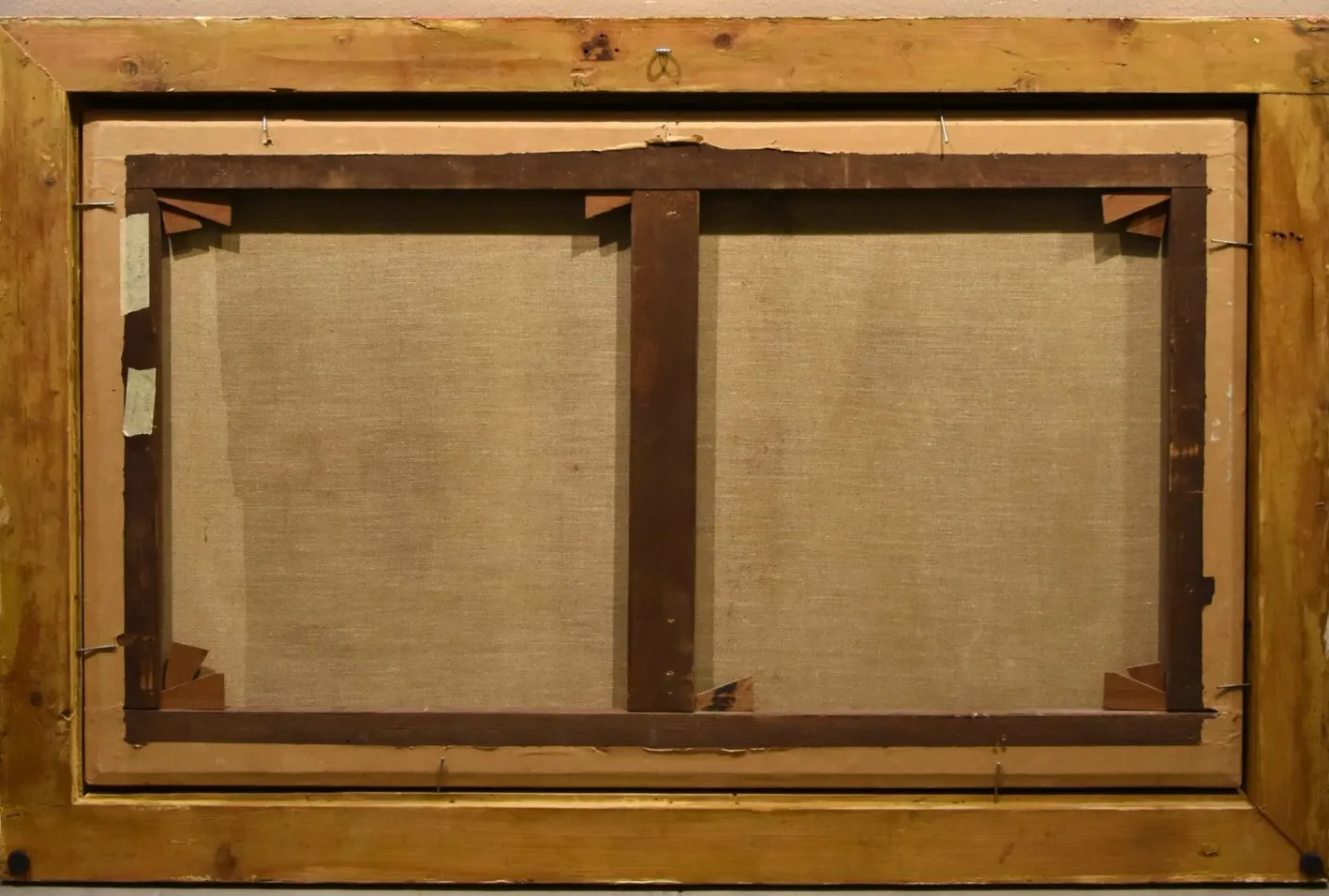
| Zustand | Gut — Dieser Vintage/antike Artikel kann einige Gebrauchsspuren wie Kratzer und andere Zeichen der Zeit aufweisen. |
| Details über Schäden und Restaurierungen |
Leichte altersbedingte Gebrauchsspuren, Altersbedingte Patina, Neu bezogen, Zum Teil restauriert
|
| Artikelnummer | CYT-2353128 |
| Material | Öl auf Leinwand |
| Farbe | Mehrfarbig |
| Breite | 116 cm 116 cm |
| Tiefe | 12 cm 12 cm |
| Höhe | 76 cm 76 cm |
Be the first to review “Angelo Solimena, Vermehrung der Brote und Fische, 1710, Öl auf Leinwand”
Related products
Arbeiten Auf Papier
Druckgraphiken Und Multiples
Abstraction
Druckgraphiken Und Multiples
Reviews
There are no reviews yet.